
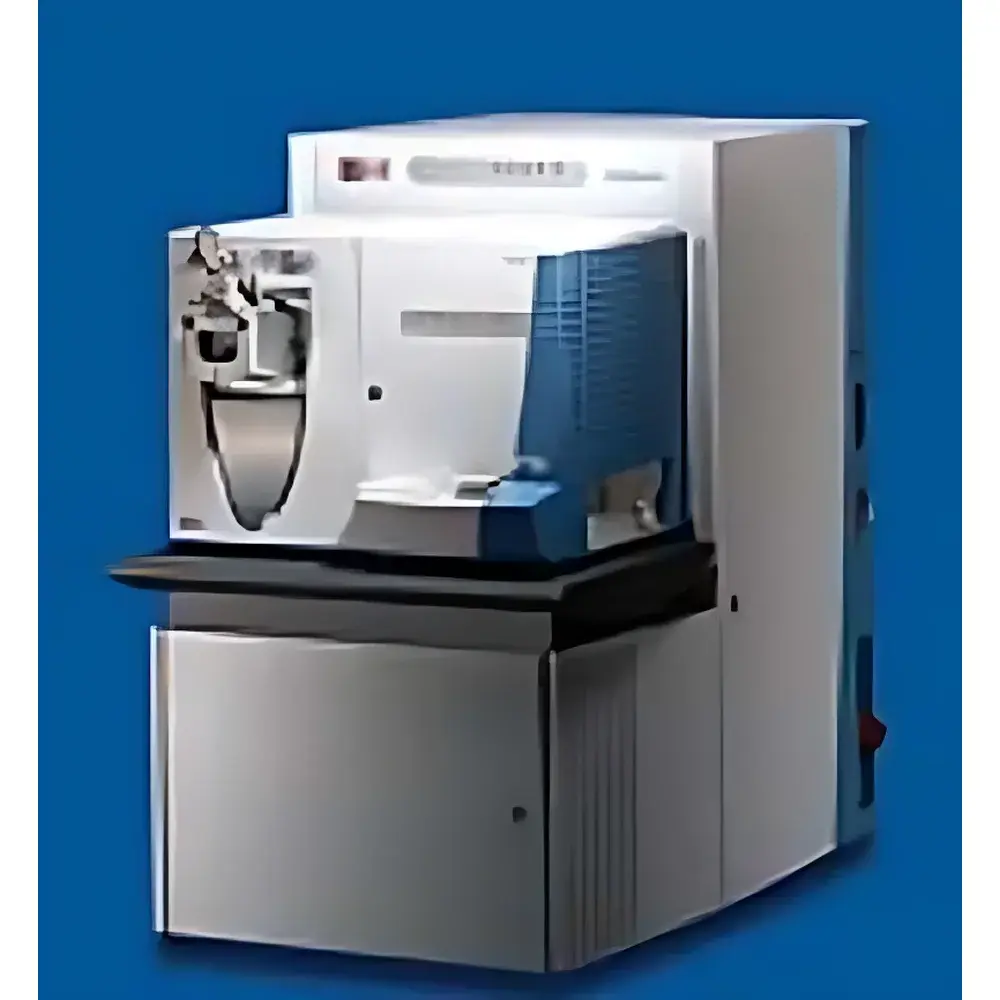
Thermo Scientific LTQ Orbitrap Discovery™ Hybrid Mass Spectrometer
| Brand | Thermo Fisher |
|---|---|
| Origin | USA |
| Manufacturer Type | Original Equipment Manufacturer (OEM) |
| Import Status | Imported |
| Model | LTQ Orbitrap Discovery |
| Instrument Type | Orbitrap Hybrid Mass Spectrometer |
| Resolution | 30,000 (at m/z 400) |
| Mass Accuracy | < 5 ppm (internal calibration), < 3 ppm (external calibration) |
| Scan Speed | Up to 10 MS/MS spectra per second |
| MSⁿ Capability | Up to MS⁵ |
| Ionization Options | ESI, APCI (standard) |
| LC Compatibility | Fully compatible with all major UHPLC and HPLC systems |
Overview
The Thermo Scientific LTQ Orbitrap Discovery™ is a hybrid linear ion trap–Orbitrap mass spectrometer engineered for high-performance qualitative and quantitative analysis in complex biological matrices. It integrates the speed and dynamic range of a linear ion trap (LTQ) with the high mass resolution and mass accuracy of an Orbitrap mass analyzer—enabling simultaneous acquisition of high-resolution full-scan MS data and rapid, sensitive MS/MS spectra. Based on electrostatic trapping and Fourier-transform detection principles, the Orbitrap analyzer achieves mass measurement accuracy routinely below 3 ppm with internal calibration and sub-5 ppm under external calibration protocols. This architecture supports both data-dependent acquisition (DDA) and targeted workflows—including label-free differential expression profiling, intact protein analysis, post-translational modification (PTM) mapping, and small-molecule structural elucidation—without requiring isotopic labeling or extensive method development.
Key Features
- Hybrid architecture combining a linear ion trap (LTQ) for fast isolation, fragmentation, and ion accumulation with an Orbitrap mass analyzer for high-resolution, high-accuracy mass measurement
- Resolution of up to 30,000 at m/z 400 (FWHM), enabling baseline separation of isobaric and near-isobaric species in complex mixtures
- Mass accuracy ≤ 5 ppm (internal calibration); ≤ 3 ppm (with external lock mass calibration), supporting confident compound identification against spectral libraries and databases
- Real-time MSn capability up to MS5, essential for structural characterization of metabolites, lipids, glycans, and synthetic compounds
- High-speed scanning: up to 10 MS/MS spectra per second, facilitating deep proteome coverage in single-run LC-MS/MS experiments
- Flexible ionization compatibility: standard electrospray ionization (ESI) and atmospheric pressure chemical ionization (APCI); optional nano-ESI source and MALDI interface for specialized applications
- Robust vacuum system and temperature-stabilized optics ensure long-term signal stability and reproducibility across multi-day acquisition campaigns
Sample Compatibility & Compliance
The LTQ Orbitrap Discovery accommodates a broad range of sample types—from enzymatically digested peptides and intact proteins to polar metabolites, pharmaceuticals, environmental contaminants, and natural products. Its wide dynamic range (>104) and low detection limits (sub-femtomole for peptides) support direct injection and LC-coupled analyses without pre-fractionation. The system complies with key regulatory frameworks including FDA 21 CFR Part 11 (with optional audit trail and electronic signature modules), ISO/IEC 17025 for testing laboratories, and GLP/GMP documentation requirements. All firmware and control software are validated for use in regulated environments where traceability, instrument qualification (IQ/OQ/PQ), and data integrity are mandated.
Software & Data Management
Controlled via Thermo Scientific Tune and Xcalibur software platforms, the LTQ Orbitrap Discovery supports automated method setup, real-time spectral visualization, and integrated peak detection, alignment, and quantitation. Raw data files (.raw) are natively compatible with third-party processing tools including Proteome Discoverer (for proteomics), Compound Discoverer (for untargeted metabolomics), and SIEVE (for label-free differential expression). All software modules support metadata tagging, batch processing, and export to standard formats (mzML, mzXML) for interoperability with open-source pipelines. Audit trail functionality logs all user actions, parameter changes, and calibration events—ensuring full compliance with ALCOA+ (Attributable, Legible, Contemporaneous, Original, Accurate, Complete, Consistent, Enduring, Available) data governance principles.
Applications
- Proteomics: High-throughput peptide identification, PTM localization (e.g., phosphorylation, ubiquitination), and label-free relative quantification across cell lines, tissues, or time-course experiments
- Metabolomics: Untargeted profiling of polar and semi-polar metabolites; accurate mass-based annotation using HMDB, METLIN, and MassBank databases
- Pharmaceutical R&D: Impurity profiling, degradation product identification, and biotransformation studies in drug metabolism (ADME-Tox)
- Clinical Biomarker Discovery: Differential expression analysis of serum/plasma proteomes and metabolomes in case-control cohorts
- Environmental & Food Safety: Residue screening of pesticides, mycotoxins, and veterinary drugs at regulatory action levels (e.g., EU MRLs)
FAQ
What distinguishes the LTQ Orbitrap Discovery from Q-TOF instruments?
The LTQ Orbitrap Discovery provides superior mass accuracy and resolution at comparable acquisition speeds, enabling more confident identification in complex backgrounds—particularly for co-eluting isobars and low-abundance analytes.
Is the system suitable for regulated bioanalysis (e.g., GLP studies)?
Yes—when configured with 21 CFR Part 11-compliant software modules and documented IQ/OQ/PQ protocols, it meets audit readiness requirements for regulated laboratories.
Can it perform both top-down and bottom-up proteomics?
It supports robust bottom-up workflows; top-down analysis is feasible for proteins < 30 kDa with optimized ionization and fragmentation parameters.
What LC systems are compatible?
All major UHPLC and HPLC platforms—including Thermo Vanquish, Waters Acquity, Agilent 1290—and nano-flow systems with appropriate interface kits.
Does it support retention time alignment across multiple runs?
Yes—Xcalibur and Compound Discoverer include automated retention time correction algorithms based on internal standards or aligned features.
Related Products






