
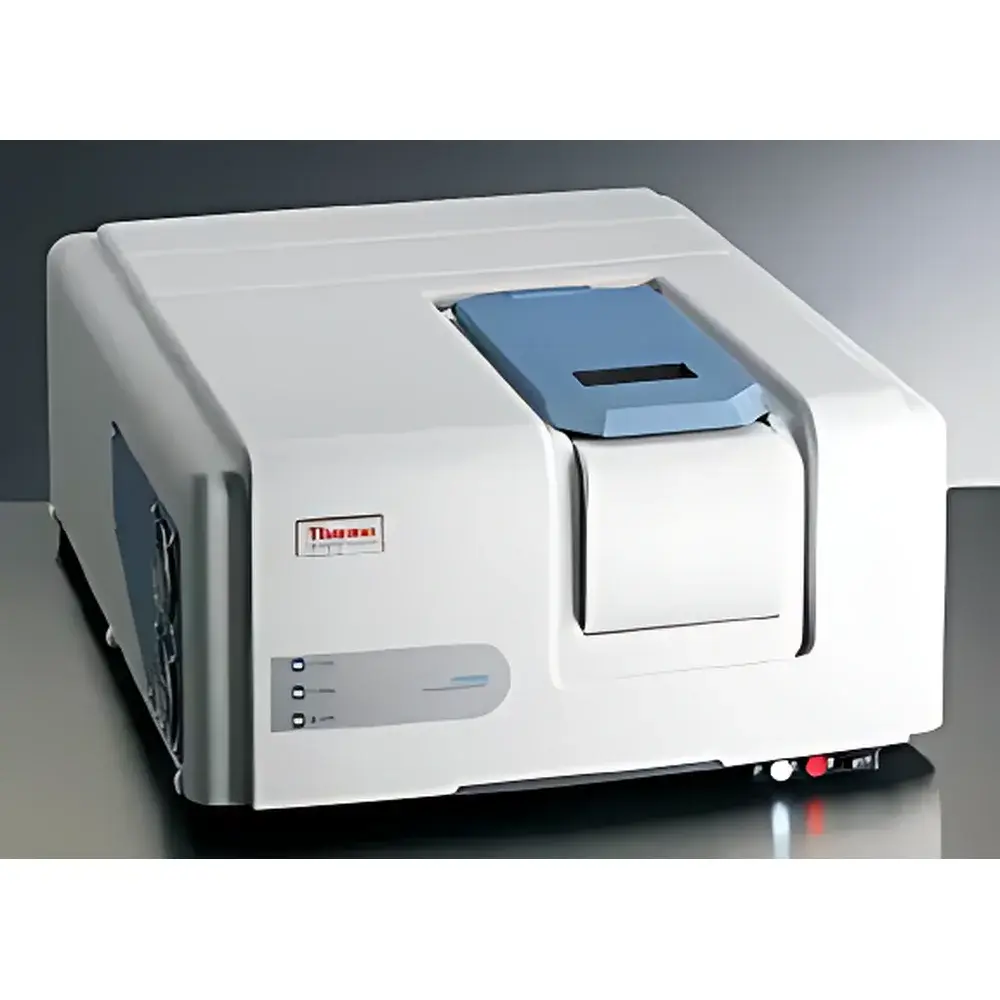
Thermo Scientific Lumina Molecular Fluorescence Spectrometer
| Brand | Thermo Fisher |
|---|---|
| Origin | USA |
| Manufacturer | Thermo Fisher Scientific |
| Import Status | Imported |
| Model | Lumina |
| Wavelength Range | 190–900 nm |
| Spectral Bandwidth (Slit) | 0.5 nm |
| Resolution | 0.5 nm |
| Sensitivity | >4000:1 (at water Raman peak) |
| Wavelength Accuracy | ±0.5 nm |
| Excitation Source | 150 W Xenon Arc Lamp |
| Optical Design | Horizontal Beam Path |
| Monochromator Type | Grating-based, Pre-aligned Modular Monochromator |
| Detector | High-sensitivity PMT with extended red response |
Overview
The Thermo Scientific Lumina Molecular Fluorescence Spectrometer is a high-performance, research-grade fluorescence instrument engineered for quantitative and qualitative analysis of fluorescent species across life sciences, pharmaceutical development, materials science, and environmental chemistry. Based on the principle of molecular fluorescence spectroscopy—where analytes absorb photons at specific excitation wavelengths and emit lower-energy photons at characteristic emission wavelengths—the Lumina delivers precise, reproducible spectral data with exceptional signal-to-noise ratio and photometric stability. Its horizontal optical beam path minimizes stray light and maximizes collection efficiency, while the pre-aligned modular grating monochromator ensures long-term wavelength fidelity and mechanical robustness. Designed and manufactured in the United States, the system complies with ISO/IEC 17025 calibration traceability requirements and supports GLP/GMP workflows through audit-ready software features.
Key Features
- Grating-based monochromator with fixed 0.5 nm spectral bandwidth—optimized for high-resolution spectral deconvolution of overlapping fluorophores.
- Variable slit control enables dynamic adjustment of spectral resolution to balance sensitivity and selectivity per application.
- 150 W xenon arc lamp provides stable, broadband excitation (190–900 nm) with low temporal drift (<0.3% RMS over 1 hour), critical for kinetic and time-resolved measurements.
- Optimized optical train featuring MgF₂-coated mirrors and lenses ensures high UV throughput and minimal photodegradation of sensitive samples.
- High-quantum-efficiency photomultiplier tube (PMT) detector with extended red response (up to 900 nm) enables detection of near-infrared dyes (e.g., Cy7, IRDye 800CW), chlorophylls, and other low-quantum-yield compounds.
- Fast-scanning capability up to 6,000 nm/min supports high-throughput screening and rapid spectral acquisition without compromising data integrity.
- Large-volume sample compartment accommodates temperature-controlled stages, solid-sample holders, multi-cell changers, polarization accessories, and rapid-mixing modules—all without realignment.
Sample Compatibility & Compliance
The Lumina supports liquid, solid, powder, and thin-film samples via interchangeable accessories validated under ASTM E1318 (Standard Practice for Fluorescence Spectrophotometry) and ISO 17025-compliant calibration protocols. Quartz cuvettes (10 mm pathlength standard), Peltier-cooled 4-position cell holders (±0.1 °C stability), and dedicated solid-sample adapters enable consistent measurement conditions across heterogeneous matrices. All hardware and firmware comply with IEC 61000-6-3 (EMC) and UL 61010-1 safety standards. Data integrity features—including electronic signatures, user-access levels, and full audit trails—meet FDA 21 CFR Part 11 requirements for regulated laboratories.
Software & Data Management
Luminous Software is a unified, standalone platform integrating instrument control, spectral acquisition, post-run processing, and system validation. It provides intuitive method templates for quantitative analysis (single-/multi-point calibration, internal standard correction), kinetic modeling (first-order, second-order, exponential decay fitting), and spectral deconvolution (Gaussian/Lorentzian peak separation). Raw data are stored in vendor-neutral .csv and .spc formats; metadata—including lamp hours, monochromator position, detector voltage, and environmental logs—is embedded per spectrum. Built-in system suitability tests (e.g., water Raman signal intensity, peak width verification) support routine qualification per USP and EP 2.2.43. Automated report generation supports customizable templates compliant with ISO/IEC 17025 reporting clauses.
Applications
- Protein conformational studies using intrinsic tryptophan fluorescence and extrinsic probes (ANS, Nile Red).
- Drug–protein binding affinity determination via fluorescence quenching or Förster resonance energy transfer (FRET).
- Quantification of nucleic acid concentrations and purity (A260/A280 ratios) in genomic workflows.
- Characterization of quantum dots, carbon nanodots, and luminescent MOFs in materials research.
- Environmental monitoring of polycyclic aromatic hydrocarbons (PAHs) in soil and water extracts.
- Quality control of fluorescent brighteners in textile and detergent formulations.
- Enzyme kinetics assays using fluorogenic substrates (e.g., MCA-peptides for proteases).
FAQ
What is the recommended calibration frequency for the Lumina system?
Annual factory calibration is advised; however, users should perform daily water Raman checks and quarterly wavelength accuracy verification using holmium oxide or didymium filters per ISO 17025 Section 6.5.2.
Can the Lumina be integrated into automated liquid handling workflows?
Yes—via RS-232 and Ethernet interfaces, the instrument supports bidirectional communication with third-party robotic platforms using ASCII command protocol (Luminous Script API).
Is the detector cooled, and does it support photon counting mode?
No—this model uses an analog PMT optimized for high-dynamic-range analog detection (10⁶ linear range); photon counting requires optional upgrade to the Lumina Plus configuration.
Are spectral correction files provided for instrument response normalization?
Yes—factory-measured excitation and emission correction curves are embedded in Luminous Software and automatically applied during quantitation to ensure comparability across instruments and labs.
Related Products





