
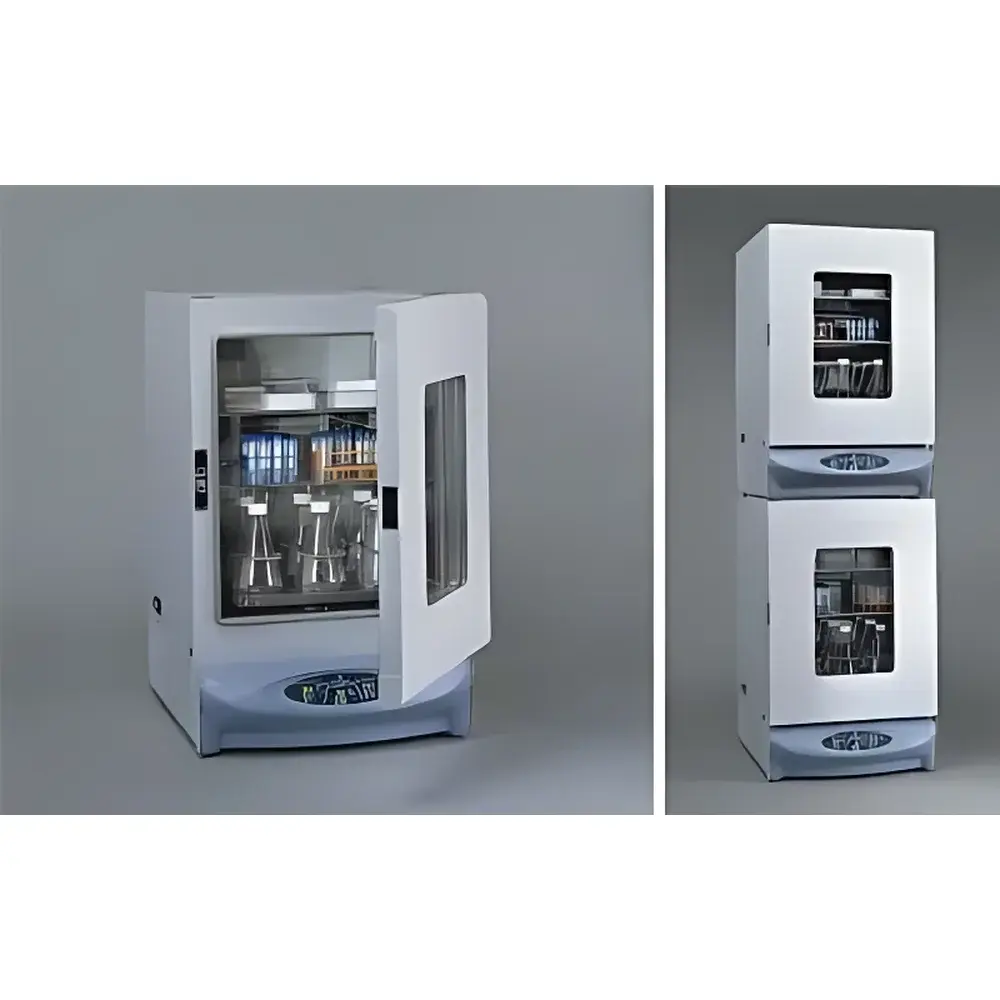
Thermo Scientific MaxQ 6000 Orbital Shaker
| Brand | Thermo Fisher Scientific |
|---|---|
| Origin | USA |
| Manufacturer | Thermo Fisher Scientific |
| Type | Imported Instrument |
| Model | MaxQ 6000 |
| Pricing | Available Upon Request |
Overview
The Thermo Scientific MaxQ 6000 Orbital Shaker is an engineered platform for precise, reproducible orbital motion in life science and bioprocessing applications. Utilizing a brushless DC motor-driven eccentric drive mechanism, it delivers consistent circular motion (orbital diameter: 19 mm) across a wide speed range—ideal for cell culture, solubility studies, enzyme assays, immunoassays, and microbial growth optimization. Designed for laboratory environments requiring long-term unattended operation, the MaxQ 6000 integrates thermal control (in temperature-controlled variants), real-time parameter monitoring, and fail-safe operational logic to ensure experimental integrity under GLP- and GMP-aligned workflows. Its robust mechanical architecture minimizes vibration transmission to adjacent equipment while maintaining positional stability under variable load conditions.
Key Features
- Brushless DC motor with closed-loop speed regulation ensures ±10% speed accuracy and high torque consistency across the full 15–500 rpm range
- Dual-mode operation: continuous mode with cumulative runtime display or programmable timer mode with selectable resolution (0.1 min to 999 min or 0.1 hr to 999 hr)
- Triple independent LED displays showing real-time setpoint and actual values for speed (rpm), elapsed/remaining time, and chamber temperature (°C)
- Integrated imbalance detection system halts operation and triggers audible/visual alerts when mechanical oscillation exceeds safe amplitude thresholds
- Soft-start ramping prevents sample splashing, lid contamination, and mechanical shock during initiation or cessation of motion
- Non-volatile memory retains user-defined parameters—including speed, time, temperature setpoints, and timer mode—through power interruption and auto-resumes upon restoration
- RS232 serial interface enables remote monitoring and logging of speed, time, and temperature via external data acquisition systems or LIMS-compatible software
- Front-access temperature sensor port provides analog output for external thermographic recording and validation-grade temperature profiling
- Temperatures exceeding ±1°C deviation from setpoint trigger simultaneous visual alert and automatic heater shutdown; speed deviations >±10% initiate immediate motion halt and alarm
Sample Compatibility & Compliance
The MaxQ 6000 accommodates standard labware including flasks (up to 4 L), culture bottles, multi-well plates, and deep-well microplates. Adjustable shelf spacing (two removable, height-variable platforms) supports heterogeneous vessel configurations without mechanical interference. The transparent front door with internal LED illumination allows non-invasive visual inspection during operation. Units comply with IEC 61010-1:2010 safety standards for laboratory electrical equipment and meet electromagnetic compatibility requirements per EN 61326-1. Temperature-controlled models support ISO/IEC 17025-compliant calibration traceability when used with NIST-traceable reference thermometers and validated speed verification protocols (e.g., certified optical tachometer per ASTM E2877-22).
Software & Data Management
While the MaxQ 6000 operates as a standalone instrument, its RS232 interface supports integration into centralized lab automation infrastructures. Raw telemetry—including real-time speed, elapsed time, and temperature readings—can be streamed to third-party SCADA or ELN platforms. Audit trail functionality is maintained through hardware-level timestamping of all parameter changes and alarm events. For regulated environments (e.g., pharmaceutical QC labs), the device supports 21 CFR Part 11–compliant electronic record generation when paired with validated data capture software that enforces user authentication, electronic signatures, and immutable log archiving.
Applications
- Mammalian and insect cell suspension culture in vented or sealed vessels
- Protein solubilization and buffer exchange in affinity chromatography workflows
- Antibody-antigen binding kinetics in ELISA and lateral flow assay development
- Microbial growth curve analysis under controlled thermal and agitation conditions
- Extraction efficiency optimization for nucleic acid or metabolite isolation protocols
- Stability testing of biologics and formulation candidates per ICH Q5C guidelines
FAQ
Does the MaxQ 6000 support external temperature probes for independent validation?
Yes—the built-in temperature sensor port provides a calibrated analog output compatible with external dataloggers for concurrent temperature mapping and IQ/OQ documentation.
Can speed calibration be performed in-house?
Yes—users may perform speed recalibration using a NIST-traceable optical tachometer and following the manufacturer’s documented procedure (Document No. MAXQ-6000-CAL-REV3), which includes linearity verification at five points across the operational range.
Is the unit suitable for use inside a cold room?
The ambient operating range is 5–40°C; units configured for low-temperature operation (MaxQ 6000-LT) are rated for stable performance down to 4°C ambient, provided condensation is mitigated per installation guidelines.
What safety certifications does the MaxQ 6000 hold?
It is certified to UL 61010-1, CSA C22.2 No. 61010-1, and CE-marked per the Low Voltage Directive (2014/35/EU) and EMC Directive (2014/30/EU).
How is load imbalance detected and managed?
A piezoelectric accelerometer monitors vertical acceleration harmonics; sustained amplitudes >0.5 g RMS trigger immediate motor deactivation and dual-channel (LED + buzzer) alerting within ≤100 ms.



