
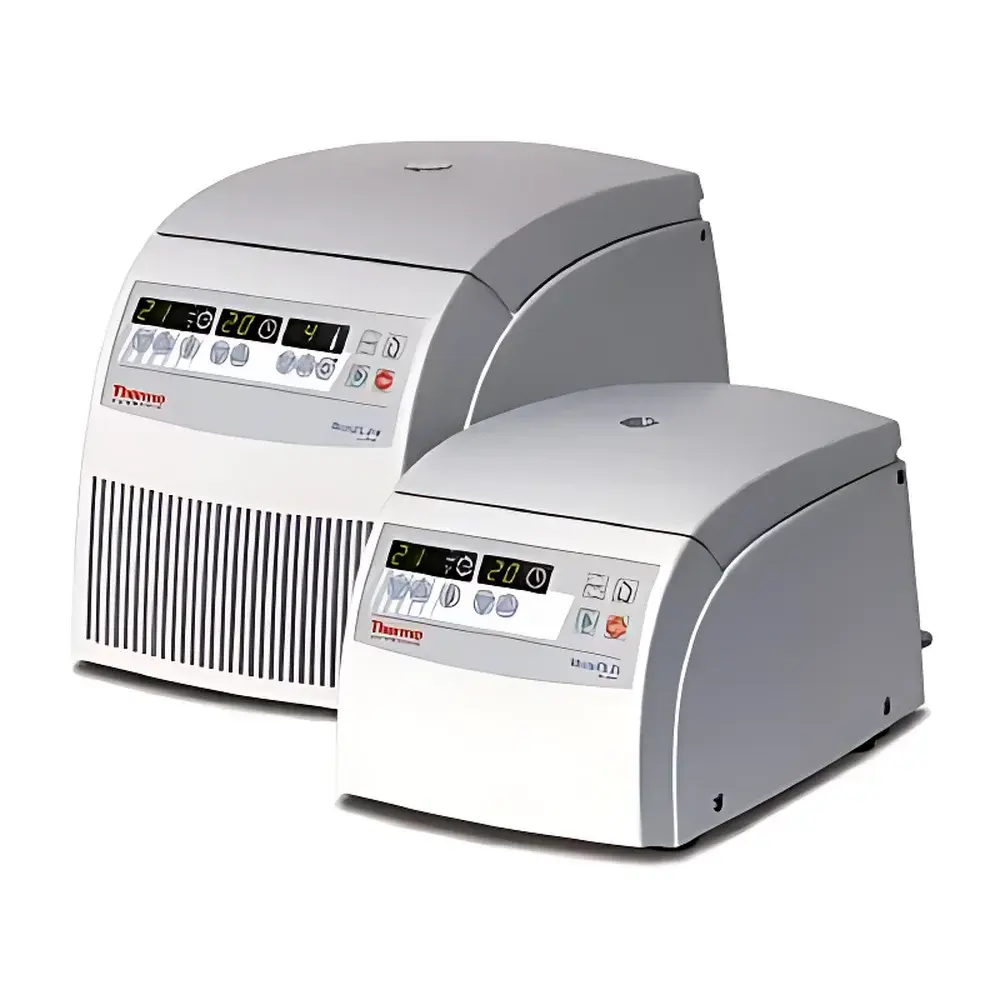
Thermo Scientific MicroCL 17 & 21 Microcentrifuge
| Brand | Thermo Fisher Scientific |
|---|---|
| Origin | USA |
| Model | MicroCL 17 & 21 |
| Max RCF | 17,000 × g (MicroCL 17) / 21,100 × g (MicroCL 21) |
| Max RPM | 13,300 (MicroCL 17) / 14,800 (MicroCL 21) |
| Timer Range | 1–99 min |
| Temperature Range | Ambient only (MicroCL 17/21) |
| Noise Level | <55 dBA (MicroCL 17/21), <56 dBA (MicroCL 21) |
| Dimensions (H×D×W) | 225 × 243 × 352 mm (non-refrigerated), 330 × 295 × 445 mm (refrigerated) |
| Net Weight | 11 kg (non-refrigerated), 28 kg (refrigerated) |
| Certified | CAMR-validated ClickSeal™ biocontainment rotor |
Overview
The Thermo Scientific MicroCL 17 & 21 microcentrifuge is a benchtop centrifugal system engineered for precision, reproducibility, and operational safety in molecular biology, clinical diagnostics, and quality control laboratories. Designed around the principles of fixed-angle centrifugation, it delivers high gravitational forces (up to 21,100 × g) to rapidly sediment nucleic acids, proteins, cellular organelles, and particulates from small-volume samples (0.2–2.0 mL). Its compact footprint—under 35 cm wide—optimizes space-constrained environments without compromising mechanical stability or thermal management. The non-refrigerated MicroCL 17 and MicroCL 21 models operate at ambient temperature, while their refrigerated counterparts (MicroCL 17R and MicroCL 21R) integrate a hermetic compressor-based cooling system compliant with IEC 61010-2-020 safety standards for laboratory equipment. All units meet ISO 13485 design controls for medical device–adjacent applications and support GLP-compliant workflows through audit-trail-capable parameter logging when integrated with optional Thermo Fisher Connect software.
Key Features
- Two performance tiers: 17,000 × g (13,300 rpm) and 21,100 × g (14,800 rpm) configurations to match protocol-specific sedimentation requirements
- ClickSeal™ biocontainment rotor system—24-position 2.0 mL rotor certified by the UK’s Centre for Applied Microbiology & Research (CAMR) for aerosol-tight operation during high-speed runs
- Tool-free rotor exchange with positive-latch mechanism; no wrenches or alignment tools required
- Accelerated spin-up and spin-down profiles (≈12 seconds to reach full speed; ≈10 seconds to stop), minimizing turnaround time across multi-step purification workflows
- Corrosion-resistant aluminum rotors compatible with repeated autoclaving (121 °C, 20 min, saturated steam) and exposure to ethanol, isopropanol, sodium hypochlorite, and enzymatic decontaminants
- Intuitive membrane keypad with backlit LCD display supporting real-time monitoring of speed, time remaining, and rotor ID recognition
- Integrated imbalance detection and automatic shutdown at >5 g differential mass across opposing positions
Sample Compatibility & Compliance
The MicroCL platform accommodates a broad range of sample formats without adapters: standard 1.5 mL and 2.0 mL conical tubes, 0.5 mL microtubes, 0.2 mL PCR strips/tubes, capillary hematocrit tubes, and filtration devices (e.g., spin columns for plasmid prep or desalting). The optional 18-position dual-row rotor accepts mixed tube sizes simultaneously—eliminating adapter dependency and reducing cross-contamination risk. All rotors comply with ISO 22870:2016 (point-of-care testing) and are validated per CLSI EP17-A2 for minimum detectable centrifugal force consistency. The ClickSeal™ lid meets EN 13098-1:2018 requirements for biological containment under dynamic loading conditions. Units ship with CE marking (2014/30/EU EMC Directive, 2014/35/EU LVD), RoHS 2011/65/EU compliance, and FDA-listed establishment registration (21 CFR Part 807).
Software & Data Management
While standalone operation requires no software, the MicroCL series supports digital integration via Thermo Fisher Connect—a secure, browser-based platform enabling remote instrument status monitoring, method synchronization across lab networks, and export of run logs in CSV or PDF format. Audit trails record operator ID (via LDAP integration), timestamped parameter changes, rotor usage cycles, and fault events—fully aligned with FDA 21 CFR Part 11 electronic record/electronic signature (ER/ES) requirements. Firmware updates are delivered over HTTPS with SHA-256 signature verification. No local database installation is required; data residency options include AWS GovCloud (US) or EU Frankfurt regions for regulated environments.
Applications
- Nucleic acid isolation (plasmid, genomic DNA, RNA) using silica-membrane or magnetic bead chemistries
- Protein precipitation and clarification prior to SDS-PAGE or LC-MS analysis
- Viral pellet concentration from cell culture supernatants (e.g., lentivirus, AAV)
- Microfiltration of viscous lysates or clarified bioprocess intermediates
- Hematocrit determination in point-of-care or veterinary settings
- Centrifugal removal of residual ethanol after nucleic acid wash steps
- Pre-analytical sample stabilization for biobanking (e.g., plasma separation within 30 minutes of venipuncture)
FAQ
Is the MicroCL 17/21 suitable for use with infectious agents?
Yes—the CAMR-validated ClickSeal™ rotor provides validated aerosol containment up to 21,100 × g, meeting WHO BSL-2 and CDC/NIH Appendix B containment recommendations for low-risk pathogens.
Can I autoclave the rotor and lid assembly?
Yes—both the aluminum rotor body and polypropylene ClickSeal™ lid are rated for ≥100 cycles of steam sterilization at 121 °C, 20 minutes, per ISO 17664-1.
Does the non-refrigerated model generate significant heat during extended runs?
No—its brushless DC motor and optimized airflow path maintain rotor temperature rise below 8 °C above ambient over 30-minute continuous operation at maximum speed.
What regulatory documentation is provided with shipment?
Each unit includes a Declaration of Conformity (DoC), Factory Calibration Certificate traceable to NIST standards, CAMR Validation Report (for ClickSeal™ rotor), and full IEC 61010-1 test report.
How is rotor lifetime tracked?
The onboard controller logs cumulative run hours and speed cycles; service alerts trigger at 10,000 hours or 50,000 cycles—whichever occurs first—per Thermo Fisher’s rotor lifecycle policy.



