
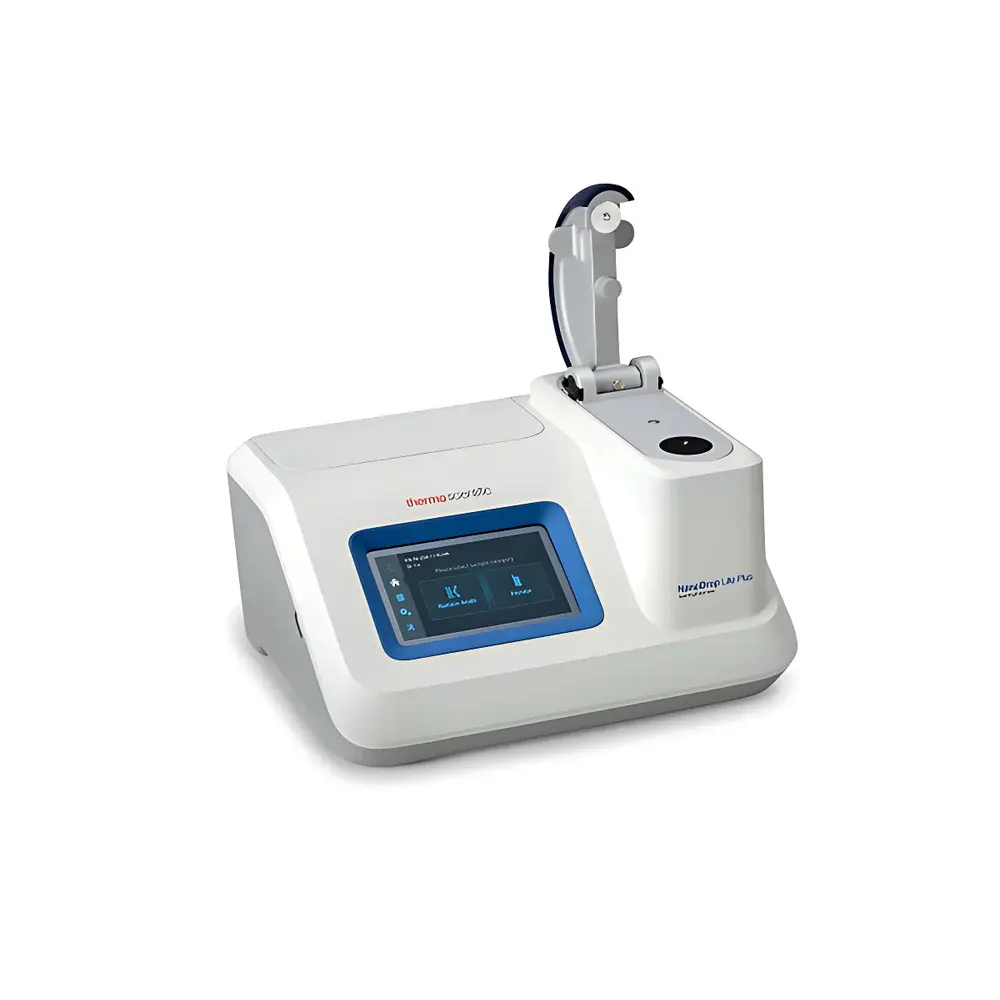
Thermo Scientific NanoDrop Lite Plus UV-Vis Spectrophotometer
| Brand | Thermo Fisher |
|---|---|
| Origin | USA |
| Manufacturer Type | Original Equipment Manufacturer (OEM) |
| Import Status | Imported |
| Model | NanoDrop Lite Plus |
| Instrument Architecture | Dual-beam |
| Detector Type | Photodiode Array |
| Wavelength Range | 260–280 nm |
| Wavelength Automation | Automatic |
| Spectral Bandwidth | 0.5 nm |
| Stray Light | 0.01% T |
| Key Applications | Nucleic Acid & Protein Quantification, Purity Ratio Analysis (A260/A280, A260/A230) |
Overview
The Thermo Scientific NanoDrop Lite Plus UV-Vis Spectrophotometer is a compact, fixed-wavelength microvolume spectrophotometer engineered for rapid, reliable quantification and purity assessment of nucleic acids and proteins in research, quality control, and educational laboratory environments. Unlike conventional cuvette-based instruments, the NanoDrop Lite Plus employs surface tension-mediated sample retention—requiring only 0.5–2 µL of undiluted sample—eliminating the need for dilution, cuvettes, or extensive calibration routines. Its optical architecture is based on dual-beam absorbance measurement at precisely defined wavelengths (260 nm and 280 nm), optimized for direct calculation of A260/A280 and A260/A230 ratios without spectral scanning. This design prioritizes operational simplicity and throughput over broad-spectrum flexibility, making it ideal for routine, high-frequency measurements where assay specificity and reproducibility are paramount.
Key Features
- Microvolume capability: Measures samples as small as 0.5 µL using pedestal-based optical pathlength (1 mm effective pathlength), minimizing reagent consumption and eliminating pipetting errors associated with dilution.
- Dual-beam photometric system: Compensates for lamp drift and environmental fluctuations in real time, enhancing measurement stability across extended usage periods.
- Fixed-wavelength operation at 260 nm and 280 nm: Optimized for nucleic acid and protein quantification per established extinction coefficient conventions (e.g., 50 µg/mL for dsDNA at A260 = 1.0).
- Photodiode array detector: Provides high signal-to-noise ratio and fast response time, supporting absorbance measurements up to 30 Abs with linear dynamic range maintained through hardware-level gain adjustment.
- Stray light performance of ≤0.01% T: Ensures minimal spectral contamination at high absorbance values, critical for accurate quantification of concentrated or impure samples.
- Spectral bandwidth of 0.5 nm: Delivers sufficient resolution to distinguish between closely spaced absorption peaks relevant to nucleic acid and protein purity evaluation.
Sample Compatibility & Compliance
The NanoDrop Lite Plus is validated for use with purified DNA, RNA, and protein solutions—including those isolated via column-based, magnetic bead, or phenol-chloroform methods. It accommodates standard aqueous buffers (e.g., TE, Tris-HCl, PBS) and low-concentration denaturants (e.g., 5 cP), or strong UV-absorbing contaminants (e.g., guanidine salts, phenol residuals) require prior cleanup to avoid erroneous readings. While not designed for full spectral compliance with ISO 17025 or ASTM E275, its fixed-wavelength protocol aligns with common QC workflows referenced in ISO/IEC 17025-accredited laboratories for nucleic acid integrity screening. The instrument supports GLP-compliant documentation when paired with external LIMS integration via CSV export.
Software & Data Management
The NanoDrop Lite Plus operates via an embedded firmware interface with intuitive touchscreen navigation. Measurement data—including concentration (ng/µL or mg/mL), A260/A280, A260/A230, and raw absorbance values—is stored locally and exportable via USB drive in CSV format. No proprietary software installation is required; exported files are compatible with Microsoft Excel, GraphPad Prism, and laboratory information management systems (LIMS). Audit trail functionality is limited to timestamped measurement logs; for full 21 CFR Part 11 compliance—including electronic signatures and user access controls—a higher-tier NanoDrop platform (e.g., NanoDrop OneC) is recommended.
Applications
- Routine QC of PCR templates, plasmid preps, and in vitro transcription products in molecular biology core facilities.
- Teaching laboratories: Enables undergraduate students to perform hands-on nucleic acid quantification with minimal training and zero consumable cost per measurement.
- Biomanufacturing process monitoring: Rapid verification of eluate fractions during affinity chromatography or size-exclusion purification steps.
- Protein expression screening: Initial assessment of lysate supernatants for soluble target yield prior to SDS-PAGE or HPLC analysis.
- Library preparation QC in next-generation sequencing workflows, particularly for low-input FFPE-derived DNA or fragmented RNA samples.
FAQ
Does the NanoDrop Lite Plus support full UV-Vis spectral scanning?
No. It is a fixed-wavelength instrument operating exclusively at 260 nm and 280 nm for targeted nucleic acid and protein analysis.
Can I measure samples with absorbance >30 Abs?
No. The instrument’s linear dynamic range is specified up to 30 Abs; samples exceeding this value must be diluted or measured using alternative methods such as fluorometric assays.
Is the NanoDrop Lite Plus compliant with FDA 21 CFR Part 11?
It does not include electronic signature, role-based access control, or audit trail features required for full Part 11 compliance.
What maintenance is required?
Daily cleaning of the quartz pedestals with lint-free wipes and 70% ethanol; biannual recalibration using supplied reference standards is recommended for long-term accuracy retention.
How does it differ from the NanoDrop One/OneC models?
The Lite Plus lacks full spectral scanning (190–850 nm), integrated spectrophotometric algorithms for contaminant identification, Bluetooth connectivity, and advanced data security features found in the One/OneC series.




