
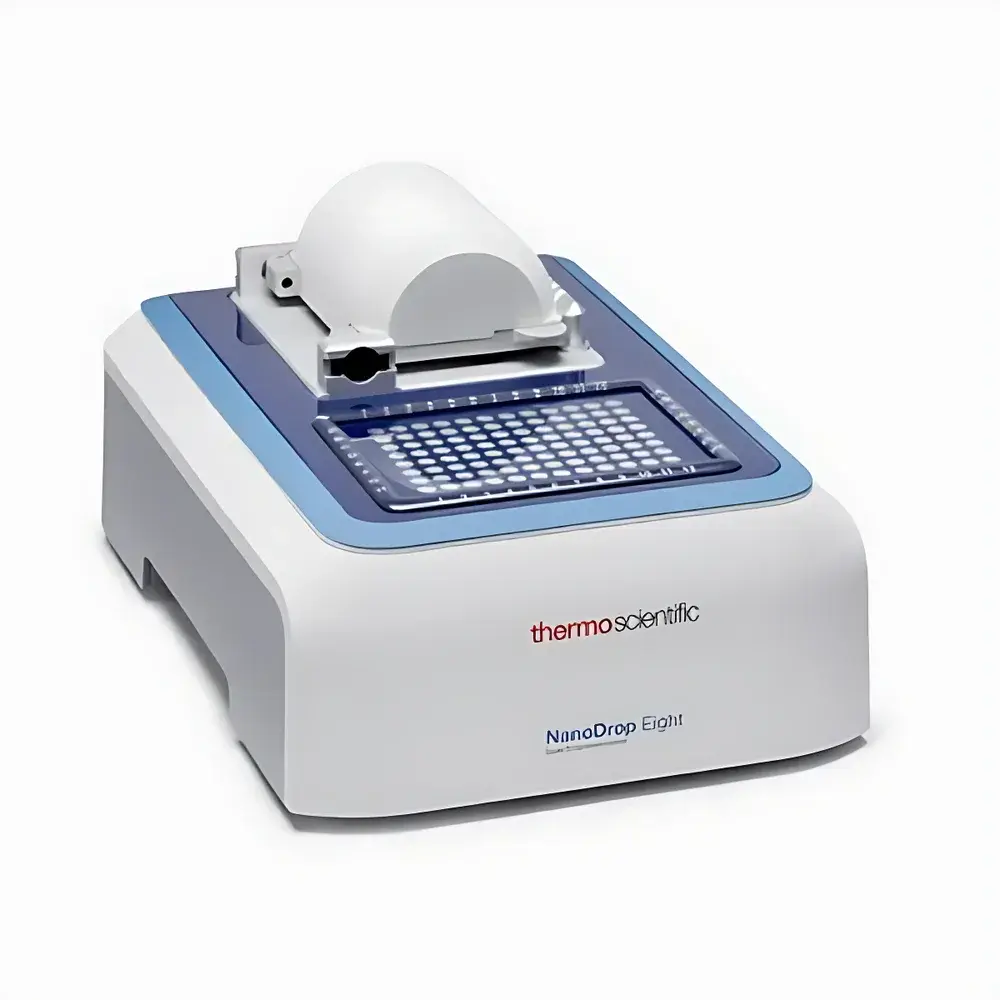
Thermo Scientific NanoDrop Eight Ultra Micro Spectrophotometer
| Brand | Thermo Fisher Scientific |
|---|---|
| Origin | Shanghai, China |
| Manufacturer Type | Authorized Distributor |
| Product Origin | Domestic (China) |
| Model | NanoDrop Eight Ultra Micro Spectrophotometer |
| Pricing | Available Upon Request |
Overview
The Thermo Scientific NanoDrop Eight Ultra Micro Spectrophotometer is a benchtop microvolume UV-Vis spectrophotometer engineered for rapid, accurate quantification and quality assessment of nucleic acids and proteins using only 0.5–2 µL of undiluted sample. It operates on the principle of surface tension-mediated sample retention between two optical quartz pedestals—eliminating the need for cuvettes or capillaries—and employs a xenon flash lamp light source with a CCD array detector to acquire full-spectrum absorbance data from 190–850 nm in under five seconds. Unlike traditional cuvette-based systems, the NanoDrop Eight leverages pathlength-independent measurement via real-time pathlength calculation, enabling direct concentration determination without dilution across an extended dynamic range. Its core architecture supports routine QC in molecular biology, biopharma process development, and academic research labs where sample scarcity, throughput demands, and regulatory traceability are critical constraints.
Key Features
- Acclaro Sample Intelligence Technology: Automatically identifies and quantifies common contaminants—including guanidine salts, phenol, EDTA, and residual solvents—that distort A260/A280 ratios and inflate apparent nucleic acid concentrations.
- Chemometric Correction Algorithms: Applies empirically validated correction models to compute true analyte concentration by deconvoluting contaminant spectral contributions—validated against reference methods per ISO/IEC 17025 guidelines.
- DNA/RNA Discrimination Engine: Differentiates mammalian dsDNA from co-purified RNA (and vice versa) using second-derivative spectral analysis and multivariate regression, supporting accurate normalization in RNA-seq library prep and CRISPR gRNA validation.
- Extended Dynamic Range: Measures dsDNA up to 10,000 ng/µL and IgG up to 145 mg/mL without manual dilution—reducing pipetting error and cross-contamination risk.
- Ergonomic Dual-Handed Sample Loading: Vertically aligned pedestal array and magnetic pipette guide enable ambidextrous operation with minimal wrist deviation; compliant with ISO 9241-5 ergonomic workstation standards.
- One-Touch Measurement & Auto-Zero: Lowering the arm initiates automatic baseline correction and spectral acquisition—configurable to disable for specialized workflows requiring manual zeroing.
Sample Compatibility & Compliance
The NanoDrop Eight accommodates aqueous buffers (e.g., TE, PBS, nuclease-free water), chaotropic salt solutions (e.g., guanidine HCl up to 6 M), and low-viscosity protein formulations. It is validated for use with standard nucleic acid purification kits (QIAGEN, Zymo, Norgen) and recombinant protein preparations. Regulatory compliance includes full support for FDA 21 CFR Part 11 requirements when paired with optional SciVault software—enabling electronic signatures, role-based user access control, immutable audit trails, and automated IQ/OQ documentation generation. Instrument design adheres to IEC 61010-1 safety standards and electromagnetic compatibility per EN 61326-1. All firmware and application modules undergo periodic verification per laboratory GLP/GMP internal validation protocols.
Software & Data Management
NanoDrop Eight ships with embedded software featuring preloaded applications for dsDNA, RNA, protein A280, BCA, Bradford, and UV-Vis scanning. Data export supports CSV, XML, and PDF formats with embedded metadata (timestamp, operator ID, instrument serial number). LIMS integration is achieved via configurable folder-watch functionality—allowing third-party LIMS platforms to monitor designated directories for new measurement files. SciVault software (optional add-on) extends capabilities with centralized user management, multi-instrument audit log aggregation, and automated report generation compliant with ISO 15197 and CLIA requirements. Software updates are delivered through thermoscientific.com/ndropsw—registered users receive version notifications and release notes detailing algorithm refinements, bug fixes, and new application modules.
Applications
- High-throughput nucleic acid QC in NGS library preparation and qPCR assay development
- Concentration and purity assessment of CRISPR-Cas9 ribonucleoprotein complexes
- Stability monitoring of monoclonal antibody formulations during accelerated stability studies
- Verification of oligonucleotide synthesis yield and desalting efficiency
- Quantitative validation of exosome-associated RNA isolation protocols
- Supporting analytical method transfer between R&D and QC laboratories under ICH Q5E guidelines
FAQ
Does the NanoDrop Eight require calibration with NIST-traceable standards?
Yes—routine performance verification uses Thermo Scientific™ NanoDrop™ Calibration Verification Standards (Cat. No. ND-CAL-1), certified to NIST SRM 2034 for absorbance accuracy and SRM 930e for photometric linearity.
Can the instrument distinguish between ssDNA and dsDNA?
No—the Acclaro algorithm differentiates dsDNA vs. RNA and identifies common contaminants, but does not resolve ssDNA/dsDNA structural differences; orthogonal validation (e.g., agarose electrophoresis or fluorometric assays) is recommended for denaturation state confirmation.
Is remote instrument monitoring supported?
Not natively—however, SciVault server deployment enables centralized logging and permission-based remote access to audit trails and configuration settings across networked instruments.
What is the minimum detectable concentration for BSA using A280?
The practical lower limit is ~0.05 mg/mL under standard measurement conditions, consistent with the instrument’s specified photometric noise specification of <0.002 AU at 260 nm.
Are method templates exportable between instruments?
Yes—custom measurement methods, including user-defined extinction coefficients and contaminant thresholds, can be saved as .ndm files and deployed across multiple NanoDrop Eight units via USB or network share.
Related Products






