
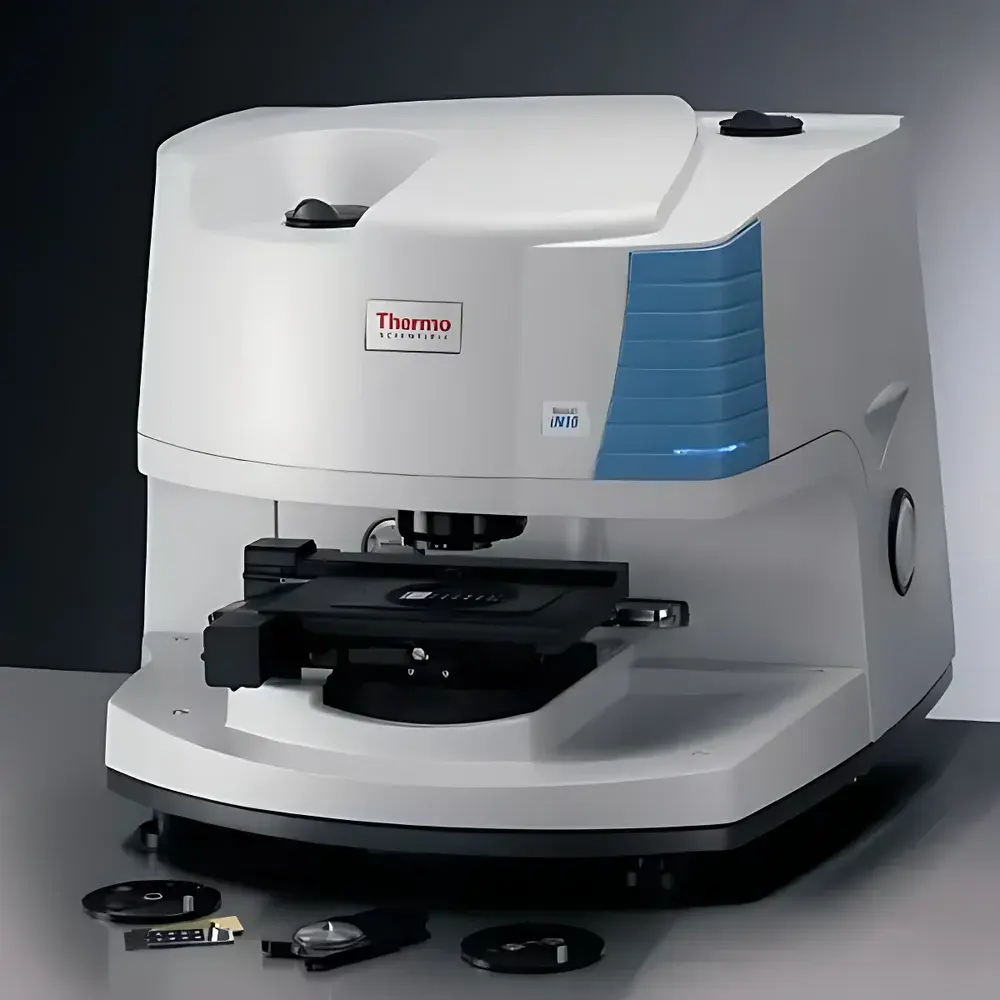
Thermo Scientific Nicolet iN10 FTIR Microscope
| Brand | Thermo Fisher |
|---|---|
| Origin | Shanghai, China |
| Manufacturer Type | Authorized Distributor |
| Origin Category | Domestic (China-manufactured) |
| Model | Nicolet iN10 FTIR Microscope |
| Pricing | Contact for Quote |
| Detector Type | Standard DTGS |
| Height | 533 mm |
| Width | 622 mm |
| Depth | 653 mm |
| Voltage | 100–240 VAC, 47–63 Hz |
| Current Rating | 3.2 A |
| Certifications | CE, ETL, ISO 9001:2000 certified manufacturing facility |
| Warranty | 1-year comprehensive system warranty |
| Included | Sampling Tool Kit |
| Unit Size | Each |
Overview
The Thermo Scientific Nicolet iN10 FTIR Microscope is a fully integrated, benchtop Fourier Transform Infrared (FTIR) microspectroscopy system engineered for high-fidelity chemical imaging and microscale spectral analysis. Unlike conventional FTIR microscopes requiring external spectrometers and complex optical alignment, the iN10 integrates a compact, high-stability interferometer, precision reflective optics, and an automated visible-IR co-registered microscope into a single robust platform. It operates on the principle of interferometric modulation of infrared radiation—capturing full spectral data across the mid-IR range (typically 4000–650 cm−1) with spectral resolution configurable down to 4 cm−1. Designed for routine laboratory use, it enables spatially resolved identification of organic functional groups, crystalline phases, and molecular contaminants at lateral resolutions approaching 5–10 µm—limited primarily by diffraction and objective magnification—not by detector or source performance. Its architecture supports both transmission, reflection, and attenuated total reflectance (ATR) modalities, making it suitable for heterogeneous solid samples, thin films, multilayer structures, and micro-particulates without extensive sample preparation.
Key Features
- Integrated FTIR spectrometer and optical microscope in one compact footprint (622 × 653 × 533 mm), minimizing lab space requirements and eliminating external beam path alignment.
- Room-temperature DTGS detector standard; optional liquid-nitrogen-cooled MCT-A detector for enhanced signal-to-noise ratio in low-light or rapid-scan applications.
- Computer-controlled motorized X-Y stage with programmable coordinate mapping—enabling automated spectral acquisition grids for chemical imaging and distribution mapping.
- Co-registered visible-light and IR optical paths with dual-display capability: real-time visible image overlay with IR spectral acquisition point, ensuring precise targeting of sub-50 µm features.
- OMNIC Specta software suite with embedded spectral library search (including polymer, pharmaceutical, and contaminant databases), mixture analysis algorithms, and spectral subtraction tools.
- Automated system performance verification (SPV) protocol compliant with ASTM E1421 and ISO 17025 quality assurance frameworks—executed before each session or on schedule to maintain measurement traceability.
- MicroTip ATR accessory for direct, non-destructive contact sampling of irregular or fragile surfaces; compatible with standard IR microscope objectives (15×, 30×, 74×).
- Optional polarized visible-light optics for birefringence assessment during morphological inspection—critical for polymer phase separation or crystal habit analysis.
Sample Compatibility & Compliance
The iN10 accommodates a broad range of solid and semi-solid specimens relevant to materials science, pharmaceutical QA/QC, failure analysis, and regulatory compliance testing. It routinely analyzes polymer laminates, coated substrates, tablet cross-sections, adhesive interfaces, micro-contaminants on silicon wafers, and API-excipient distributions in blended powders. All hardware and software components comply with CE and ETL safety directives. The manufacturing facility adheres to ISO 9001:2000 quality management standards. While the instrument itself does not carry FDA 21 CFR Part 11 certification out-of-the-box, OMNIC Specta software supports audit-trail-enabled operation when configured with user authentication, electronic signatures, and secure data archiving—meeting GLP and GMP documentation requirements for regulated environments.
Software & Data Management
OMNIC Specta serves as the unified control and analysis interface. It provides intuitive workflow-guided acquisition—including auto-focus, auto-aperture, and auto-background collection—and supports batch processing of hyperspectral datasets (e.g., 100 × 100 pixel maps). Spectral data are stored in vendor-neutral .spa format, exportable to CSV, JCAMP-DX, or HDF5 for third-party chemometric analysis (e.g., PCA, cluster analysis). The software includes built-in tools for baseline correction, atmospheric compensation, peak integration, and spectral deconvolution. For laboratories subject to regulatory oversight, optional OMNIC Security Pack enables role-based access control, electronic signature capture, and immutable audit logs—all aligned with ALCOA+ (Attributable, Legible, Contemporaneous, Original, Accurate) data integrity principles.
Applications
- Micro-scale material identification: Differentiation of polymeric resins, fillers, and additives in composites using characteristic C=O, C–H, and Si–O stretching bands.
- Coating thickness and uniformity assessment: Quantitative layer analysis via interference fringe modeling in reflection mode.
- API distribution mapping in solid dosage forms: Chemical imaging of active pharmaceutical ingredient homogeneity across tablet cross-sections.
- Contaminant forensics: Identification of silicone oils, mold release agents, or cleaning residue on medical device surfaces.
- Failure analysis of electronic packaging: Detection of hydrolysis products or oxidation signatures at delaminated interfaces.
- Quality control of laminated packaging: Verification of adhesive integrity and barrier layer composition in food/pharma packaging films.
FAQ
What is the minimum resolvable feature size under standard operating conditions?
The practical spatial resolution is ~5–10 µm, governed by the diffraction limit of mid-IR wavelengths (~2–25 µm) and objective numerical aperture—not by detector pixel count or software interpolation.
Can the iN10 be upgraded to support synchrotron IR sources or step-scan capabilities?
No—the iN10 is a dedicated benchtop system with a fixed Michelson interferometer and thermal source; it is not designed for external beamline coupling or time-resolved measurements.
Is liquid-nitrogen handling training required for MCT-A detector operation?
Yes—users must complete Thermo Fisher’s certified cryogen safety and detector cooldown protocol training prior to installation and routine use of the MCT-A option.
Does the system support ASTM E2893-22 (Standard Guide for FTIR Microspectroscopy of Polymers)?
Yes—hardware configuration, spectral calibration procedures, and OMNIC Specta reporting templates align with key provisions of ASTM E2893-22 for polymer microanalysis.
How is spectral calibration maintained over time and temperature fluctuations?
The iN10 employs internal HeNe laser referencing and temperature-stabilized interferometer housing; daily SPV routines verify wavenumber accuracy (±0.05 cm−1) and photometric linearity per NIST-traceable polystyrene film standards.





