
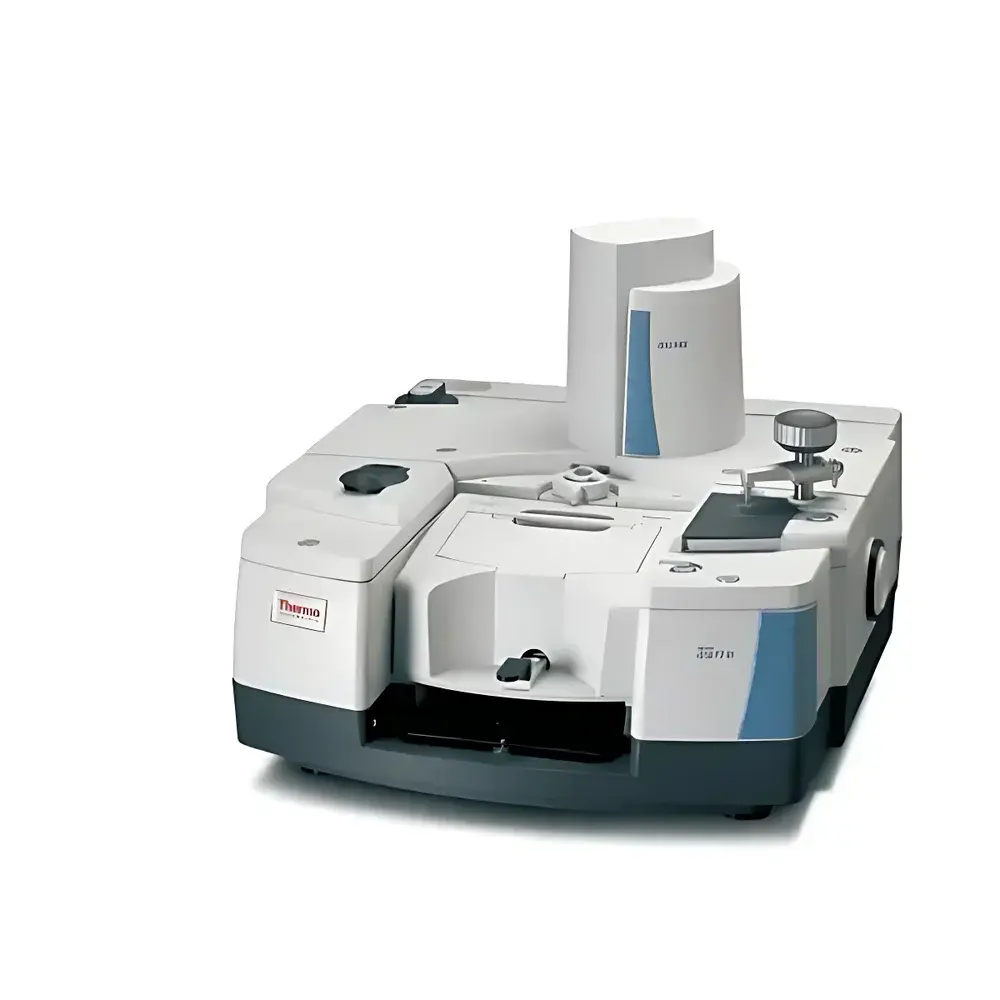
Thermo Scientific Nicolet iS50 Fourier Transform Infrared (FTIR) Spectrometer
| Brand | Thermo Scientific |
|---|---|
| Origin | Shanghai, China |
| Manufacturer Type | Original Equipment Manufacturer (OEM) |
| Regional Classification | Domestic (China-manufactured) |
| Model | Thermo Scientific Nicolet iS50 FTIR Spectrometer |
| Instrument Category | Infrared Auxiliary Equipment |
| Instrument Form Factor | Benchtop (not portable — correction per technical specification) |
| Spectral Resolution | 0.09 cm⁻¹ |
| Light Sources | Dual-source configuration (Polaris long-life IR source + tungsten-halogen visible/NIR source) |
| Detectors | Triple-detector sample compartment (MCT, DTGS, and optional far-IR detector) |
| Optical Path | Gold-coated optics (standard), aluminum-coated option available |
| Beam Delivery | Parallel or focused output ports |
| Standard Features | Motorized calibration wheel, motorized neutral density filter wheel, motorized polarizer wheel (optional), purge interface (optional), USB 2.0 high-speed interface, integrated diamond ATR (mid- and far-IR capable), Smart accessory compatibility, automatic beam alignment, internal storage for two additional beamsplitters |
| Software Platform | OMNIC Specta with Mercury GC, TGA-IR, and step-scan modules |
Overview
The Thermo Scientific Nicolet iS50 Fourier Transform Infrared (FTIR) Spectrometer is a modular, research-grade benchtop instrument engineered for high-fidelity molecular characterization across the mid-infrared (MIR), far-infrared (FIR), and near-infrared (NIR) spectral regions. Based on Michelson interferometry with a dynamically aligned optical path, the iS50 delivers exceptional spectral fidelity through its high-stability, vibration-insensitive interferometer architecture—optimized for routine QC and advanced R&D applications alike. Its core design supports seamless expansion from a standard FTIR workstation to a multi-technique platform integrating ATR, Raman, NIR, TGA-IR, and GC-IR modalities—all within a single, space-efficient footprint. The system complies with ISO/IEC 17025 requirements for analytical instrument qualification and supports GLP/GMP workflows via audit-trail-enabled OMNIC software (21 CFR Part 11 compliant when configured with appropriate user access controls and electronic signature modules).
Key Features
- Sub-0.1 cm⁻¹ spectral resolution (0.09 cm⁻¹ standard), enabling precise peak deconvolution in complex mixtures and fine-structure analysis of vibrational modes.
- Dual-source capability: Polaris long-life infrared source for MIR/FIR stability and tungsten-halogen lamp for NIR/visible extension—both automatically selected based on spectral range.
- Triple-detector sample compartment accommodating simultaneous or sequential use of DTGS (ambient), MCT (cooled), and bolometric (far-IR) detectors without manual realignment.
- Full gold-coated optical train (standard), ensuring >98% reflectivity across 10,000–10 cm⁻¹ and minimizing oxidation-related drift in humid or corrosive environments.
- Motorized calibration wheel with NIST-traceable polystyrene reference film for automated daily verification per ASTM E1421 and ISO 18381.
- Integrated diamond ATR module with pressure-controlled contact and auto-alignment—enabling rapid, solvent-free analysis of solids, gels, pastes, and liquids without KBr pellet preparation.
- Smart accessory ecosystem: All Thermo Scientific Smart accessories (e.g., iD5, iD7, iQ Attenuated Total Reflectance units) are recognized, calibrated, and configured automatically upon connection.
Sample Compatibility & Compliance
The iS50 accommodates diverse physical forms—including powders, films, coatings, fibers, tablets, biological tissues, and viscous fluids—via interchangeable sampling interfaces: transmission cells (CaF₂, BaF₂, KBr), specular reflectance stages, diffuse reflectance accessories (integrating spheres), and hyphenated modules (TGA-IR, GC-IR). Its modular architecture conforms to ASTM E1252 (general principles of FTIR), ASTM E168 (qualitative analysis), ASTM E1421 (instrument performance verification), and ISO 18381 (FTIR spectrometer validation). For regulated environments, OMNIC software supports 21 CFR Part 11 compliance through role-based permissions, electronic signatures, and immutable audit trails—validated for pharmaceutical QC (USP ), forensic casework (SWGDRUG Method 1 & 2), and polymer certification (ASTM D3418, ISO 11357).
Software & Data Management
Controlled by OMNIC Specta v10+, the iS50 provides unified acquisition, processing, and reporting across all integrated techniques. The platform includes quantitative algorithms (PLS, PCA, CLS), spectral library search (Sadtler, Polymer, Forensic, Pharma), and method-driven workflows (e.g., “Polymer ID”, “Residual Solvent Quantitation”). GC-IR data is processed using OMNIC Mercury GC, which correlates retention time with spectral identity for isomer differentiation—fully compatible with Chromeleon CDS for synchronized GC-FID/GC-IR operation. Raw interferograms and spectra are stored in vendor-neutral .spa/.spc formats; metadata embedding (sample ID, operator, instrument parameters, calibration status) ensures traceability. Data export supports CSV, JCAMP-DX, and ASCII for LIMS integration.
Applications
- Pharmaceuticals: Polymorph screening, excipient compatibility studies, API quantification in blends, residual solvent analysis (ICH Q2(R2)), and cleaning validation per FDA guidance.
- Polymers & Elastomers: Crystallinity index calculation (ASTM D2471), oxidation induction time (OIT), copolymer composition mapping, and degradation kinetics under thermal/UV stress.
- Forensics: Identification of illicit drugs, explosives residues, paint layers, and textile fibers—supporting SWGDRUG Category A methods and FBI Laboratory protocols.
- Materials Science: Thin-film thickness determination (interference fringe analysis), surface functionalization verification, and catalyst characterization via in situ DRIFTS.
- Food & Agriculture: Fat/oil composition (fatty acid profile), moisture content (NIR correlation), adulterant detection (e.g., melamine in milk), and authenticity verification of botanical extracts.
- Academic Research: Time-resolved step-scan experiments (kinetics down to µs scale), photoinduced reaction monitoring, and low-frequency lattice mode analysis in MOFs and perovskites.
FAQ
Is the Nicolet iS50 truly portable?
No—the iS50 is a benchtop instrument designed for laboratory installation. Its “portable” designation in some regional marketing materials is inaccurate; it requires stable vibration-isolated mounting, electrical grounding, and purge gas (dry air or nitrogen) for optimal performance.
What is the difference between the iS50 and iS50R models?
The iS50R incorporates a high-precision Vectra-Piezo interferometer with active phase correction, enabling step-scan, time-resolved, and phase-modulated experiments not supported on the standard iS50. It also features enhanced electronics (SST digitizers) and dedicated step-scan control firmware.
Can the iS50 perform far-infrared spectroscopy below 400 cm⁻¹?
Yes—when equipped with the optional far-IR detector (bolometer or composite DTGS) and Mylar or polyethylene beamsplitter, the iS50 covers 10–400 cm⁻¹, suitable for lattice vibrations, heavy-atom stretching, and rotational transitions.
Does the system support automated calibration and performance verification?
Yes—motorized calibration wheel with NIST-traceable standards enables automated daily verification per ASTM E1421; OMNIC reports include pass/fail metrics for resolution, wavenumber accuracy, and photometric linearity.
How is data integrity ensured in regulated environments?
OMNIC Specta supports 21 CFR Part 11 compliance via configurable audit trails, electronic signatures, user authentication (LDAP/Active Directory), and secure database logging—validated for GxP use with documented IQ/OQ/PQ protocols.







