
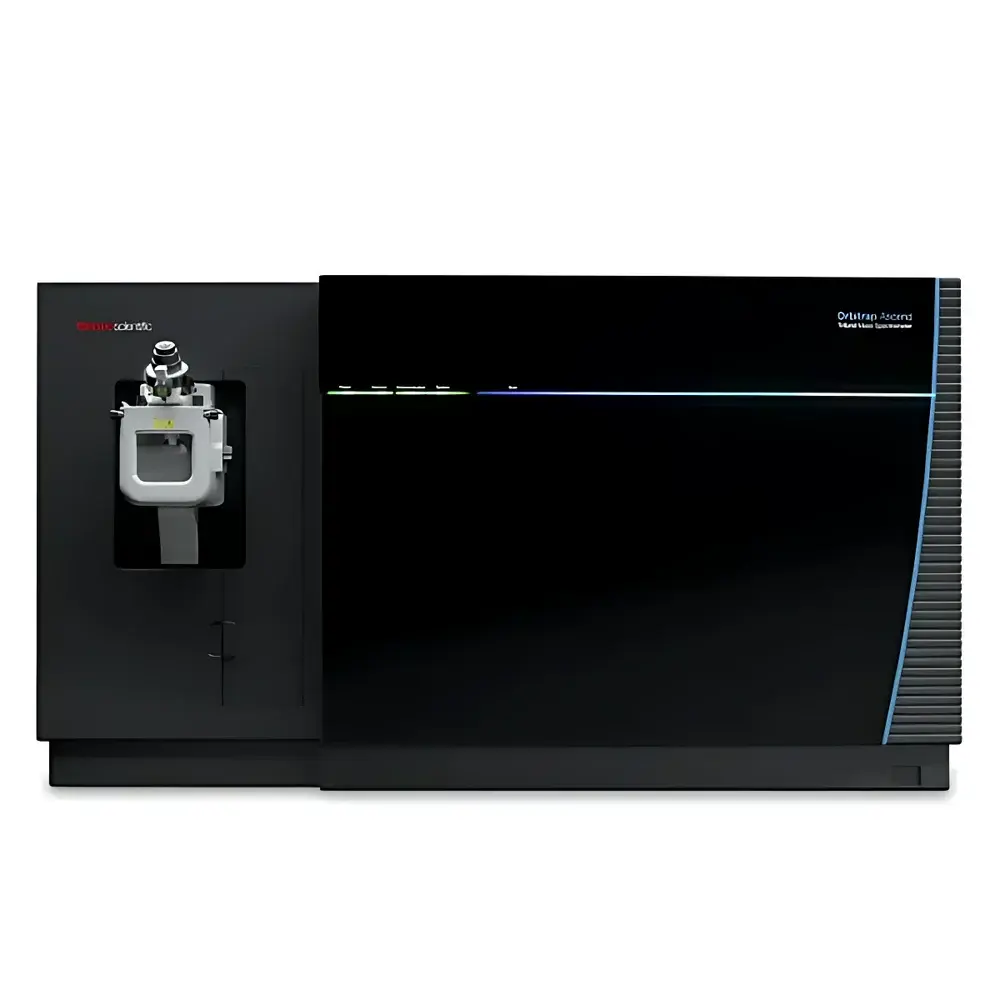
Thermo Scientific Orbitrap Ascend Structural Biology Tribrid Mass Spectrometer
| Brand | Thermo Fisher |
|---|---|
| Origin | Shanghai, China |
| Manufacturer Type | Authorized Distributor |
| Product Origin | Domestic (China-assembled) |
| Model | Orbitrap Ascend Structural Biology Tribrid Mass Spectrometer |
| Price Range | USD 14,000 – 720,000 (based on configuration and regional pricing) |
Overview
The Thermo Scientific Orbitrap Ascend Structural Biology Tribrid Mass Spectrometer is a purpose-engineered platform for native mass spectrometry (nMS), designed to resolve the structural complexity of intact protein assemblies, membrane proteins, virus-like particles, and multi-subunit complexes under non-denaturing conditions. Built upon the proven Tribrid architecture—integrating a high-performance quadrupole mass filter, linear ion trap (LIT), and ultra-high-resolution Orbitrap mass analyzer—the system delivers simultaneous high sensitivity, wide dynamic range, and sub-ppm mass accuracy across m/z 5–16,000. Its structural biology configuration features optimized ion transmission optics, cryo-cooled ion transfer optics, and dedicated non-denaturing electrospray ionization (nESI) source geometry to preserve weak non-covalent interactions during gas-phase transfer. Unlike conventional denatured workflows, this platform enables direct interrogation of stoichiometry, topology, ligand binding, and conformational heterogeneity without prior crystallization or labeling—making it essential for integrative structural biology pipelines aligned with cryo-EM, hydrogen-deuterium exchange (HDX), and cross-linking MS (XL-MS) studies.
Key Features
- Native MS-optimized ion path with low-energy collisional activation control and extended m/z detection up to 16,000 in the Orbitrap analyzer
- Tribrid architecture enabling parallel acquisition modes: synchronous precursor selection (SPS) MS3, real-time decision tree-based data-dependent acquisition (DDA), and targeted parallel reaction monitoring (tPRM)
- Dedicated non-denaturing ESI source with temperature-controlled capillary, low-flow sheath gas, and adjustable desolvation voltage for fragile complex integrity
- High-field asymmetric waveform ion mobility spectrometry (FAIMS Pro) integration option for enhanced conformational separation and charge-state deconvolution
- Ultra-stable electrostatic lens system and dual-pressure linear ion trap (LIT) supporting high-fidelity MS/MS at m/z ≤ 8,000 with isolation width down to m/z 5
- Onboard calibration using internal lock mass reference (e.g., cesium iodide clusters) ensuring long-term mass stability (< 1 ppm RMS over 48 h)
Sample Compatibility & Compliance
The Orbitrap Ascend Structural Biology Tribrid supports analysis of native samples ranging from small oligomeric proteins (e.g., hemoglobin tetramers) to megadalton-scale complexes (e.g., ribosomes, proteasomes, VLPs). Compatible with volatile ammonium acetate buffers (10–200 mM, pH 6.5–8.0), aqueous glycerol mixtures, and detergent-free nanodisc preparations. All hardware and firmware comply with IEC 61010-1:2010 safety standards and electromagnetic compatibility (EMC) Directive 2014/30/EU. Data acquisition and processing workflows support audit-trail-enabled operation per FDA 21 CFR Part 11 requirements when deployed with Thermo Scientific Chromeleon CDS v7.3+ and optional electronic signature modules. Instrument qualification documentation (IQ/OQ/PQ) templates are provided for GLP- and GMP-aligned laboratories.
Software & Data Management
Controlled via Thermo Scientific Compound Discoverer 3.3+ and BioPharma Finder 4.2+, the platform integrates with the Thermo Scientific Proteome Discoverer 2.5+ environment for automated deconvolution of high-mass charge envelopes (e.g., using UniDec or Massign algorithms). Raw data files (.raw) are natively compatible with open-source tools including TOPP, OpenMS, and msConvert. The instrument’s embedded real-time processing engine performs on-the-fly charge state determination, mass deconvolution, and signal-to-noise optimization during acquisition—reducing post-run computational burden. All metadata—including instrument parameters, calibration history, and user-defined acquisition methods—is embedded in vendor-neutral mzML format for FAIR (Findable, Accessible, Interoperable, Reusable) data management.
Applications
- Stoichiometric quantification of heterogeneous protein complexes under native conditions
- Ligand-binding affinity assessment via titration MS and native competition assays
- Conformational dynamics mapping using collision-induced unfolding (CIU) and ion mobility-resolved activation
- Characterization of biosimilar higher-order structure (HOS) and comparability against innovator biologics
- Intact mass analysis of monoclonal antibodies, antibody-drug conjugates (ADCs), and fusion proteins with site-specific modifications
- Validation of cryo-EM map fitting through experimental mass constraints
FAQ
Is this instrument suitable for routine QC of biopharmaceuticals in regulated environments?
Yes—when configured with validated software modules (Chromeleon CDS + BioPharma Finder), it supports 21 CFR Part 11 compliance, including electronic signatures, audit trails, and role-based access control.
What is the maximum observed m/z for intact protein complexes in native mode?
The system routinely detects and resolves charge-reduced species up to m/z 16,000 in the Orbitrap analyzer, corresponding to ~1.2 MDa complexes under optimal buffer and instrumental conditions.
Can FAIMS Pro be retrofitted to existing Orbitrap Ascend systems?
Yes—FAIMS Pro integration is available as a field-upgradable option for all Orbitrap Ascend Tribrid platforms manufactured after Q2 2023.
Does the instrument require liquid nitrogen or external chillers?
No—it uses a closed-cycle cryo-cooling system for the Orbitrap analyzer; no consumables or external utilities are required beyond standard lab power and compressed air.
Is method transfer possible between different Orbitrap Ascend editions?
Yes—acquisition methods (.meth files) and processing workflows are fully portable across MultiOmics, Structural Biology, and BioPharma editions due to shared firmware architecture and unified software stack.
Related Products





