
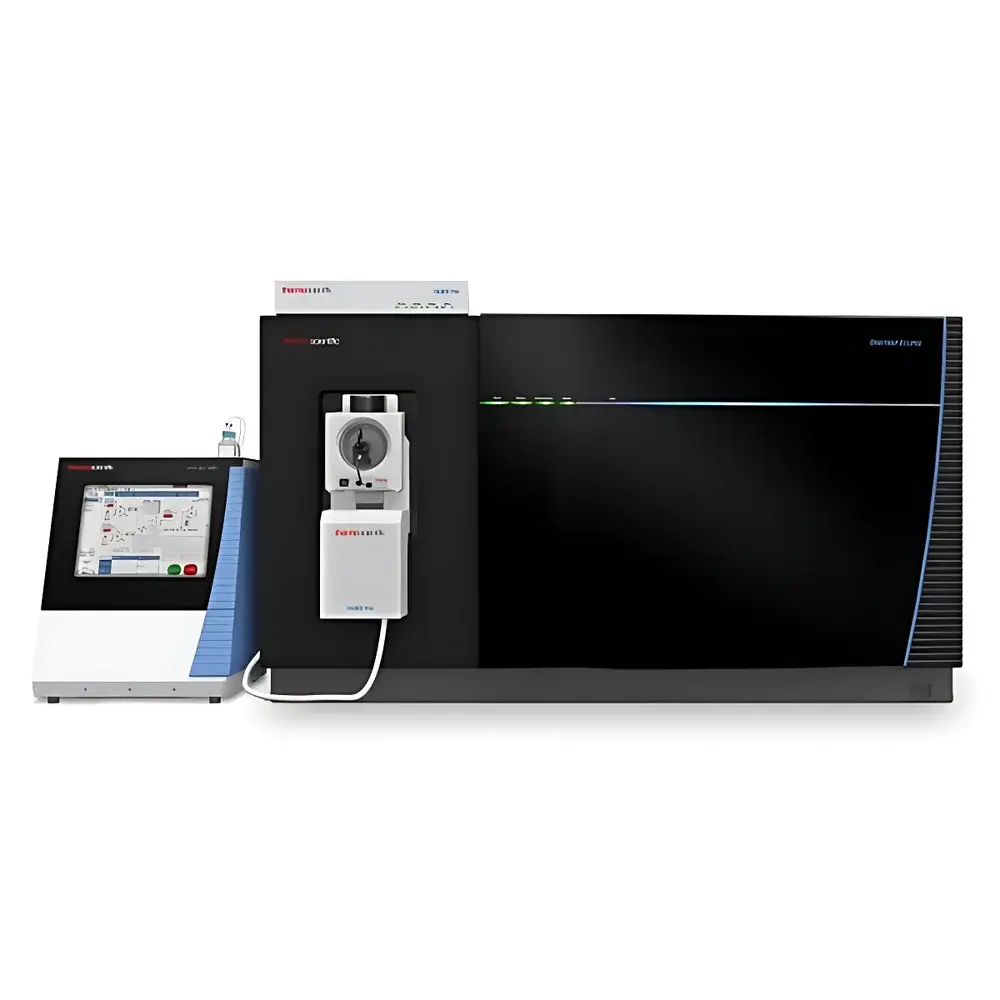
Thermo Scientific Orbitrap Eclipse Tribrid Mass Spectrometer
| Brand | Thermo Scientific |
|---|---|
| Origin | USA |
| Manufacturer Type | Original Equipment Manufacturer (OEM) |
| Origin Category | Imported |
| Model | Orbitrap Eclipse |
| Instrument Type | Orbitrap-based Tribrid Mass Spectrometer |
| Mass Range (HMRn) | up to 8,000 Da for MSⁿ (n = 1–10) |
| Resolution | 500,000 (standard), up to 1,000,000 with optional upgrade |
| Quadrupole | Hyperbolic QR5 segmented quadrupole, 25 cm length, 0.4 Da isolation width |
| Ion Source Technology | Proton Transfer Charge Reduction (PTCR) using perfluorophenanthrene (PFPP) reagent gas |
| Real-time Search (RTS) | Integrated database-matching algorithm for dynamic SPS-MS³ decisioning |
| Software Platform | Thermo Scientific BioPharma Finder and Proteome Discoverer 3.0 compatible |
Overview
The Thermo Scientific Orbitrap Eclipse Tribrid Mass Spectrometer is an advanced high-resolution, high-mass-accuracy platform engineered for next-generation top-down, native, and quantitative proteomics. Built upon the proven tribrid architecture—integrating a dual-pressure linear ion trap (LTQ), a high-field Orbitrap mass analyzer, and a segmented quadrupole—this instrument delivers unprecedented analytical depth in structural biology and biopharmaceutical characterization. Its core measurement principle relies on electrostatic trapping and Fourier-transform detection in the Orbitrap analyzer, combined with parallelizable ion activation (HCD, ETD, CID) and real-time intelligent acquisition logic. Unlike conventional bottom-up workflows, the Orbitrap Eclipse enables intact protein analysis, native complex interrogation, and comprehensive post-translational modification (PTM) mapping—all within a single LC-MS/MS run.
Key Features
- High Mass Range MSn
- Supports MSn (n = 1–10) up to m/z 8,000 in both Orbitrap and LTQ analyzers—enabling robust native omics applications including membrane protein–ligand interaction studies and intact subunit dissociation analysis.
- Proton Transfer Charge Reduction (PTCR): Utilizes perfluorophenanthrene (PFPP) as a neutral reagent gas in the dual-pressure LTQ to selectively reduce charge states of intact proteins and complexes via gas-phase proton transfer—yielding simplified, high-S/N spectra ideal for top-down sequencing and conformational analysis.
- Real-time Search (RTS) Algorithm: Dynamically evaluates precursor identity during acquisition; suppresses redundant MS³ scans for confidently identified peptides, increasing throughput by ~2× while improving TMT-based quantification precision and proteome coverage.
- Hyperbolic QR5 Segmented Quadrupole: 25 cm active length with enlarged bore diameter enhances ion transmission efficiency and enables high-fidelity isolation of precursors with ≤0.4 Da window width—critical for multiplexed isobaric tagging and low-abundance target analysis.
- Ultra-High Resolution Capability: Standard 500,000 resolution at m/z 200; optionally scalable to 1,000,000 with extended transient acquisition—ensuring baseline separation of isotopic fine structure and confident elemental composition assignment.
Sample Compatibility & Compliance
The Orbitrap Eclipse is optimized for direct coupling with nano-LC, micro-LC, and UHPLC systems—including Thermo Scientific Vanquish Flex and UltiMate 3000 platforms—for seamless integration into regulated environments. It supports native MS workflows using volatile ammonium acetate buffers (pH 6.8–7.2), denatured top-down analysis under acidic conditions, and intact mAb characterization with online IdeS digestion. The system complies with key regulatory frameworks including FDA 21 CFR Part 11 (via secure audit trails, electronic signatures, and role-based access control in Thermo Scientific Chromeleon CDS), ISO/IEC 17025 for testing laboratories, and ICH Q5E guidelines for comparability assessment of biologics. All firmware and software versions are validated per GxP-aligned IQ/OQ protocols.
Software & Data Management
Data acquisition is controlled via Thermo Scientific Xcalibur 4.5 or later, supporting method-driven, retention-time-aligned scheduling and intelligent peak-triggered MS/MS. Quantitative and qualitative analysis leverages Thermo Scientific Proteome Discoverer 3.0 (with Sequest HT, MS Amanda, and Byonic search engines) and BioPharma Finder 4.0 for higher-order structure assessment. All raw data files (.raw) are stored in vendor-neutral, metadata-rich formats compliant with HUPO-PSI mzML standards. Audit trails, instrument calibration logs, and user activity records are retained for ≥36 months in accordance with GLP/GMP data integrity requirements.
Applications
- Native mass spectrometry of protein complexes, virus-like particles (VLPs), and membrane protein assemblies
- Top-down sequencing of monoclonal antibodies, ADCs, and biosimilars—including disulfide bond mapping and domain-level PTM localization
- Comprehensive phosphoproteomics and ubiquitinome profiling with stoichiometric quantification
- Intact mass analysis of gene therapy vectors (AAV capsids) and mRNA-LNP formulations
- High-throughput biomarker verification in plasma and CSF using targeted HRAM-SRM workflows
FAQ
What distinguishes the Orbitrap Eclipse from the Orbitrap Fusion Lumos?
The Eclipse introduces three foundational innovations: HMRn for extended mass range MSn, PTCR for controlled charge reduction in native mode, and RTS for intelligent, real-time spectral decisioning—collectively enabling deeper proteome coverage, improved quantification accuracy, and enhanced structural fidelity.
Is the Orbitrap Eclipse compatible with existing Thermo LC systems?
Yes—it maintains full hardware and software interoperability with Thermo Scientific Vanquish, UltiMate 3000, and EASY-nLC platforms, including support for nanoflow, microflow, and standard flow configurations.
Does the system support 21 CFR Part 11 compliance out-of-the-box?
When deployed with Thermo Scientific Chromeleon Chromatography Data System (CDS) v7.3 or later and configured per validated installation protocols, the platform meets all technical and procedural requirements for electronic records and signatures.
Can the 1,000,000 resolution option be retrofitted to existing instruments?
Resolution enhancement requires factory-installed hardware upgrades—including modified Orbitrap transducer electronics and extended acquisition firmware—and is only available as a pre-delivery configuration option.
What sample introduction methods are supported for native MS analysis?
The system accepts electrospray ionization (ESI) sources optimized for native conditions, including standard stainless-steel emitters, gold-coated capillaries, and cryo-cooled source modules for thermal stabilization of labile complexes.





