
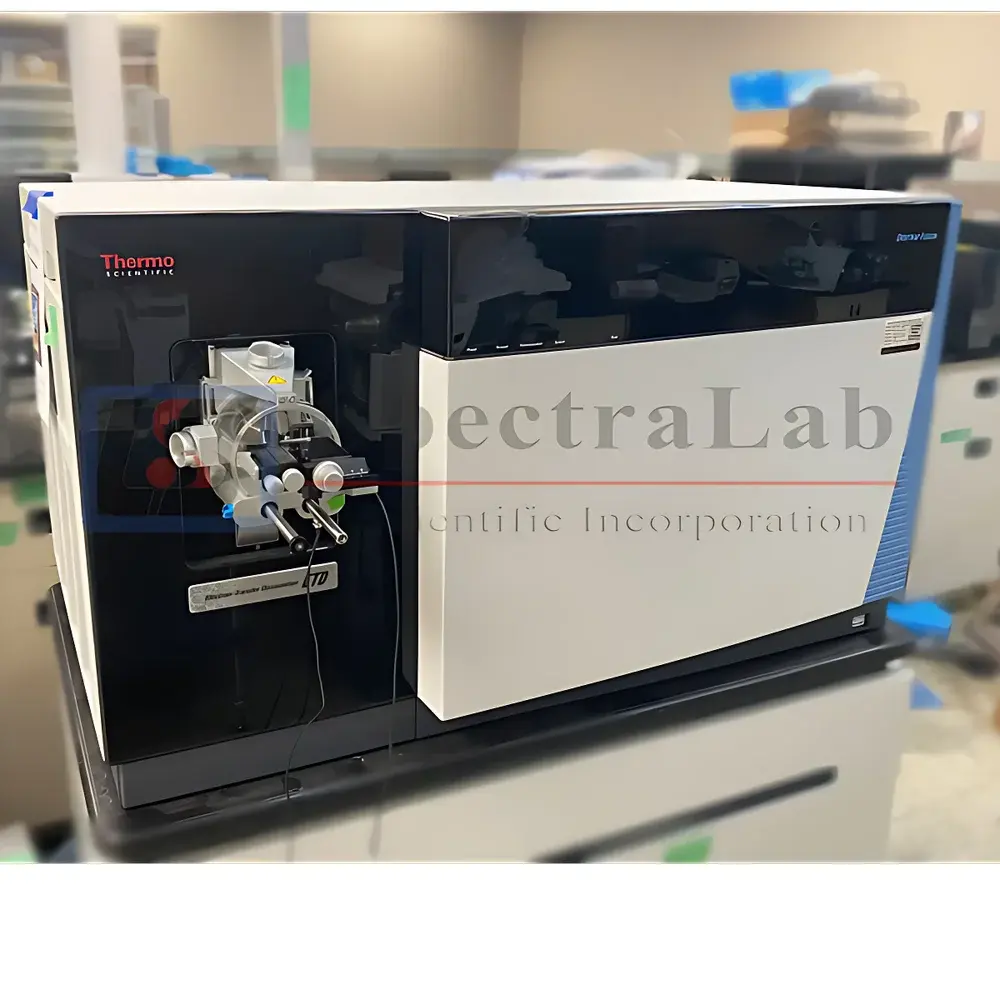
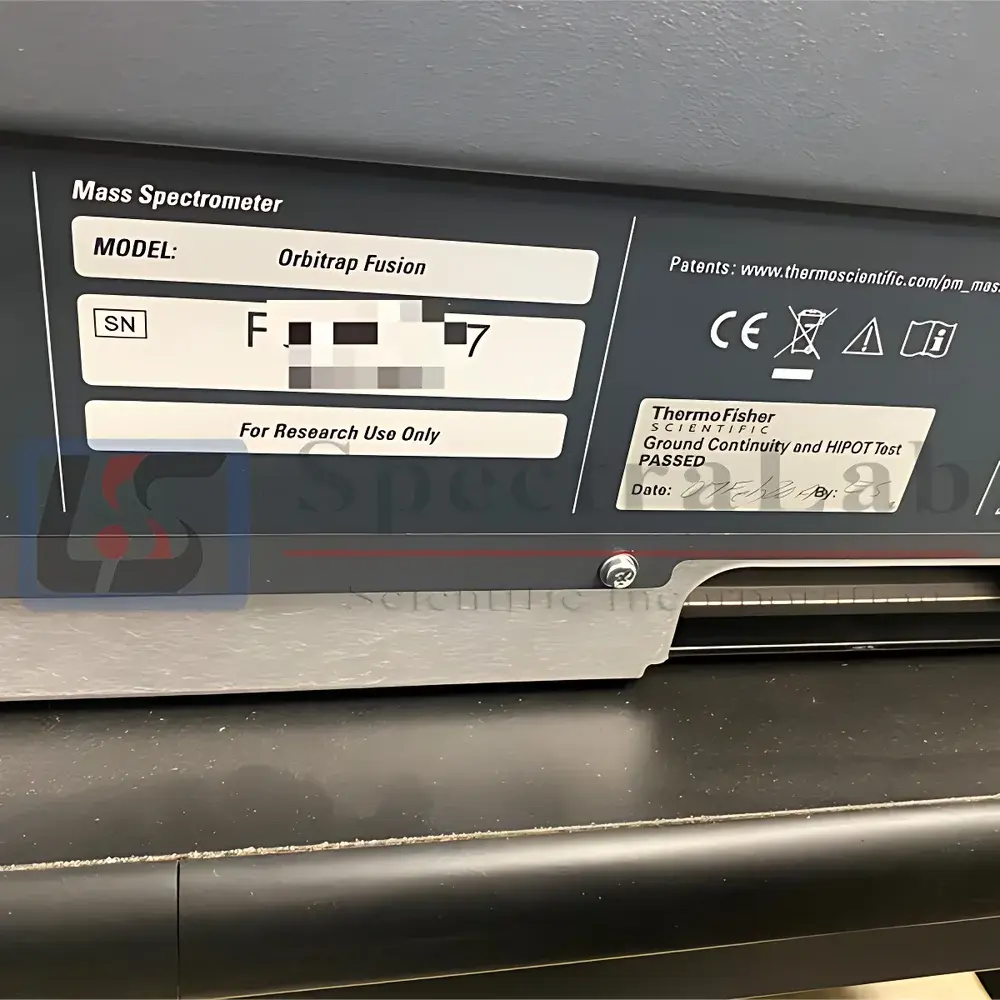
Thermo Scientific Orbitrap Fusion Tribrid Mass Spectrometer
| Brand | Thermo Fisher |
|---|---|
| Origin | Canada |
| Manufacturer Type | Authorized Distributor |
| Origin Category | Imported |
| Model | Orbitrap Fusion |
| Instrument Type | Orbitrap-based Hybrid Mass Spectrometer |
| Application Scope | Universal |
| Mass Range | 100–6000 m/z |
| Sensitivity | S/N ≥ 100:1 (50 fg/µL reserpine) |
| Resolution | Up to 500,000 (at m/z 200, FWHM) |
Overview
The Thermo Scientific Orbitrap Fusion Tribrid Mass Spectrometer is a high-performance hybrid mass spectrometer engineered for next-generation proteomics, metabolomics, and structural biology applications. It integrates three complementary mass analyzers—quadrupole, linear ion trap (LTQ), and ultra-high-field Orbitrap—in a single platform, enabling simultaneous or sequential operation across multiple fragmentation modes (CID, HCD, and optional ETD) and detection modalities (high-resolution accurate-mass, fast MS/MS, and real-time spectral interrogation). Its core architecture leverages the fundamental physics of the Orbitrap mass analyzer: a spindle-shaped electrostatic field trap in which ions orbit a central electrode while undergoing axial harmonic oscillation; the frequency of this oscillation is inversely proportional to the square root of m/z, enabling Fourier-transform-based mass measurement with exceptional mass accuracy (< 3 ppm RMS) and intrinsic stability. Unlike detector-dependent systems, the Orbitrap functions as both mass analyzer and transducer—eliminating signal decay mechanisms associated with electron multipliers and ensuring long-term reproducibility without consumable replacement.
Key Features
- Ultra-High-Field Orbitrap Analyzer: Delivers up to 500,000 resolution at m/z 200 (FWHM), enabled by optimized electrode geometry, elevated trapping voltages, and advanced ion optics—including a newly designed C-trap and integrated ion transfer multipoles that maximize transmission efficiency into the Orbitrap.
- Dual-Pressure Linear Ion Trap: Comprises separate high-pressure (for efficient ion capture, cooling, and CID fragmentation) and low-pressure (for rapid scanning and improved resolution) compartments, enabling concurrent high-sensitivity MS/MS acquisition and high-fidelity precursor isolation.
- Intelligent Easy-Source Platform: The Easy Max NG ion source integrates heated electrospray (HESI) and atmospheric pressure chemical ionization (APCI) capabilities within a single mechanical interface; source switching requires only nozzle exchange, with automatic gas/electrical coupling and firmware-based source recognition.
- S-Lens Ion Optics & Curved Quadrupole Ion Guide: Replaces conventional tube lenses with an S-lens assembly offering >3× higher ion transmission efficiency; the curved quadrupole ion guide physically separates neutral species from charged ions, significantly reducing chemical noise and enhancing signal-to-noise ratio.
- Flexible Fragmentation Architecture: Supports collision-induced dissociation (CID) in the ion trap, higher-energy collisional dissociation (HCD) in the ion transfer multipole, and optional electron-transfer dissociation (ETD) via a dedicated reaction cell—enabling comprehensive sequence coverage, PTM retention, and top-down analysis.
Sample Compatibility & Compliance
The Orbitrap Fusion accommodates a broad range of sample introduction methods—including nanospray, microflow, and standard-flow LC interfaces—and is fully compatible with reversed-phase, HILIC, and ion-pairing chromatographic separations. It meets essential regulatory requirements for GLP/GMP environments through native support for 21 CFR Part 11-compliant audit trails, electronic signatures, and secure data archiving when operated with Xcalibur Software v4.3 or later. All instrument control, method execution, and raw data acquisition comply with ISO/IEC 17025:2017 principles for testing laboratories and align with ASTM E2606-20 (Standard Guide for Mass Spectrometry Data Acquisition and Processing) and USP (Analytical Instrument Qualification).
Software & Data Management
Controlled exclusively via Thermo Scientific Xcalibur (Fusion Edition), the system provides unified method development, real-time data acquisition, and post-acquisition processing—including peak detection, deconvolution, database searching (via Proteome Discoverer integration), and label-free or isobaric tag quantitation. Raw data files (.raw) are stored in vendor-neutral, metadata-rich format compliant with mzML 1.1.0 specifications. Full traceability is maintained through embedded acquisition logs, hardware configuration snapshots, and user-action timestamps—all accessible via the built-in Audit Trail Viewer. Optional Thermo Scientific Compound Discoverer and LipidSearch software modules extend functionality for untargeted small-molecule profiling and lipidomics workflows.
Applications
The Orbitrap Fusion excels in high-complexity biological analyses where depth, speed, and confidence intersect. In discovery proteomics, it enables deep coverage of human whole-cell lysates (>10,000 proteins per run) using data-dependent acquisition (DDA) or data-independent acquisition (DIA) strategies. For post-translational modification (PTM) mapping—including phosphorylation, glycosylation, and ubiquitination—ETD compatibility preserves labile modifications during fragmentation. In top-down proteomics, intact protein analysis benefits from high mass accuracy (4 orders), and seamless integration with native MS workflows. Additionally, its robust small-molecule performance supports quantitative bioanalysis (e.g., pharmacokinetic studies), environmental contaminant screening, and synthetic chemistry verification—leveraging its wide linear dynamic range (up to 5 decades) and sub-attomole sensitivity.
FAQ
What distinguishes the Orbitrap Fusion from earlier Orbitrap platforms like the Q Exactive?
The Fusion incorporates a tribrid architecture—quadrupole + dual-pressure ion trap + ultra-high-field Orbitrap—whereas the Q Exactive is a quadrupole-Orbitrap benchtop system lacking a dedicated ion trap for rapid MS/MS and ETD capability.
Is ETD available as a factory-installed option or field-upgradable?
ETD is offered as a factory-configured option; retrofitting requires hardware integration of the ETD reaction cell, electron source, and fluoranthene vapor delivery module, performed under Thermo Fisher service certification.
Does the system support scheduled or triggered DIA (SWATH-like) acquisition?
Yes—Xcalibur Fusion Edition natively supports targeted and untargeted DIA methods with variable isolation windows, dynamic exclusion, and real-time spectral library matching.
What vacuum system configuration is standard?
The system employs a dual-stage turbomolecular pumping system (typically two 300 L/s pumps) backed by a dry scroll pump, achieving base pressures <5 × 10⁻¹⁰ mbar in the Orbitrap chamber.
Can the instrument be integrated with third-party liquid chromatography systems?
Yes—standard analog/digital I/O ports and Thermo’s Open Access API enable bidirectional communication with Agilent, Waters, Shimadzu, and other LC platforms supporting TTL-triggered acquisition and gradient synchronization.
Related Products





