
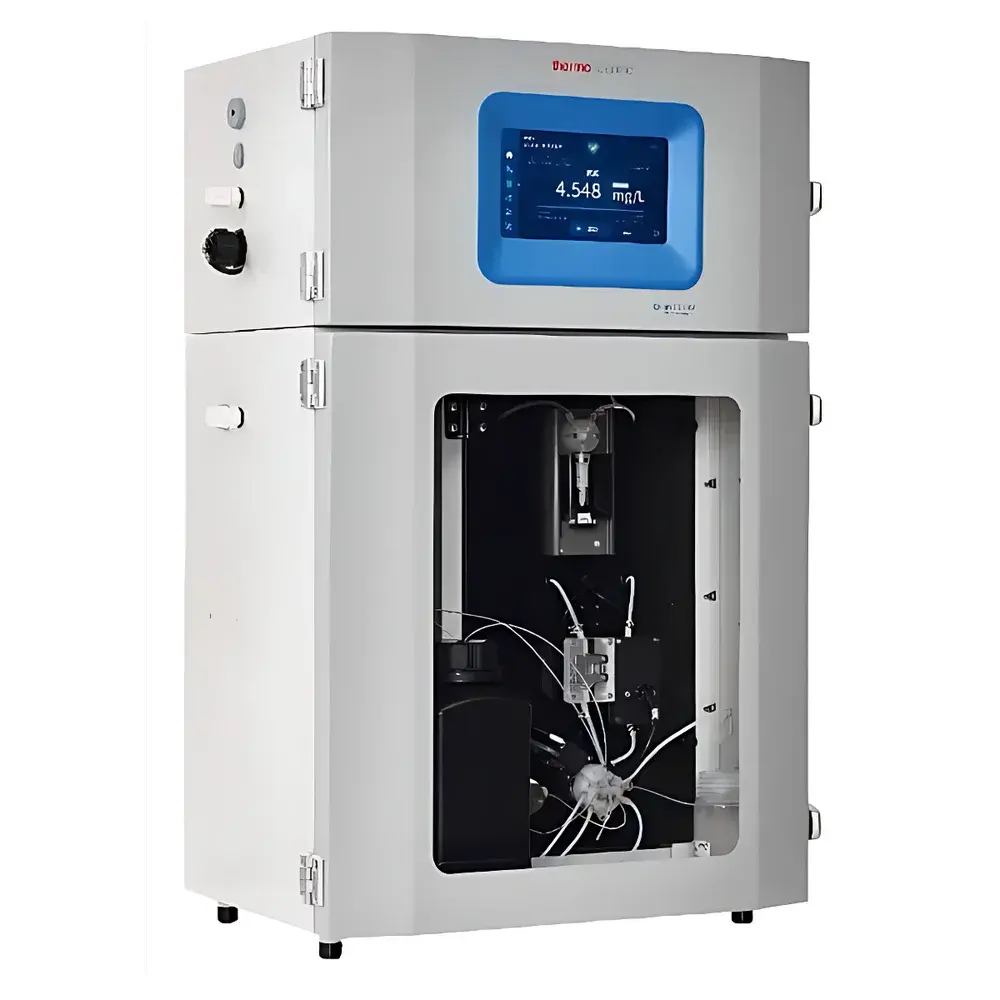
Thermo Scientific Orion 8010cX Online Ammonia Nitrogen Analyzer
| Brand | Thermo Fisher |
|---|---|
| Origin | Shanghai, China |
| Model | Orion 8010cX |
| Instrument Type | Online Analyzer |
| Measurement Principle | Salicylate Spectrophotometry |
| Measurement Ranges | (0.02–2) mg/L |
| Accuracy | ±3% of reading ±0.04 mg/L (0.02–2 mg/L) |
| Detection Limit | 0.02 mg/L |
| Analysis Time | ≤30 min |
| Resolution | 0.001 mg/L (<100 mg/L) |
| Operating Temperature | 5–40 °C |
| Relative Humidity | ≤95% RH (non-condensing) |
| Sample Flow Rate | 50–1000 mL/min |
| Sample Pressure | 1–5 bar |
| Sample Temperature | 5–50 °C |
| Sample pH | 4–9 |
| Max. Turbidity (NTU) | <30 |
| Max. Color (Pt-Co) | <180 |
| Enclosure Rating | IP65 |
| Dimensions (W×H×D) | 450 × 737 × 322 mm |
| Weight | 40 kg |
| Power Supply | 100–240 VAC, 100 W, 50/60 Hz |
| Analog Outputs | Two 4–20 mA (max. 900 Ω load) |
| Digital Interface | RS485 |
| Relay Outputs | Two dry contacts (2 A @ 250 VAC) |
| Regulatory Compliance | cTUVus, CB, CE-LVD, RCM, FCC, CE-EMC, CE-RoHS, REACH, China RoHS |
Overview
The Thermo Scientific™ Orion™ 8010cX Online Ammonia Nitrogen Analyzer is an industrial-grade, fully automated photometric analyzer engineered for continuous, unattended measurement of ammonia nitrogen (NH₃-N) in aqueous matrices using the standardized salicylate spectrophotometric method (aligned with ISO 11732, EPA 350.1, and HJ 536–2009). Unlike hazardous Nessler-based or ion-selective electrode (ISE) approaches, this method eliminates the use of mercury- or cyanide-containing reagents, ensuring operator safety, regulatory compliance, and long-term method traceability to national reference standards. The instrument employs dual-beam optical detection with temperature-stabilized LED light sources and high-precision photodiodes to minimize drift and enhance signal-to-noise ratio—critical for low-concentration measurements in complex wastewater streams. Its robust architecture supports deployment across diverse environmental monitoring contexts, including effluent discharge points, municipal wastewater treatment plant (WWTP) influent/effluent zones, raw water intakes, drinking water distribution systems, and industrial process streams where real-time NH₃-N feedback is essential for biological nitrification/denitrification control.
Key Features
- Multi-range auto-switching capability across five calibrated ranges (0.02–2 mg/L to 30–500 mg/L), enabling seamless transition between ultra-trace and high-concentration applications without manual intervention
- Integrated self-cleaning flow path and automatic calibration sequence—including zero, span, and blank compensation—reducing maintenance frequency and minimizing downtime
- Advanced interference mitigation algorithms specifically optimized for color and turbidity compensation, validated against samples with Pt-Co color up to 180 and turbidity ≤30 NTU
- IP65-rated enclosure with modular internal architecture, supporting field-replaceable fluidic cartridges, optical modules, and reagent reservoirs to extend service intervals and simplify lifecycle management
- Low reagent consumption design (≤1.2 mL per analysis cycle) and minimal chemical waste generation (≤2.5 L/month at 15-min cycle), contributing to reduced operational cost and environmental footprint
- Intuitive graphical user interface (GUI) with multilingual support, real-time trend visualization, and configurable alarm thresholds aligned with local discharge limits (e.g., China’s GB 18918–2002, EU Urban Wastewater Directive 91/271/EEC)
Sample Compatibility & Compliance
The Orion 8010cX is validated for use with representative water samples meeting defined physicochemical constraints: pH 4–9, TDS <170 mg/L, TSS <30 mg/L, and color <180 Pt-Co units. For samples exceeding these specifications—particularly in primary clarifier effluents or industrial cooling waters—integrated or external pre-filtration (e.g., 50 µm stainless-steel mesh filter) and pH stabilization may be required prior to analysis. All measurement protocols adhere to Good Laboratory Practice (GLP) principles, with full audit trail logging of calibration events, maintenance logs, and analytical results. Data integrity is reinforced via time-stamped event records and non-volatile memory storage compliant with FDA 21 CFR Part 11 requirements when paired with Thermo Fisher’s optional LIMS-integrated software platform. Electrical and electromagnetic compatibility conforms to IEC 61000-4 series standards, while material declarations satisfy REACH, RoHS, and China RoHS directives.
Software & Data Management
Embedded firmware supports both continuous and programmable interval-based sampling (1–240 minute cycles), with configurable start times and hold periods. Raw absorbance data, calculated concentrations, diagnostic flags (e.g., low signal, air bubble detection, reagent depletion), and system health metrics are stored locally for ≥90 days. Remote access is enabled via RS485 Modbus RTU protocol, allowing integration into SCADA, DCS, or cloud-based environmental monitoring platforms. Two isolated 4–20 mA analog outputs provide real-time transmission of primary concentration values and secondary diagnostics (e.g., temperature or pressure status). Optional Ethernet/Wi-Fi connectivity enables over-the-air firmware updates and secure TLS-encrypted data export to centralized dashboards. All configuration changes and calibration actions generate immutable digital signatures, satisfying GLP/GMP documentation requirements for regulated utilities and pharmaceutical manufacturing sites.
Applications
- Municipal wastewater: Real-time monitoring at plant inlet, bioreactor zones, and final effluent to optimize aeration energy use and verify nitrification efficiency
- Surface water surveillance: Early-warning detection in reservoirs and rivers upstream of drinking water intakes, supporting adaptive response to agricultural runoff events
- Drinking water treatment: Verification of chloramination stability and residual NH₃-N levels post-disinfection to prevent THM formation and maintain regulatory compliance
- Industrial process control: Closed-loop feedback for ammonia scrubbers in semiconductor fabs, fertilizer production lines, and food processing facilities requiring strict nitrogen balance accounting
- Regulatory reporting: Automated generation of certified data packages for submission to provincial environmental protection bureaus (e.g., MEP Order No. 80) or EU E-PRTR reporting portals
FAQ
What sample pretreatment is required for accurate operation?
For samples with TSS >30 mg/L or color >180 Pt-Co, a 50 µm inline filter and optional pH adjustment to 6.5–8.5 are recommended to ensure consistent reaction kinetics and optical clarity.
How does the analyzer handle air bubbles or particulate interference in the flow cell?
The system incorporates dual optical path validation and real-time bubble detection logic; if air is detected, the analyzer pauses analysis, initiates purge cycles, and resumes only after optical baseline stability is reconfirmed.
Is remote calibration verification supported?
Yes—via Modbus commands, users can trigger remote zero/span checks and download full calibration reports with uncertainty budgets traceable to NIST-certified standards.
What is the expected service life of critical components such as the photometer and peristaltic pump?
Under typical operating conditions (25 °C, 15-min cycle), the LED light source maintains >95% intensity for ≥5 years, and the precision peristaltic pump head achieves >12,000 hours MTBF with scheduled roller replacement every 18 months.
Can the instrument operate in outdoor enclosures without climate control?
While rated for 5–40 °C ambient operation, prolonged exposure to direct sunlight or sub-zero temperatures requires supplemental thermal management (e.g., heated cabinet with thermostatic fan control) to maintain internal stability and prevent condensation-related drift.
Related Products







