
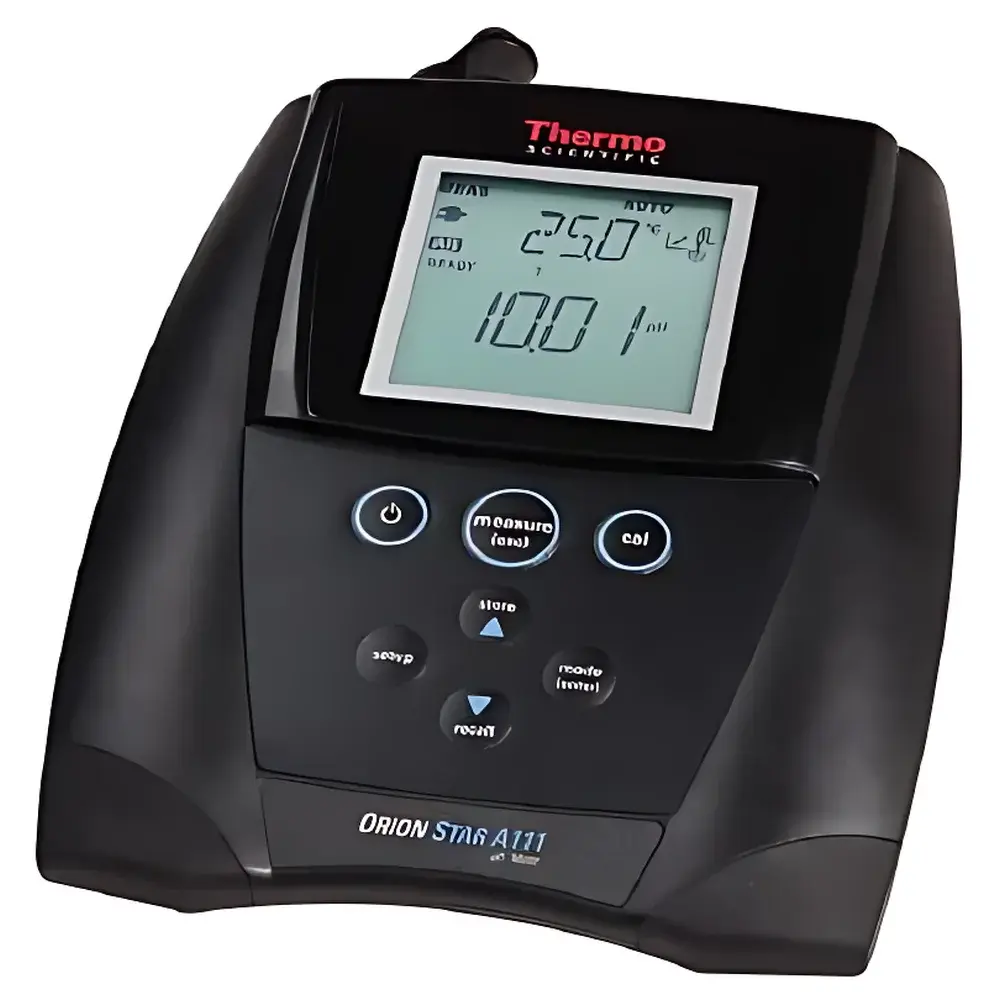
Thermo Scientific Orion Star A Benchtop/Portable Basic pH Meter
| Origin | Singapore |
|---|---|
| Manufacturer Type | Authorized Distributor |
| Origin Category | Imported |
| Model | A111 (Benchtop), A121 (Portable) |
| Instrument Type | Benchtop & Portable |
| Parameter Type | Single-Parameter (pH/mV/Temp) |
| pH Accuracy | ±0.01 |
| pH Range | –2.00 to 16.00 |
| pH Resolution | 0.1 / 0.01 |
| mV Range | ±1600.0 mV (mV), ±1999.9 mV (RmV) |
| mV Resolution | 0.1 |
| mV Accuracy | ±0.1 mV |
| Temperature Range | –5 to 105 °C |
| Temp Resolution | 0.1 °C |
| Temp Accuracy | ±0.1 °C |
| Calibration Points | Up to 3-point pH |
| Buffer Recognition | USA, NIST, DIN |
| Data Storage | 50 entries (manual/auto) |
| Input Interfaces | BNC (pH electrode), 8-pin mini-DIN (ATC probe) |
| Power | 4 × AA alkaline batteries or universal 100–240 V AC adapter |
| IP Rating | IP54 (A111), IP67 (A121) |
Overview
The Thermo Scientific™ Orion™ Star A Benchtop/Portable Basic pH Meter (Models A111 and A121) is a rigorously engineered electrochemical instrument designed for reliable, traceable pH and redox potential (mV/RmV) measurements in diverse laboratory, field, and quality control environments. Built upon proven potentiometric measurement principles—where the potential difference between a pH-sensitive glass electrode and a stable reference electrode is converted into a logarithmic pH value—the Star A series delivers high reproducibility and long-term stability under routine operational conditions. Its dual form factor supports both fixed-location benchtop workflows and ruggedized field deployment without compromising core metrological integrity. The instrument complies with fundamental requirements of ISO/IEC 17025 for calibration traceability and supports GLP-compliant documentation through on-device data logging and structured calibration history.
Key Features
- Large backlit LCD display showing real-time pH or mV values alongside simultaneous temperature reading, battery status, electrode health indicators, and calibration status icons—enhancing operator situational awareness and reducing misreading risk.
- AUTO-READ™ functionality automatically detects signal stability and locks the reading with visual confirmation, minimizing subjective judgment in endpoint determination.
- Intelligent buffer recognition algorithm auto-detects and applies correction factors for USA, NIST, and DIN standard pH buffer sets—reducing setup time and mitigating calibration errors due to manual selection.
- On-device calibration verification: users can review slope (%), offset (mV), and asymmetry potential for each calibration point—enabling immediate assessment of electrode performance and drift trends.
- Dual power architecture: operates continuously via included universal AC adapter (100–240 V) or four standard AA alkaline batteries—ensuring uninterrupted operation during extended field campaigns or facility-wide power fluctuations.
- Ingress protection rated at IP54 (A111 benchtop unit) and IP67 (A121 portable unit), permitting safe use in humid laboratories, cleanrooms, or outdoor sampling sites where dust and transient water exposure are present.
Sample Compatibility & Compliance
The Star A series interfaces exclusively with industry-standard BNC-compatible pH electrodes and optional 8-pin mini-DIN ATC (Automatic Temperature Compensation) probes—ensuring compatibility with Thermo Scientific Orion ROSS™, Triode™, and other third-party electrodes meeting IEC 60746-1 specifications. All pH measurements adhere to ASTM E70 and ISO 3696 Grade 3 water purity requirements for buffer preparation. Calibration procedures follow USP and EP 2.2.3 guidelines for pharmaceutical applications. While not inherently 21 CFR Part 11 compliant as a standalone device, audit-ready calibration logs—including date/time stamps, buffer IDs, slope/offset values, and user-defined notes—are exportable via manual transcription for inclusion in validated QC records.
Software & Data Management
Data management is performed locally via internal non-volatile memory storing up to 50 measurement entries—each tagged with timestamp, mode (pH/mV/RmV), temperature, and operator-defined sample ID (via alphanumeric keypad input). Recording modes include manual trigger and timed auto-capture (interval configurable per user protocol). Users may perform last-entry deletion or full memory reset—supporting data lifecycle control aligned with ISO 15197:2013 retention expectations. No proprietary software or USB connectivity is required; however, exported records may be integrated into LIMS or ELN platforms via manual entry or CSV-formatted reports generated using companion Thermo Fisher Connect™ tools (optional add-on).
Applications
- Academic teaching labs: Introducing foundational electrochemical concepts including Nernst equation derivation, electrode conditioning, and buffer standardization protocols.
- Environmental monitoring: Field-based pH profiling of surface water, wastewater effluents, and soil leachates per EPA Method 150.1 and APHA Standard Methods 4500-H+.
- Food & beverage QA/QC: Monitoring acidity in dairy products, juices, and fermented goods in accordance with AOAC 973.41 and ISO 2918.
- Pharmaceutical manufacturing: In-process testing of aqueous formulations, cleaning validation rinse samples, and stability study buffers under cGMP Annex 11-aligned practices.
- Industrial process support: Routine verification of boiler feedwater, cooling tower chemistry, and plating bath pH—complementing online analyzers with periodic spot-check validation.
FAQ
Does the Star A series support GLP-compliant calibration documentation?
Yes—each calibration event stores date/time, buffer IDs, measured mV values, calculated slope (%), and offset (mV), accessible directly on the instrument screen for review and manual transcription into lab notebooks.
Can I use non-Thermo pH electrodes with the A111/A121?
Yes, provided they feature standard BNC connectors and meet IEC 60746-1 output impedance and voltage range specifications (typically ≤ 1 GΩ input impedance, ±1999.9 mV range).
Is temperature compensation mandatory for accurate pH readings?
While manual temperature entry is supported, automatic compensation using the optional ATC probe is strongly recommended—especially when measuring samples outside 20–25 °C—to correct for the temperature-dependent Nernst slope deviation.
What is the expected electrode lifetime under typical usage?
With proper storage (in 3 M KCl solution), regular cleaning (e.g., protein removal with pepsin/HCl for biological samples), and avoidance of extreme pH (13) or dehydrating solvents, glass pH electrodes typically maintain ±0.02 pH accuracy for 12–18 months.
How does the AUTO-READ™ function improve measurement repeatability?
By eliminating operator-dependent timing decisions, AUTO-READ™ reduces inter-user variability and ensures consistent stabilization criteria—particularly beneficial in multi-analyst environments or training scenarios where technique standardization is critical.





