
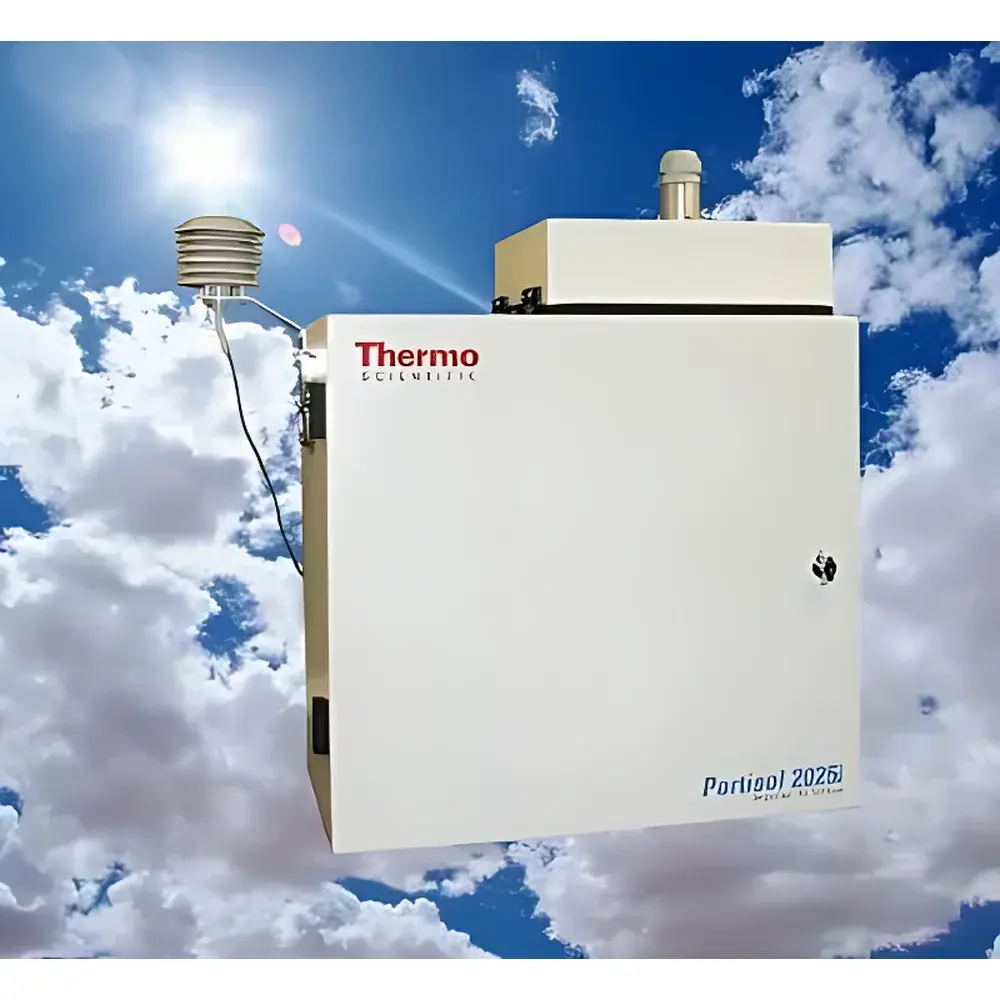
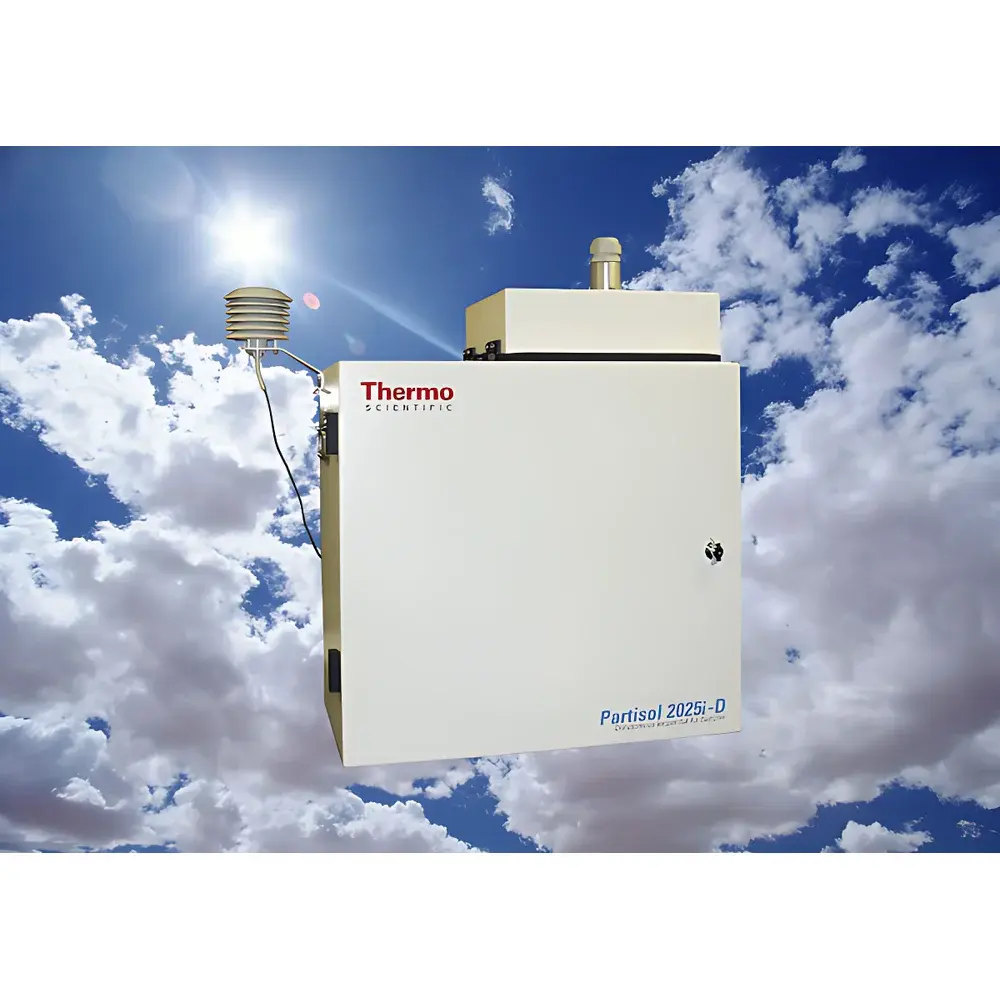
Thermo Scientific Partisol 2025i and 2025i-D Continuous Particulate Matter Samplers
| Brand | Thermo Fisher |
|---|---|
| Origin | USA |
| Manufacturer Type | Original Equipment Manufacturer (OEM) |
| Product Origin | Imported |
| Models | Partisol 2025i, Partisol 2025i-D |
| Flow Control | Activol Mass Flow Controller |
| Volume Flow Range | 1.67–15 L/min |
| Flow Accuracy | ±2% of setpoint |
| Operating Temperature | −40 °C to +50 °C |
| Power Requirement | 1.5 A @ 240 VAC |
| Data Storage | 86 days at 5-minute intervals + 32 filter records |
| Compliance | U.S. EPA Reference Methods RFPS-0498-118 (PM₂.₅), RFPS-1298-127 (PM₁₀), RFPS-0509-176 (Coarse PM) |
| Safety Certification | CE / EN 61326 |
Overview
The Thermo Scientific Partisol 2025i and 2025i-D Continuous Particulate Matter Samplers are U.S. Environmental Protection Agency (EPA)-certified reference and equivalent method instruments engineered for regulatory-grade ambient air monitoring of PM₂.₅, PM₁₀, and coarse particulate matter (PM₁₀–PM₂.₅). Designed for unattended, long-term deployment in national monitoring networks—including the U.S. EPA’s nationwide PM₂.₅ Monitoring Network—the 2025i series implements gravimetric sampling based on federal regulatory protocols. The system draws ambient air through standardized 47 mm filter media (e.g., Teflon® 2 µm pore, Pallflex TX-40, or quartz fiber) using a precision mass flow controller (Activol™), ensuring volumetric accuracy traceable to NIST standards. Sampling is conducted under controlled isokinetic conditions compliant with EPA Method IO-3.1 and ISO 7708 for inhalable particle size fractionation. The 2025i operates as a single-channel sampler; the 2025i-D integrates a virtual impactor to simultaneously collect fine and coarse fractions onto two independent 47 mm filters—enabling concurrent PM₂.₅ and coarse PM measurement per EPA Equivalent Method requirements.
Key Features
- U.S. EPA reference method certification for PM₂.₅ (RFPS-0498-118), PM₁₀ (RFPS-1298-127), and coarse PM (RFPS-0509-176); equivalent method certification for dual-fraction sampling (EQPS-0509-179, EQPS-0509-180, EQPS-0311-198)
- Modular architecture with field-replaceable pump assemblies, standardized electronics, and tool-free access to critical components—reducing scheduled maintenance downtime
- Automated 16-position filter magazine enabling up to 14 consecutive days of unattended operation with programmable daily filter changes (e.g., midnight-to-midnight cycles)
- Activol™ mass flow control system delivering stable volumetric flow across variable backpressure conditions (1.67 L/min for coarse channel; 15 L/min for fine channel on 2025i-D; 10–19 L/min on 2025i), with real-time flow display and ±2% accuracy
- i-Series platform featuring enhanced Ethernet connectivity, flash-based data storage (86 days at 5-min resolution), iPort™ communications software, and a high-contrast graphical user interface with tactile keypad
Sample Compatibility & Compliance
The Partisol 2025i and 2025i-D accept standard 47 mm diameter filter substrates validated for regulatory use: polytetrafluoroethylene (PTFE) membrane filters (2 µm pore size) for PM₂.₅ and PM₁₀ reference methods; Pallflex TX-40 and quartz fiber filters for PM₁₀ and coarse PM applications. Filter holders comply with EPA design specifications for uniform face velocity, minimal edge loading, and reproducible deposition geometry. All sampling configurations meet U.S. Code of Federal Regulations Title 40, Part 53 performance criteria for reference and equivalent methods. Instrument firmware and data handling protocols support audit-ready documentation aligned with GLP principles. Electrical safety conforms to CE marking per EN 61326-1:2013 (EMC) and EN 61010-1:2010 (safety), suitable for outdoor cabinet or sheltered installation.
Software & Data Management
Data acquisition, configuration, and diagnostics are managed via the embedded i-Series operating environment. Internal memory stores time-stamped flow, temperature, pressure, and status logs at user-configurable intervals (default 5 minutes), retaining up to 86 days of continuous telemetry plus metadata for 32 filter events. Raw data export is supported via USB 2.0 port (high-speed download) and RS-232 serial interface. iPort™ software enables remote instrument interrogation, firmware updates, and automated data retrieval over TCP/IP networks—facilitating integration into centralized environmental data management systems (EDMS). Audit trails include operator login timestamps, parameter change logs, and calibration event records—supporting compliance with 21 CFR Part 11 where electronic records are subject to regulatory review.
Applications
These samplers serve as primary instrumentation in national and regional air quality monitoring programs, including the U.S. EPA Air Quality System (AQS), European EEA AirBase, and WHO Global Urban Ambient Air Pollution Database initiatives. They are routinely deployed at urban background, traffic, industrial fence-line, and rural supersite locations for trend analysis, source apportionment modeling, and regulatory reporting. The 2025i-D’s dual-channel capability supports receptor modeling studies requiring simultaneous fine/coarse mass concentration ratios—critical for identifying crustal, sea salt, and combustion-derived aerosol contributions. Field validation studies confirm compatibility with subsequent laboratory analyses including XRF, IC, TO-13A, and gravimetric mass determination per EPA Methods IO-1, IO-2, and IO-3.1.
FAQ
What regulatory methods does the Partisol 2025i support?
It is certified by the U.S. EPA as a reference method for PM₂.₅ (RFPS-0498-118), PM₁₀ (RFPS-1298-127), and coarse PM (RFPS-0509-176).
How does the 2025i-D achieve simultaneous fine and coarse PM collection?
It uses a virtual impactor to aerodynamically separate particles at ~2.5 µm aerodynamic diameter, directing PM₂.₅ and coarse PM (PM₁₀–PM₂.₅) to two independent 47 mm filter positions.
Is remote monitoring supported?
Yes—via integrated Ethernet and iPort™ software, enabling secure remote access for status checks, data pull, and configuration updates.
What filter types are required for EPA-compliant operation?
Teflon® 2 µm pore membranes for PM₂.₅/PM₁₀ reference methods; Pallflex TX-40 or quartz fiber filters for PM₁₀ and coarse PM sampling.
Can the instrument operate in extreme ambient temperatures?
Yes—fully specified for continuous operation from −40 °C to +50 °C, including condensation-resistant internal thermal management.
Related Products







