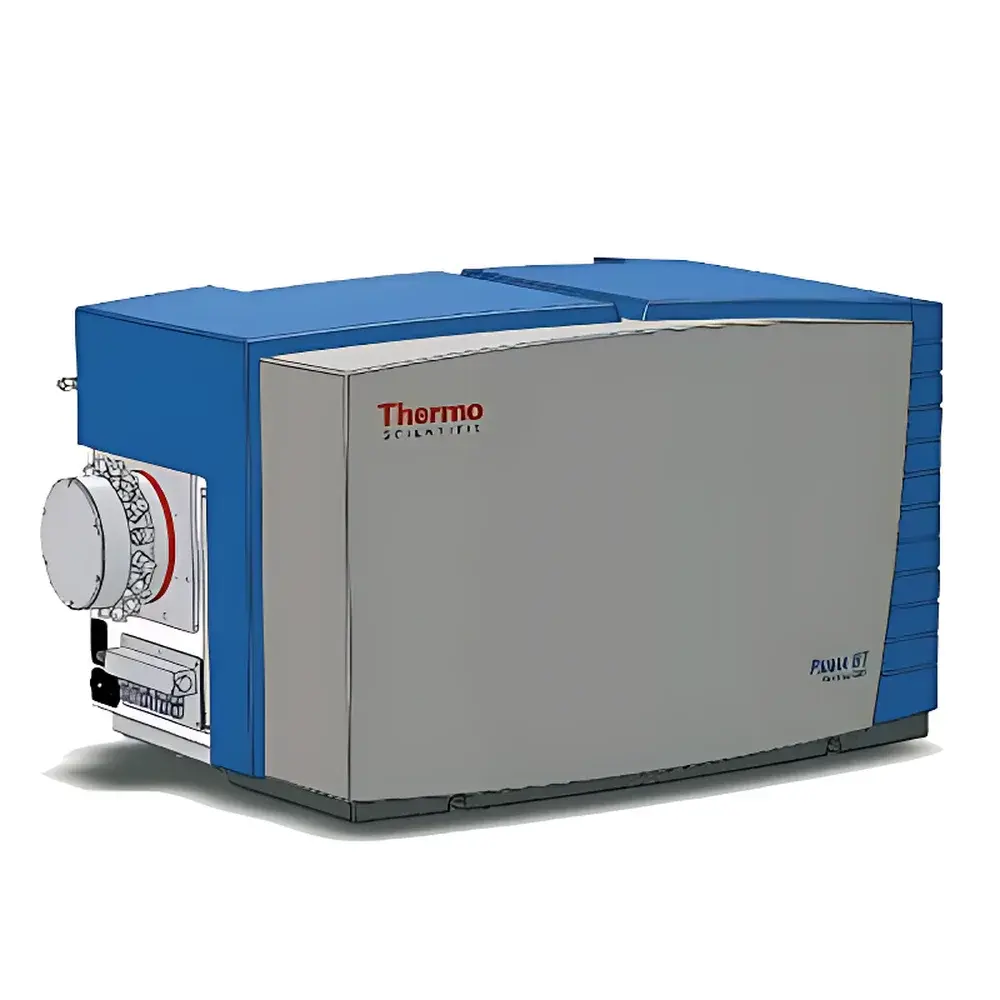
Thermo Scientific Prima BT Process Development Mass Spectrometer
| Brand | Thermo Fisher |
|---|---|
| Origin | USA |
| Manufacturer Type | Original Equipment Manufacturer (OEM) |
| Origin Category | Imported |
| Model | Thermo Scientific Prima BT |
| Pricing | Upon Request |
Overview
The Thermo Scientific Prima BT is a benchtop, high-performance magnetic sector mass spectrometer engineered for real-time, quantitative gas-phase analysis in process development laboratories and small-scale industrial environments. Unlike quadrupole or time-of-flight systems, the Prima BT employs a double-focusing, stacked-scan magnetic sector architecture—combining electrostatic and magnetic fields to achieve superior mass resolution, long-term mass stability, and exceptional signal-to-noise ratio. Its core measurement principle relies on electron ionization (EI) of neutral gas molecules in a controlled ion source, followed by velocity- and charge-dependent deflection in a 6 cm radius, 80° magnetic sector. Only ions with specific m/z ratios satisfying the Lorentz force equilibrium condition pass through adjustable collector slits and are quantified via Faraday cup detection. This physics-based separation mechanism ensures trace-level accuracy, minimal isotopic interferences, and compliance with fundamental metrological requirements for compositional gas analysis in bioprocess R&D.
Key Features
- Magnetic sector mass analyzer with 6 cm radius and 80° deflection angle—enabling high mass resolution (selectable slit combinations: 60/20, 140/81, 100/45, or 140/45) and <0.013 amu mass drift over 24 hours at m/z 28
- Dual-filament, temperature-controlled (120–200 °C ±0.1 °C), closed-ion-source design optimized for reproducible EI and reduced memory effects in polar compound analysis (e.g., NH₃, CH₃OH, C₂H₅OH)
- Integrated Rapid Multi-stream Sampler (RMS) supporting up to 15 independent sample streams; stepper-motor-driven, non-rotary, continuous-flow selector with >6 million switching cycles/year reliability and optional 80 °C heating for condensable species
- Modular vacuum system: turbomolecular pump + external rotary vane pump (or optional diaphragm pump); base pressure <1×10⁻⁷ mbar
- Fully distributed VGiNet control architecture based on RS-485, enabling hot-swap module replacement without full system power-down
- Dedicated Freescale-based controller running a hardened industrial RTOS—field-proven across >1 billion operational hours—with dual serial interfaces for simultaneous DCS/PLC integration (Modbus, OPC) and LIMS data export
Sample Compatibility & Compliance
The Prima BT accommodates gas samples across a dynamic concentration range from 10 ppb to 100% (v/v), with typical linearity error <1% relative and long-term stability <1% relative over one week. Its RMS inlet accepts sample pressures up to 100 mbar (1.5 psi) differential, with flow rates digitally monitored per stream at 0.1–1.0 L/min (standard: 0.2 L/min). The system complies with IEC 61000-6-2/6-4 for electromagnetic compatibility and meets mechanical safety standards per ISO 13849-1. While not certified for SIL-rated hazardous areas, its architecture supports integration into GxP-aligned workflows: audit-trail-capable configuration via GasWorks™ software, configurable digital I/O for alarm interlocks, and native support for 21 CFR Part 11-compliant electronic signatures when deployed with validated host systems. It is routinely applied in accordance with ASTM D7504 (trace gas analysis), ISO 14644-8 (cleanroom air monitoring), and USP (residual solvent quantification).
Software & Data Management
Control and data acquisition are managed via Thermo’s GasWorks™ platform—a Windows-based application offering method editor, real-time chromatogram-style display, multistream trending, and automated calibration routines. All raw spectral data, diagnostic logs, and configuration snapshots are stored locally in non-volatile memory for full lifecycle health monitoring—including predictive failure indicators derived from filament emission decay, vacuum gauge drift, and detector gain history. Historical data can be exported in CSV or XML formats compatible with LIMS, MES, or PAT frameworks. The embedded controller maintains autonomous operation during PC downtime; critical process data continues streaming via Modbus TCP or OPC UA to DCS/SCADA systems without interruption. Optional firmware updates are delivered via secure HTTPS and verified using SHA-256 checksums.
Applications
The Prima BT is extensively deployed in upstream and downstream bioprocess development: real-time monitoring of dissolved O₂ and CO₂ in stirred-tank bioreactors; headspace analysis of shake flasks and wave bags; off-gas profiling during fed-batch mammalian cell culture; verification of sterilizing-grade filter integrity via helium leak testing; and rapid method development for residual solvent clearance in purification steps. Its multi-stream capability enables parallel fermentation screening across 15 vessels while maintaining identical analytical conditions—critical for DOE studies and scale-down model validation. In academic and contract research settings, it serves as a reference-grade tool for kinetic modeling of gas-transfer-limited reactions and metabolic flux analysis via ¹³C-labeling experiments.
FAQ
What is the difference between Prima BT and Prima PRO?
The Prima BT shares identical magnetic sector hardware and core firmware with the Prima PRO but is optimized for controlled laboratory and small-plant environments (ambient temperature-stabilized, non-explosion-proof). The PRO variant includes enhanced environmental hardening, extended temperature range (-20 to +55 °C), and redundant power/communication paths for unattended 24/7 operation in harsh industrial settings.
Can the Prima BT detect sub-ppm concentrations?
Yes—when equipped with the optional microchannel plate (MCP) detector, detection limits reach low-ppb levels for selected analytes, subject to matrix interference and dwell time optimization.
Is the RMS compatible with corrosive or condensable gases?
The heated RMS (up to 80 °C) minimizes adsorption and condensation of polar species; however, aggressive halogenated or sulfur-containing compounds require inert passivation of internal surfaces and may necessitate custom inlet filtration.
How often does preventive maintenance require intervention?
With the optional Service Kit (“Toolbox”), scheduled maintenance intervals extend to 3 years for internal components; only the external roughing pump requires periodic oil changes or membrane replacement, typically every 6–12 months depending on duty cycle and gas composition.
Does the system support 21 CFR Part 11 compliance?
The Prima BT itself is not pre-validated for Part 11, but its architecture—including electronic signature-ready GasWorks™, audit-trail logging, and role-based access control—provides the technical foundation for customer-led validation under GMP/GLP quality systems.
Related Products