
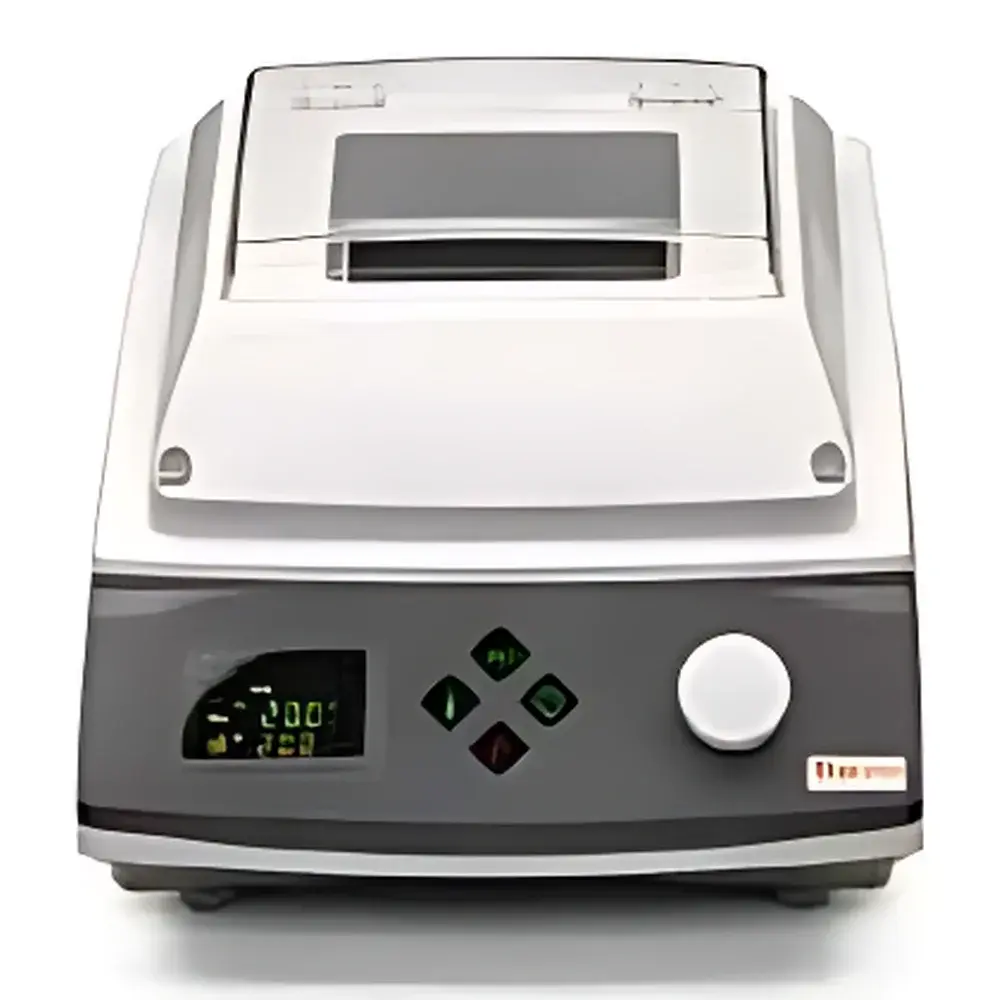
Thermo Scientific Refrigerated/Heating Dry Block Incubator
| Brand | Thermo Fisher Scientific |
|---|---|
| Origin | South Korea |
| Manufacturer Type | Original Equipment Manufacturer (OEM) |
| Product Category | Imported Instrument |
| Model | Thermo Scientific Refrigerated/Heating Dry Block Incubator |
| Price Range | USD 1,400 – 2,800 (based on current exchange rate and configuration) |
| Instrument Type | Programmable Dry Bath Incubator (Non-shaking) |
| Timer Range | 1 min – 99 hrs 59 min / Continuous Operation |
| Temperature Range | 4 °C to 95 °C |
| Temperature Uniformity at 37 °C | ±0.55 °C |
| Programmable Protocols | 10 user-defined programs, up to 10 steps per program |
| Timing Modes | Start-on-reach & Start-on-set |
| Heating Block Compatibility | Interchangeable modular blocks (e.g., part #88880030) |
| Display | Digital LED with real-time temperature readout |
| Control System | PID feedback algorithm |
| Internal Dimensions (W×D×H) | 99 × 77.5 × 36 mm |
| External Dimensions (W×D×H) | 276 × 334 × 165 mm |
| Weight | 5 kg |
| Power Supply | 230 V, 50/60 Hz |
| Certifications | CE compliant |
Overview
The Thermo Scientific Refrigerated/Heating Dry Block Incubator is a precision-engineered thermal management platform designed for consistent, programmable temperature control of samples in microtubes, PCR strips, vials, and other small-volume containers. Unlike traditional water baths or shaking incubators, this dry block system employs solid-state Peltier-based thermoelectric modules for bidirectional thermal regulation—enabling both active cooling down to 4 °C and heating up to 95 °C without refrigerants or external chillers. Its compact footprint and modular block architecture support high-density sample processing while minimizing benchtop space requirements. The device operates on a closed-loop PID control algorithm, ensuring stable thermal equilibrium and minimal overshoot during ramping phases. This makes it especially suitable for applications requiring strict thermal fidelity—including enzyme reactions, DNA denaturation/annealing, cell lysis optimization, and reagent pre-warming or storage stabilization.
Key Features
- Peltier-driven dual-mode thermal control: precise cooling and heating within a single unit, eliminating dependency on external cold sources.
- Digital PID temperature regulation with real-time feedback, delivering ±0.55 °C uniformity at 37 °C across the block surface.
- Two independent timer modes: “Start-on-Set” for immediate countdown initiation, and “Start-on-Reach” for accurate process timing only after target temperature stabilization.
- 10 programmable protocols, each supporting up to 10 sequential steps with individual temperature setpoints, dwell times, and ramp rates.
- Modular interchangeable heating blocks (e.g., Thermo Scientific part #88880030), compatible with common tube formats including 0.2 mL, 0.5 mL, 1.5 mL, and 2.0 mL microcentrifuge tubes.
- CE-certified design compliant with IEC 61010-1 safety standards for laboratory electrical equipment.
- Compact form factor (276 × 334 × 165 mm) and lightweight construction (5 kg) facilitate integration into biosafety cabinets, cold rooms, or multi-instrument workstations.
Sample Compatibility & Compliance
The incubator accommodates standard laboratory consumables via removable aluminum heating blocks engineered for optimal thermal conductivity and mechanical durability. Each block is anodized for corrosion resistance and calibrated for uniform heat transfer across all wells. While not a shaker or orbital mixer, its static thermal platform meets ISO/IEC 17025 requirements for calibration traceability when used in accredited QC/QA workflows. It supports GLP-compliant documentation practices through manual protocol logging; though not natively 21 CFR Part 11–enabled, audit trails can be maintained externally via LIMS integration or lab notebook entries. The device is routinely deployed in environments adhering to USP , CLSI EP23-A, and ASTM E2995 standards for thermal stability validation in pharmaceutical and clinical diagnostics labs.
Software & Data Management
This model operates via an embedded microcontroller with intuitive front-panel navigation and digital LED interface—no PC connectivity or proprietary software required. All parameters (setpoint, timer, program selection) are configured directly on-device using tactile buttons and visual confirmation. For laboratories requiring electronic record retention, temperature logs may be captured manually at defined intervals or synchronized with external data loggers via analog output (optional accessory). Firmware updates are not field-serviceable; however, Thermo Fisher provides factory-level recalibration and verification services under extended service contracts.
Applications
- Enzymatic reaction incubation (e.g., restriction digests, ligations, phosphorylations)
- PCR setup and pre-thermal cycling reagent equilibration
- Controlled denaturation studies of proteins and nucleic acids
- Long-term sample holding at sub-ambient temperatures (e.g., RNA preservation at 4 °C)
- Calibration reference for thermal sensors and thermocouples
- Quality control testing of temperature-sensitive reagents and kits
- Cell culture reagent warming prior to addition (e.g., trypsin, media supplements)
FAQ
Does this unit provide shaking or mixing functionality?
No. This is a static dry block incubator—designed exclusively for precise temperature control without agitation. For combined thermal and orbital motion, consider Thermo Scientific’s series of refrigerated/heating shakers (e.g., MaxQ series).
Can the heating block be autoclaved?
No. Aluminum blocks are not autoclavable due to thermal expansion mismatch and potential damage to internal thermistors. Cleaning is recommended with 70% ethanol and lint-free wipes.
Is remote monitoring or network connectivity available?
Not natively. The device lacks Ethernet, USB, or Bluetooth interfaces. Integration with building management systems or SCADA platforms requires third-party analog signal converters.
What is the typical warm-up and cool-down time from ambient to 37 °C and 4 °C respectively?
Approximately 12 minutes to reach 37 °C from 25 °C ambient; approximately 28 minutes to achieve 4 °C from same starting point—dependent on block mass and ambient conditions.
Are custom block configurations available?
Yes. Thermo Fisher offers OEM block design services for non-standard tube geometries or high-throughput plate formats under NRE agreements. Standard catalog blocks ship with validated thermal profiles and calibration certificates.




