

Thermo Scientific SCR-CEMS Dilution-Based Continuous Emission Monitoring System for De-NOx Applications
| Brand | Thermo Scientific |
|---|---|
| Model | SCR-CEMS |
| Origin | USA |
| Manufacturer | Thermo Fisher Scientific |
| Instrument Type | Flue Gas Continuous Emission Monitoring System (CEMS) |
| Measurement Parameters | NH₃, NO, NO₂, NOₓ, O₂ |
| Dilution Ratio | Fixed 100:1 (adjustable via calibrated sonic orifice) |
| Dilution Air Supply Requirement | 0.6 MPa, ≥20 L/min |
| Sample Flow Rate | 50–300 mL/min (typ. 50 mL/min) |
| NH₃ Conversion Furnace | Integrated within probe head |
| Probe Material | Hastelloy C-276 / Inconel 625 (corrosion-resistant high-temp alloy) |
| Compliance | EPA Performance Specification 15 (PS-15), EN 15267-3, ISO 14956, US EPA Method 7E, ASTM D6522 |
| Software | Thermo Scientific™ CEMS Pro v5.x with 21 CFR Part 11-compliant audit trail and GLP/GMP data integrity features |
| Data Output | 4–20 mA analog, Modbus TCP/IP, OPC UA, FTP/SCP |
Overview
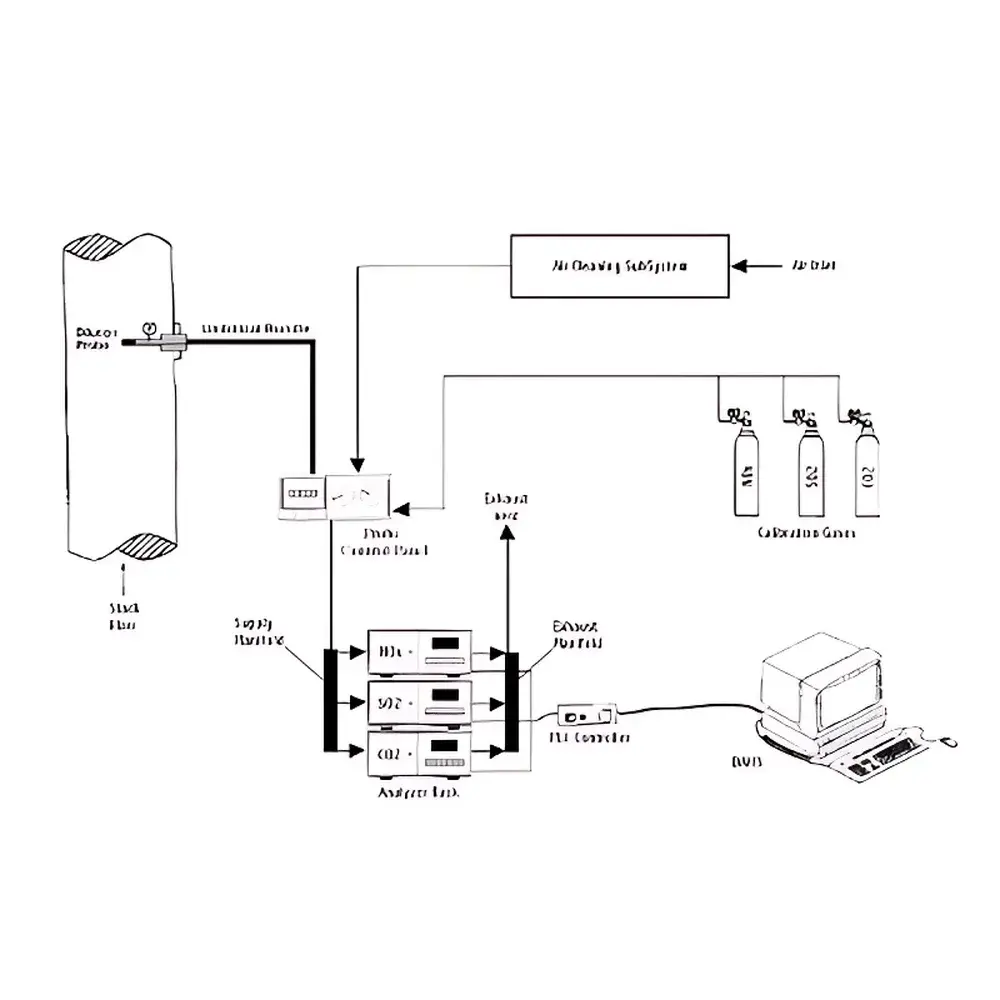
The Thermo Scientific SCR-CEMS is a purpose-engineered dilution-type Continuous Emission Monitoring System designed specifically for post-selective catalytic reduction (SCR) flue gas streams in coal-fired, biomass, and waste-to-energy power plants. It operates on the principle of controlled isokinetic dilution sampling—where hot, humid, high-dust flue gas is drawn through a heated, corrosion-resistant probe and mixed with precisely metered, ultra-pure instrument air at a fixed sonic-orifice-defined ratio (typically 100:1). This thermodynamically stable dilution process lowers the dew point of the sample stream, prevents ammonium salt formation (e.g., NH₄HSO₄, NH₄NO₃), eliminates condensation-induced corrosion, and minimizes analyte adsorption or chemical transformation—particularly critical for accurate NH₃ and NOₓ speciation in ammonia-slip monitoring applications.
Key Features
- Dual-stage heated probe assembly with integrated NH₃ catalytic converter (operating at >850 °C) located directly within the probe tip—reducing NH₃ transport distance to <5 cm and eliminating wall adsorption, aqueous dissolution, and low-temperature ammonium salt precipitation.
- Sonic orifice + venturi ejector architecture ensures constant dilution ratio independent of flue gas pressure (±15 kPa) and temperature fluctuations (up to 200 °C), validated per EPA PS-15 Annex B requirements.
- Corrosion-hardened probe materials: Hastelloy C-276 wetted surfaces and Inconel 625 structural components engineered for long-term exposure to acidic, oxidizing, and NH₃-rich environments.
- Low-flow sampling design (50 mL/min typical) reduces filter loading by >95% versus extractive systems, extending ceramic filter service life to ≥6 months under high-dust conditions (>10 g/Nm³).
- Multi-analyte capability: Simultaneous quantification of NH₃ (0–10 ppm), NO (0–100 ppm), NO₂ (0–50 ppm), NOₓ (sum), and O₂ (0–25%) using UV-Vis spectroscopy (NO/NO₂), tunable diode laser absorption spectroscopy (NH₃), and paramagnetic detection (O₂).
- Full-system calibration traceability: EPA-approved system calibration protocol—standard gases introduced at the probe inlet, undergoing identical dilution and transport as process gas—ensuring measurement uncertainty <±2% FS for NH₃ and <±1.5% FS for NOₓ at 95% confidence.
Sample Compatibility & Compliance
The SCR-CEMS is validated for operation in flue gas streams characterized by temperatures up to 200 °C, relative humidity up to 15%, particulate loadings exceeding 10 g/Nm³, and NH₃ slip concentrations ranging from 0.5 to 10 ppm. Its design meets stringent regulatory frameworks including U.S. EPA PS-15 for NOₓ and NH₃ CEMS, European Standard EN 15267-3 for QAL1 certification, ISO 14956 for ambient air quality monitoring equivalence, and ASTM D6522 for nitrogen oxide analysis in combustion exhaust. All firmware, data logging, and calibration records comply with FDA 21 CFR Part 11 requirements for electronic records and signatures—including role-based access control, immutable audit trails, and automated backup retention for ≥15 years.
Software & Data Management
CEMS Pro v5.x provides real-time visualization, automated QA/QC reporting, and regulatory compliance dashboards aligned with EU IED BREFs and U.S. Title V permit reporting cycles. The software supports dual-mode operation: standalone local HMI with touchscreen interface or networked deployment via redundant Gigabit Ethernet. All raw spectral data, dilution ratio logs, probe temperature profiles, and calibration event metadata are stored in encrypted SQLite databases with SHA-256 hashing. Export modules generate EPA Form 7, EN 14181 QA reports, and XML-based data packages compliant with national emission registries (e.g., U.S. EPA CAMD, Germany’s IUK, China’s MEP Platform). Remote diagnostics and firmware updates are performed over TLS 1.3-secured connections with certificate-based authentication.
Applications
- Ammonia slip monitoring at SCR reactor outlet for catalyst performance optimization and urea injection control.
- Regulatory NOₓ mass emission rate calculation per EPA Method 19 and EN 14181.
- Stack testing support for NSPS Subpart UU and MATS compliance verification.
- Long-term trend analysis of de-NOx efficiency under variable load, fuel blend, and catalyst aging conditions.
- Integration with DCS/SCADA systems for closed-loop combustion optimization and predictive maintenance alerts.
FAQ
Why is dilution sampling preferred over extractive sampling for SCR applications?
Dilution sampling mitigates NH₃ loss via adsorption, prevents ammonium bisulfate deposition in sample lines, eliminates condensation-related corrosion, and maintains stoichiometric integrity of NOₓ species—critical where sub-ppm NH₃ accuracy is required.
What maintenance intervals are recommended for the probe filter and NH₃ converter?
Ceramic probe filters require replacement every 6–12 months depending on dust loading; the integrated NH₃ converter is rated for ≥18 months continuous operation at 850 °C and does not require routine replacement.
Can the system be retrofitted into existing CEMS shelters?
Yes—the SCR-CEMS modular architecture supports integration with legacy sample conditioning systems and third-party analyzers via analog or digital I/O, with minimal footprint (19″ rack-mount chassis, 8U height).
How is calibration traceability maintained across the full measurement chain?
Certified NIST-traceable span gases are delivered to the probe inlet via dedicated calibration manifold; all dilution, transport, and analysis steps replicate process conditions—enabling system-level uncertainty quantification per ISO/IEC 17025.
Does the system support remote validation and audit readiness?
Yes—CEMS Pro includes automated daily zero/span checks, quarterly system calibration reports, and on-demand generation of full audit packages including raw spectra, configuration logs, and electronic signatures—all exportable in PDF/A-2b format for regulatory submission.







