
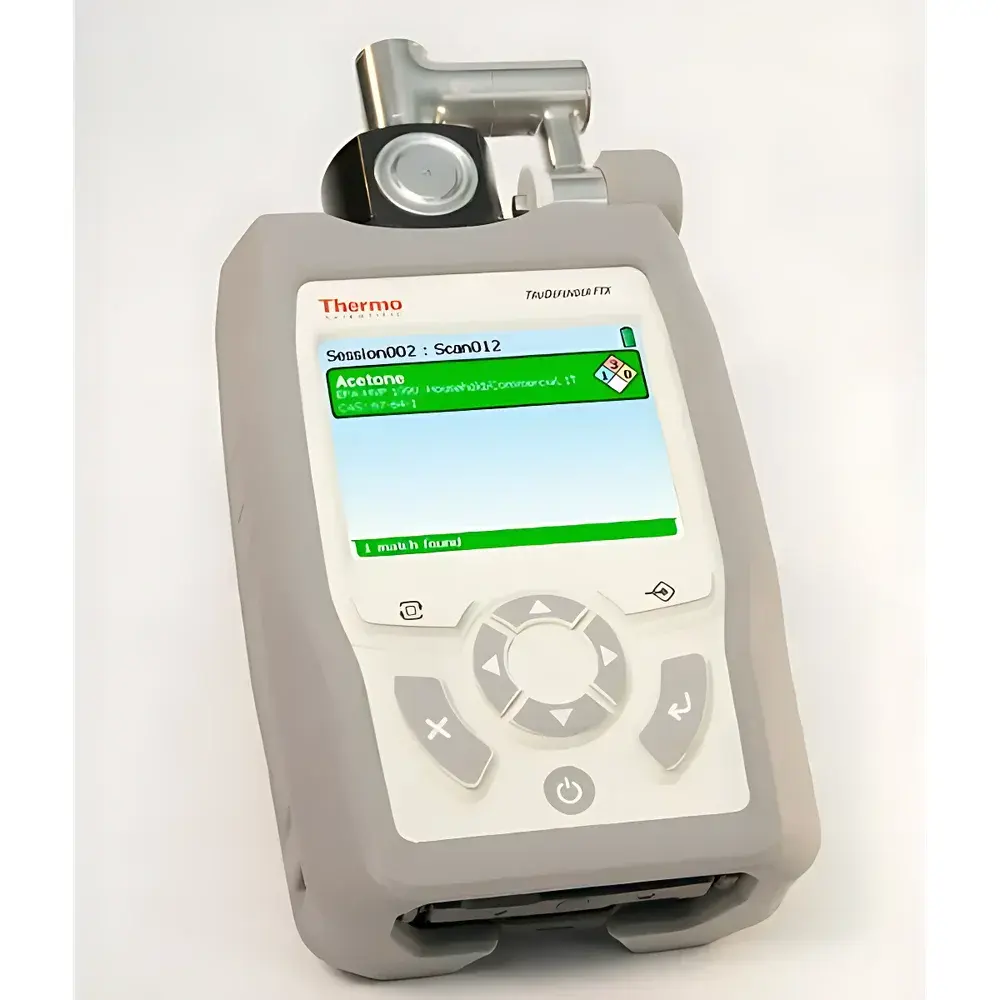
Thermo Scientific TruDefender FTX Handheld Fourier Transform Infrared (FTIR) Spectrometer
| Brand | Thermo Fisher |
|---|---|
| Origin | Shanghai, China |
| Manufacturer Type | Authorized Distributor |
| Regional Classification | Domestic (China-manufactured) |
| Model | TruDefender FTX |
| Instrument Type | Handheld |
| Instrument Principle | Fourier Transform Infrared Spectroscopy |
| Spectral Range | 4000–650 cm⁻¹ |
| Optical Interface | Diamond Crystal ATR |
| IP Rating | IP67 |
| Operating Temperature | −20 °C to +40 °C |
| Dimensions (L×W×H) | 22.61 × 11.42 × 5.33 cm |
| Weight | 1.41 kg |
| Battery | Removable & rechargeable Li-ion or dual 123A (e.g., SureFire) |
| Compliance | MIL-STD-810G tested, IP67 certified |
| Languages | English, Chinese, German, Russian (selectable) |
Overview
The Thermo Scientific™ TruDefender™ FTX is a ruggedized, handheld Fourier Transform Infrared (FTIR) spectrometer engineered for rapid, field-deployable chemical identification in high-stakes environments. Unlike benchtop FTIR systems relying on transmission or reflection geometries, the TruDefender FTX employs a robust, single-bounce Attenuated Total Reflectance (ATR) sampling interface with a diamond crystal element—optimized for direct, non-destructive contact analysis of solids, liquids, gels, and pastes. Its core optical architecture leverages Michelson interferometry with a thermally stabilized infrared source and high-sensitivity DTGS detector, delivering spectral resolution sufficient for library-matched identification of organic compounds, polymers, explosives precursors, toxic industrial chemicals (TICs), and chemical warfare agent simulants. Designed explicitly for first responders, hazardous materials (HAZMAT) teams, and military CBRNE units, the instrument operates without external power, purge gas, or laboratory infrastructure—enabling real-time decision-making under ambient environmental conditions ranging from −20 °C to +40 °C.
Key Features
- Rugged ATR Sampling Head: Integrated anvil-style sampling interface with precision-machined diamond crystal; enables consistent pressure control via adjustable knob for reproducible contact across heterogeneous or low-density samples.
- Contamination-Resistant Design: Highly polished, seamless stainless-steel housing with rounded edges and no crevices—minimizing residue retention of explosive particulates or viscous contaminants; includes liquid containment groove to prevent sample overflow during liquid analysis.
- Field-Optimized Ergonomics: Compact form factor (22.6 × 11.4 × 5.3 cm), balanced weight distribution (1.41 kg), and intuitive tactile controls allow extended operation with gloved hands in PPE-constrained scenarios.
- Multi-Language Interface: Graphical user interface supporting English, Chinese, German, and Russian—configurable per operational theater requirements without firmware reload.
- MIL-STD-810G & IP67 Certification: Validated for shock, vibration, thermal cycling, and dust/water immersion (up to 1 m for 30 min), ensuring operational integrity in urban search-and-rescue, border inspection, or battlefield reconnaissance settings.
Sample Compatibility & Compliance
The TruDefender FTX supports direct analysis of unprepared solid powders (e.g., ammonium nitrate, RDX), neat liquids (e.g., acetone, sulfuric acid), semi-solids (e.g., adhesives, lubricants), and surface residues. Optional reversible accessories—including volatile liquid containment caps and micro-particle sampling adapters—extend capability to thermally labile or airborne analytes. All spectral acquisitions comply with ASTM E1421–22 (“Standard Guide for Describing and Measuring Performance of Fourier Transform Infrared (FT-IR) Spectrometers”) and support traceability per ISO/IEC 17025:2017 requirements when integrated into accredited laboratory workflows. While not FDA 21 CFR Part 11–compliant out-of-the-box (as a standalone field device), raw interferogram data export enables downstream audit-ready processing in validated software environments.
Software & Data Management
Embedded firmware includes Thermo’s proprietary ChemVision™ spectral matching engine, preloaded with curated libraries covering >12,000 reference spectra—including NATO-standard explosive signatures, DHS Chemical Threat Library v3.2, and EPA Toxic Substances Control Act (TSCA) compounds. Spectra are stored with full metadata (GPS coordinates, operator ID, timestamp, ambient temperature/humidity if logged externally). Data export occurs via USB 2.0 or Bluetooth 4.2 to secure enterprise servers; CSV and JCAMP-DX formats ensure interoperability with LIMS platforms and third-party chemometric tools (e.g., MATLAB, Unscrambler). Firmware updates are delivered via signed package files to maintain cryptographic integrity and prevent unauthorized modification.
Applications
- Rapid screening of suspicious white powders at public venues or mail facilities
- In-field verification of decontamination efficacy following TIC exposure
- Identification of unknown residues on improvised explosive devices (IEDs) or vehicle-borne threats
- Quality assurance checks of incoming raw materials in pharmaceutical or fine chemical manufacturing (when deployed at loading docks)
- Forensic triage of seized substances prior to laboratory confirmation
- Environmental monitoring of soil or wipe samples for persistent organic pollutants (POPs)
FAQ
Is the TruDefender FTX suitable for quantitative analysis?
No—it is optimized for qualitative identification and presence/absence screening. Quantitative accuracy requires calibration against matrix-matched standards and is outside its design scope.
Can it analyze gases?
Not directly; the ATR interface requires physical contact. Volatile vapors may be captured indirectly using optional sorbent-based trapping accessories followed by thermal desorption onto the ATR crystal.
Does it require routine helium purging?
No—its sealed optical path and thermally stable interferometer eliminate the need for purge gas, unlike many benchtop FTIR systems.
How is spectral library maintenance handled?
Libraries are updated annually via secure firmware patches; custom libraries may be imported via encrypted USB drive under administrator authentication.
Is remote diagnostics supported?
Yes—Bluetooth-enabled telemetry transmits real-time instrument health metrics (battery voltage, detector signal-to-noise ratio, interferogram stability) to centralized command dashboards.




