
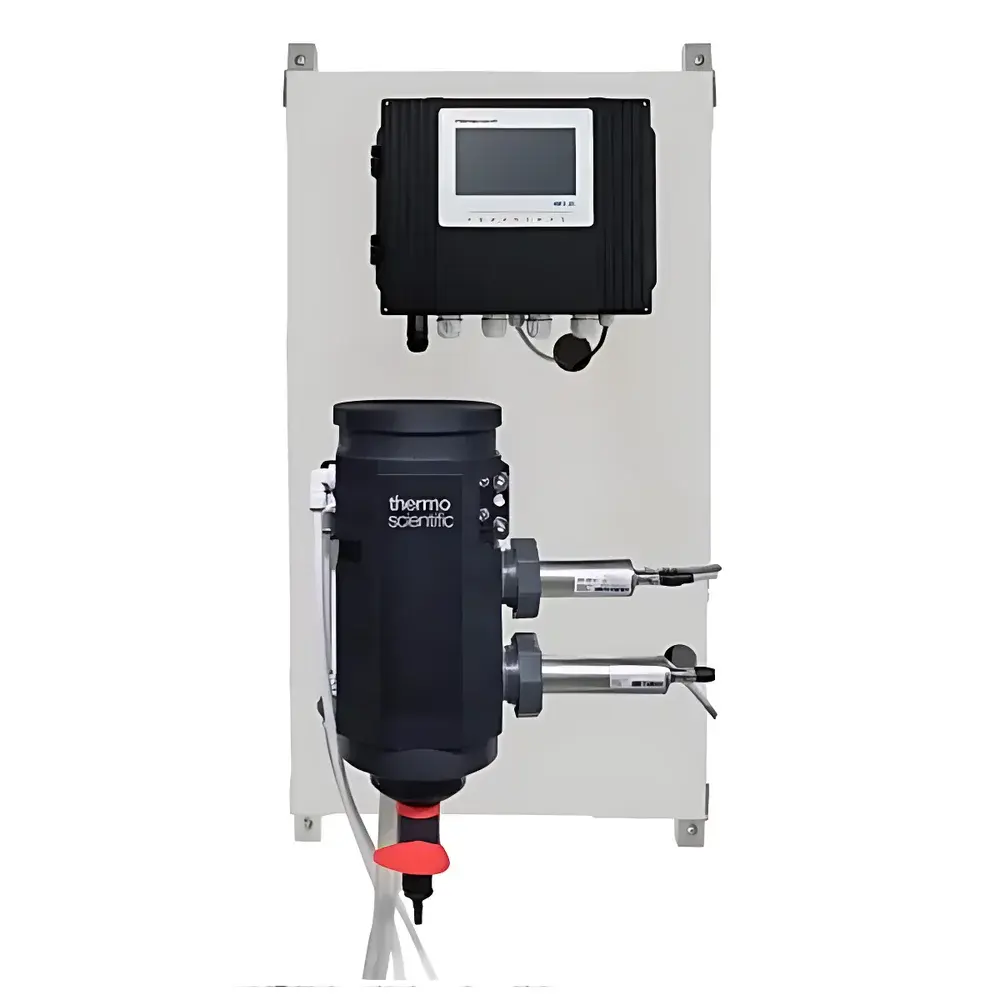
Thermo Scientific™ TSTIO1000 Online Integrated pH, Residual Chlorine, and Turbidity Analyzer
| Brand | Thermo Fisher |
|---|---|
| Origin | Shanghai, China |
| Manufacturer Type | Authorized Distributor |
| Product Origin | Domestic (China) |
| Model | Thermo Scientific™ TSTIO1000 |
| Instrument Type | Online Analyzer |
| Measurement Principle | Electrochemical Sensing (pH & residual chlorine), 90° Nephelometric Light Scattering (turbidity) |
| Measured Parameters | pH, Residual Chlorine, Turbidity, Temperature |
| Range | 0.01–20 ppm (residual chlorine) |
| Accuracy | ±0.01 ppm or ±2% of full scale (residual chlorine) |
| Repeatability | ≤2% RSD |
| Resolution | 0.01 ppm (residual chlorine) |
| Detection Limit | 0.01 ppm (residual chlorine) |
Overview
The Thermo Scientific™ TSTIO1000 Online Integrated pH, Residual Chlorine, and Turbidity Analyzer is an engineered solution for continuous, real-time water quality monitoring in non-industrial municipal and agricultural environments. Designed specifically for drinking water distribution systems, potable water treatment plants, reservoir outfalls, and irrigation networks, the system integrates three critical parameters—pH, free residual chlorine, and turbidity—into a single, compact online platform. Its measurement architecture combines electrochemical sensing (for pH and residual chlorine) with standardized 90° nephelometric light scattering (per USEPA Method 180.1) for turbidity quantification. The analyzer operates under constant-pressure and constant-flow conditions to ensure hydrodynamic stability across variable inlet pressures—a key requirement for reliable long-term deployment in aging infrastructure or low-pressure field sites. All sensors are housed within a dual-probe flow cell engineered to minimize bubble entrapment, sediment accumulation, and flow-induced signal drift.
Key Features
- Tri-parameter electrochemical probe: Simultaneously outputs residual chlorine, pH, and temperature from a single, membrane-free sensor element—eliminating electrolyte refills, replacement membranes, and associated calibration drift.
- Integrated temperature and pH compensation algorithms embedded directly in the chlorine measurement circuitry—reducing cross-sensitivity to thermal transients and pH shifts common in chlorinated surface water sources.
- Self-cleaning flat-surface electrode geometry optimized for manual or automated wipe-based maintenance—reducing fouling in high-sediment or organic-rich water matrices.
- Dual-probe flow cell with large buffer volume and pressure-dampening design—enabling stable operation under fluctuating hydraulic conditions (e.g., pump cycling, valve throttling, or intermittent flow).
- Backplate-mounted modular architecture—requiring only 180 mm × 220 mm footprint—facilitating retrofit installation into existing meter pits, kiosks, or wall-mounted enclosures without structural modification.
- Optional LTE/4G telemetry module supporting MQTT or HTTPS protocols—enabling secure, encrypted transmission of time-stamped sensor data to cloud-based SCADA or CMMS platforms compliant with ISO/IEC 27001 data handling frameworks.
Sample Compatibility & Compliance
The TSTIO1000 is validated for use with potable water, treated surface water, groundwater, and low-conductivity irrigation supply streams (conductivity < 1500 µS/cm). Turbidity measurements conform to USEPA Method 180.1 for nephelometric determination, with traceability to NIST-traceable formazin standards. Residual chlorine detection meets APHA Standard Methods 4500-Cl G (amperometric) and is compatible with regulatory reporting requirements under the U.S. Safe Drinking Water Act (SDWA) and EU Directive 98/83/EC. The system supports audit-ready data logging with timestamped events (e.g., calibration, cleaning, alarm triggers), satisfying GLP-aligned recordkeeping expectations for municipal utilities operating under ISO/IEC 17025-accredited QA programs.
Software & Data Management
Local configuration and diagnostics are performed via a web-based interface accessible through Ethernet or RS-485 Modbus RTU. All sensor outputs are logged at user-configurable intervals (1 s to 60 min) with onboard storage for ≥30 days of high-resolution data (1-second sampling). Data export supports CSV and PDF report generation with embedded metadata (sensor ID, calibration dates, firmware version). When equipped with the optional 4G module, the device implements TLS 1.2 encryption and certificate-pinned authentication for secure cloud ingestion. Audit trails—including operator login history, parameter changes, and calibration logs—are retained for ≥90 days and support FDA 21 CFR Part 11-compliant electronic signature workflows when deployed in regulated utility environments.
Applications
- Real-time compliance monitoring at finished water discharge points per local health department mandates.
- Early-warning detection of disinfectant decay or breakthrough events in distribution system dead-ends or storage tanks.
- Performance verification of inline UV or chlorine contact chambers during routine process validation studies.
- Turbidity anomaly detection correlated with rainfall-runoff events in watershed intake monitoring stations.
- Remote supervision of rural water cooperatives lacking on-site technical staff—leveraging predictive maintenance alerts based on sensor impedance trends and cleaning cycle history.
FAQ
Does the TSTIO1000 require daily maintenance or reagent addition?
No. The residual chlorine sensor operates without membranes, electrolyte gels, or consumable reagents. Routine maintenance consists of biweekly visual inspection and manual wipe-cleaning of the flat-surface electrodes.
Can the system be calibrated remotely?
Yes—pH and turbidity calibrations can be initiated and verified via the web interface; residual chlorine zero/span calibration requires physical introduction of certified standard solutions at the flow cell inlet.
Is the turbidity measurement affected by colored dissolved organic matter (CDOM)?
The 90° scattering geometry minimizes interference from absorbance-dominated color; however, for waters with high CDOM and low particle load (e.g., peat-stained streams), supplemental particle-counting validation is recommended.
What cybersecurity protocols does the 4G telemetry module support?
TLS 1.2 encryption, X.509 certificate pinning, and configurable firewall rules for inbound port restriction—aligned with NIST SP 800-82 guidelines for OT network segmentation.
How is temperature compensation applied to residual chlorine readings?
A dual-variable algorithm dynamically adjusts the amperometric current response using real-time pH and temperature inputs from the integrated tri-parameter probe—reducing combined uncertainty to ≤±1.5% of reading across 5–30 °C.
Related Products







