
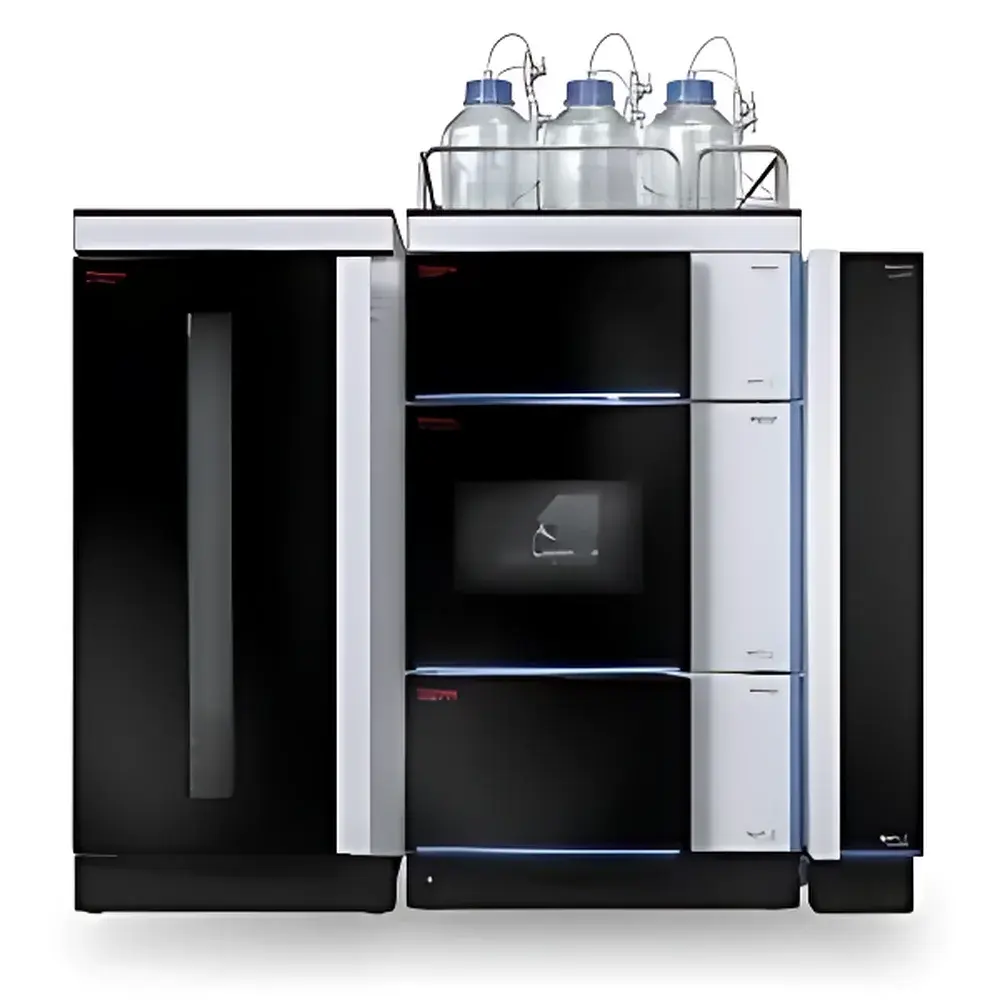
Thermo Scientific Vanquish™ UHPLC System
| Brand | Thermo Scientific |
|---|---|
| Origin | Germany |
| Manufacturer Type | Manufacturer |
| Origin Category | Imported |
| Model | Vanquish |
| Instrument Type | Ultra-High Performance Liquid Chromatograph |
| Flow Rate Range | 0.001–5.000 mL/min |
| Maximum Pressure | 150 MPa |
| Sample Tray Capacity | 8832 positions |
| Injection Volume Range | 0.01–100 µL |
| Column Oven Temperature Range | 5–120 °C |
| Data Acquisition Rate | 200 Hz |
Overview
The Thermo Scientific Vanquish™ UHPLC System represents a rigorously engineered platform for ultra-high performance liquid chromatography, built upon core principles of binary high-pressure gradient delivery, low-dispersion fluidic architecture, and thermally stabilized separation environments. Operating at pressures up to 150 MPa (22,000 psi), the system enables the use of sub-2-µm particle-packed columns with exceptional resolution, peak capacity, and analysis speed—critical for demanding applications in pharmaceutical development, biopharmaceutical characterization, clinical research, and environmental trace analysis. Its integrated design merges the mechanical robustness of a monolithic instrument with the configurability of a modular architecture, supporting seamless coupling to mass spectrometry (e.g., Orbitrap, Q Exactive, or TSQ series) without compromising dwell volume, gradient delay, or pressure stability. The system’s compact footprint—25% lower in height than prior-generation modular UHPLC platforms—reflects ergonomic optimization validated across global laboratory workflows, particularly under ISO/IEC 17025-compliant operational settings.
Key Features
- Binary solvent manager with dual high-pressure pumps delivering flow rates from 0.001 to 5.000 mL/min with ≤0.05% RSD precision and active backpressure regulation across the full pressure range.
- Autosampler with 8832-position capacity, accommodating up to 23 standard microtiter plates (96-well or 384-well) or vial racks; injection volume programmable from 0.01 to 100 µL with ≤0.25% RSD repeatability.
- Column compartment with dual-mode temperature control (air-heated convection + Peltier-cooled pre-heater), maintaining setpoint accuracy of ±0.1 °C from 5 to 120 °C and enabling active pre-heating of mobile phase to minimize thermal mismatch at column inlet.
- Optical detection module incorporating LightPipe flow cell technology—reducing pathlength dispersion and radial diffusion effects to enhance signal-to-noise ratio and quantitative linearity across dynamic ranges exceeding 4 orders of magnitude.
- Unified electronics architecture with synchronized 200 Hz data acquisition across all modules, ensuring temporal alignment of retention time, peak shape, and spectral data without interpolation artifacts.
Sample Compatibility & Compliance
The Vanquish UHPLC system is fully bio-compatible, featuring wetted surfaces constructed from titanium, PEEK, and sapphire—validated per USP and ASTM F2022 for protein, peptide, oligonucleotide, and monoclonal antibody analyses. It supports regulatory compliance frameworks including FDA 21 CFR Part 11 (with electronic signature and audit trail enabled via Thermo Scientific Chromeleon™ CDS), EU Annex 11, and GLP/GMP environments. All hardware components undergo factory calibration traceable to NIST standards, and system suitability testing protocols align with ICH Q2(R2), USP , and ISO 17025 requirements for method validation and instrument qualification.
Software & Data Management
Controlled exclusively through Thermo Scientific Chromeleon™ Chromatography Data System (CDS) version 7.3 or later, the Vanquish platform supports role-based user access, automated system suitability assessment, and real-time deviation flagging during sequence execution. Raw data files are stored in open-format .RAW containers compliant with ASAM OASIS standards, enabling third-party processing via OpenLab CDS, MassHunter, or Python-based libraries (e.g., pyOpenMS). Audit trails record every parameter change, method edit, and injection event with immutable timestamps, user IDs, and IP metadata—fully auditable during regulatory inspections.
Applications
- High-throughput small-molecule screening in drug discovery, including kinetic solubility, metabolic stability, and plasma protein binding assays.
- Charge variant and size heterogeneity profiling of therapeutic proteins using ion-exchange and SEC-UHPLC methods under GMP conditions.
- Residual solvent quantification in pharmaceutical intermediates per ICH Q3C guidelines, leveraging method transfer from HPLC to UHPLC with retention time reproducibility <0.02 min.
- Comprehensive polar metabolite profiling in untargeted metabolomics, where peak capacity >1,200 and cycle time <8 min enable robust multi-batch cohort analysis.
- Environmental analysis of PFAS compounds at sub-ppt levels using turbulent flow chromatography (TFC) coupled online to tandem MS.
FAQ
What is the maximum operating pressure of the Vanquish UHPLC system, and how is pressure stability maintained during gradient elution?
The system is rated for continuous operation at 150 MPa (22,000 psi) with active pressure feedback control and dual-servo piston compensation, ensuring ≤±0.2 MPa fluctuation during 0–100% B gradient over 0.1–10 min durations.
Can the autosampler accommodate non-standard plate formats, such as custom 1536-well plates or deep-well blocks?
Yes—the tray geometry is software-defined and mechanically adjustable; third-party plate adapters may be installed following Thermo’s mechanical interface specifications (MIS-007 Rev. D).
Is the column oven compatible with both reversed-phase and HILIC columns under extended high-temperature conditions?
Yes—thermal uniformity is verified per ASTM E2758 across 5–120 °C, with no degradation in retention time reproducibility (<0.15% RSD, n=60) observed on silica-based HILIC columns operated at 85 °C for 120 h.
How does the LightPipe detection technology improve LOD/LOQ compared to conventional flow cells?
By reducing axial dispersion and eliminating wall adsorption effects, LightPipe achieves 30–40% higher peak height sensitivity and improves integration precision for early-eluting peaks—particularly critical in fast-gradient LC-MS workflows.
Does the system support remote monitoring and predictive maintenance alerts?
Yes—via Thermo Fisher Connect cloud service integration, which provides real-time status telemetry, consumables lifetime estimation, and proactive notification of pump seal wear or detector lamp intensity decay.



