
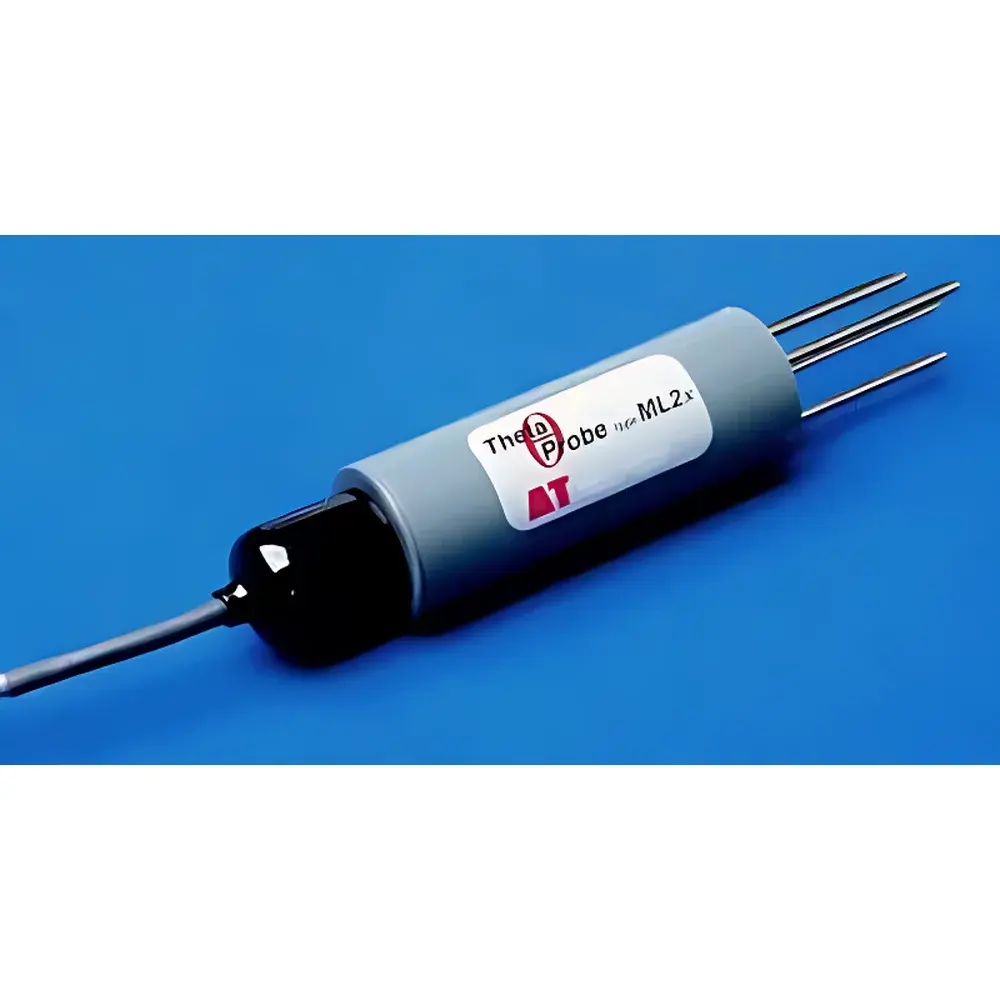
ThetaKIT TK3-BASIC Soil Moisture Meter
| Origin | UK |
|---|---|
| Manufacturer Type | Distributor |
| Origin Category | Imported |
| Model | TK3-BASIC |
| Price | Upon Request |
Overview
The ThetaKIT TK3-BASIC Soil Moisture Meter is a field-deployable, FDR (Frequency Domain Reflectometry)-based instrument engineered for rapid, non-destructive quantification of volumetric water content (θv) in soils and porous media. Unlike time-domain reflectometry (TDR), FDR operates by generating a stable high-frequency electromagnetic signal (typically 20–100 MHz) that propagates along parallel stainless-steel rods embedded in the medium. The dielectric permittivity of the surrounding matrix—dominated by water’s high relative permittivity (~80) compared to dry soil (~3–5) or air (~1)—alters the impedance and phase response of the reflected signal. The HH2 handheld meter measures the resulting voltage output, which is linearly correlated to θv via factory calibration curves traceable to gravimetric standards. This principle ensures high reproducibility across diverse soil textures (sand to clay), organic amendments, and low-salinity substrates (<4 dS/m), making the TK3-BASIC suitable for both short-term surveys and long-term monitoring networks.
Key Features
- FDR-based measurement with dual-range analog-to-digital conversion for stable mV output resolution of 1 mV
- HH2 handheld readout unit featuring four simultaneous display modes: m³·m⁻³, % vol, mm (water depth equivalent), and raw mV
- Integrated data logging capability—stores up to 1,100 readings with timestamp and probe ID tagging
- Rugged cylindrical probe (207 mm total length; 60 mm active rod length) with four 316 stainless-steel electrodes, IP68-rated for continuous burial in saturated or frozen conditions
- Standard 5 m shielded coaxial cable (extendable to 100 m without signal degradation, per IEC 61000-4-3 EMC guidelines)
- ML-INK1 insertion tool included for reliable probe deployment in compacted, stony, or high-density soils
- Transport-grade carrying case with custom foam inserts for probe, HH2 unit, cables, and accessories
Sample Compatibility & Compliance
The TK3-BASIC is validated for use across mineral soils (USDA texture classes), peat-based growing media, green roof substrates, and lightweight aggregates. It is not recommended for highly conductive environments (>6 dS/m EC) without site-specific recalibration. All components comply with CE marking requirements under Directive 2014/30/EU (EMC) and 2011/65/EU (RoHS). Calibration certificates are provided per ISO/IEC 17025-accredited procedures, and the system supports GLP-compliant data integrity through audit-trail-enabled software export. While not FDA 21 CFR Part 11 certified out-of-the-box, raw CSV exports from ThetaLink software allow integration into validated LIMS environments where electronic signatures and change control are managed externally.
Software & Data Management
ThetaLink desktop software (Windows-compatible) enables bidirectional communication with the HH2 unit via USB or RS-232. Users can download logged datasets—including date/time stamps, probe serial numbers, and user-defined site codes—and export directly to .CSV format for immediate import into Excel, R, Python (pandas), or statistical platforms such as JMP or SAS. No proprietary database engine is required. Firmware updates, calibration offset adjustments, and unit configuration (e.g., display units, auto-power-off delay) are performed within the same interface. All exported files retain native metadata fields required for ISO 11274:2022 (soil water retention curve reporting) and FAO-recommended soil moisture network protocols.
Applications
- Agricultural irrigation scheduling and deficit irrigation trials
- Ecological studies of root-zone water dynamics in grassland, forest, and wetland ecosystems
- Validation of satellite-derived soil moisture products (e.g., SMAP, Sentinel-1)
- Landfill cover performance monitoring and leachate barrier integrity assessment
- Construction QA/QC for engineered soil backfills and embankment compaction verification
- Educational field labs in environmental science, agronomy, and hydrology curricula
FAQ
What is the recommended recalibration interval for long-term monitoring deployments?
For research-grade accuracy, annual recalibration against gravimetric samples is advised; however, field stability tests show drift <±0.3% vol over 12 months in temperate climates.
Can the TK3-BASIC be used in saline soils?
Yes—within limits. Accuracy remains within ±2% vol up to 4 dS/m EC at 25°C; above this, empirical salinity correction factors must be applied using local calibration curves.
Is the HH2 readout unit compatible with third-party dataloggers?
No—the HH2 outputs only via its internal memory or direct USB/RS-232 handshake; it does not support analog voltage output or Modbus protocols.
How does probe orientation affect measurement?
The probe is isotropic—orientation (vertical/horizontal) has no effect on reading, provided all four rods are fully embedded in homogeneous medium.
Does freezing damage the probe or affect readings?
The probe is rated for -10°C to +70°C operation; ice formation around rods causes temporary signal attenuation but no permanent damage; readings stabilize within 10 minutes after thawing.







