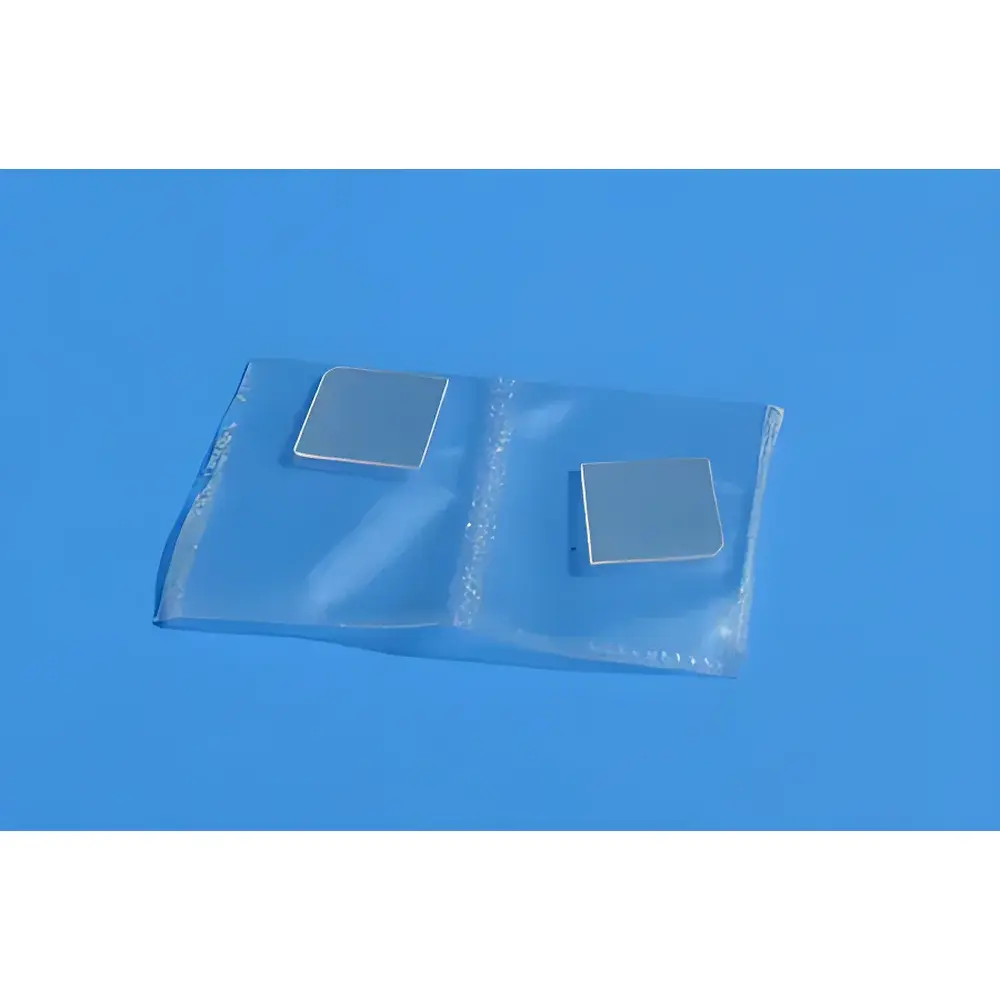
Ti-terminated SrTiO₃ Single Crystal Substrate
| Brand | Hefei Kejing |
|---|---|
| Origin | Anhui, China |
| Manufacturer Type | Authorized Distributor |
| Origin Category | Domestic |
| Model | Ti-terminated SrTiO₃ |
| Price | Upon Request |
| Crystal Structure | Cubic, a = 3.905 Å |
| Growth Method | Verneuil |
| Density | 5.175 g/cm³ |
| Melting Point | 2080 °C |
| Hardness | 6 (Mohs) |
| Thermal Expansion Coefficient | 10.4 × 10⁻⁶ /°C |
| Dielectric Constant (εᵣ) | ~300 |
| Loss Tangent (tan δ) | ~5 × 10⁻⁴ @ 10 GHz, 300 K |
| Surface Appearance | Transparent to pale brown |
| Chemical Stability | Insoluble in water |
| Standard Dimensions | 10 × 10 × 0.5 mm ± 0.05 mm |
| Miscut | 0.1° from <100> (±0.1° tolerance along Y and X axes) |
| Termination | Atomically flat TiO₂-terminated surface, single-side polished |
Overview
Ti-terminated SrTiO₃ (strontium titanate) single crystal substrates are high-purity, atomically ordered perovskite oxide wafers engineered for epitaxial thin-film growth of complex oxides, two-dimensional electron gases (2DEGs), and quantum heterostructures. As a dielectric substrate with a lattice parameter of 3.905 Å and cubic symmetry, SrTiO₃ offers near-perfect lattice matching to numerous functional oxides—including LaAlO₃, NdNiO₃, and FeSe—enabling strain-controlled interface engineering. The TiO₂ termination is achieved via controlled chemical etching and annealing, resulting in a stoichiometric, charge-neutral surface with minimal surface disorder and sub-angstrom roughness (RMS < 0.2 nm). This termination is critical for stabilizing interfacial conductivity, suppressing intermixing during pulsed laser deposition (PLD) or molecular beam epitaxy (MBE), and enabling reproducible growth of polar/non-polar heterointerfaces under ultra-high vacuum (UHV) conditions.
Key Features
- Atomically flat TiO₂-terminated surface prepared by optimized wet-chemical etching and high-temperature annealing in O₂-rich atmosphere
- Single-side polished finish with RMS roughness ≤ 0.2 nm (verified by AFM), ensuring uniform nucleation for monolayer-resolved film growth
- Precise miscut control: 0.1° ± 0.1° off the exact orientation, aligned independently along both X and Y axes to support step-flow growth modes
- High crystalline perfection confirmed by X-ray rocking curve (FWHM < 0.03°) and RHEED intensity oscillations during in-situ growth
- Low dielectric loss (tan δ ≈ 5 × 10⁻⁴ at 10 GHz, 300 K) and high relative permittivity (εᵣ ≈ 300) suitable for microwave and cryogenic device integration
- Thermally stable up to 2080 °C; compatible with high-temperature annealing protocols (>800 °C) in oxidizing or reducing atmospheres
Sample Compatibility & Compliance
This substrate is routinely used in UHV-compatible deposition systems including PLD, MBE, and sputtering platforms. Its chemical inertness—insolubility in water and resistance to mild acids—ensures compatibility with standard cleanroom handling (RCA, piranha, and oxygen plasma treatments). All wafers undergo rigorous QC screening: optical inspection for scratches/voids, XRD θ–2θ scans for phase purity, and EDS mapping to verify surface stoichiometry and absence of Sr-enriched domains. Batch documentation includes certificate of analysis (CoA) with traceable metrology data. While not certified to ISO 9001 or ASTM F1529 as a finished semiconductor wafer, the material conforms to common research-grade specifications for oxide epitaxy (per IEEE Std 118-2022 and IEC 60747-18 for substrate quality classification).
Software & Data Management
No embedded firmware or proprietary software is associated with this passive substrate. However, its dimensional and crystallographic specifications are fully compatible with standard thin-film characterization workflows: integration with Bruker D8 Discover XRD databases, Keysight PNA-L network analyzer calibration files for microwave measurements, and open-format metadata tagging in LabArchives or ELN systems (e.g., using MIAME-compliant fields for substrate orientation, termination, and miscut vector). Traceability is maintained through unique lot-number labeling and digital CoA delivery (PDF + CSV export of XRD and AFM summary metrics).
Applications
- Epitaxial growth of correlated electron systems (e.g., LaTiO₃/SrTiO₃ interfaces hosting 2DEGs)
- Template for superconducting FeSe monolayers and topological insulator Bi₂Se₃ heterostructures
- Dielectric layer in gate-tunable oxide transistors and ferroelectric tunnel junctions
- Substrate for scanning probe microscopy (STM/STS, nc-AFM) of surface reconstructions and domain dynamics
- Cryogenic platform for quantum transport studies (≤ 10 mK) due to low phonon scattering and thermal expansion match with Nb-based contacts
- Reference material in synchrotron-based X-ray standing wave (XSW) and resonant soft X-ray reflectivity (RSXR) experiments
FAQ
What does “Ti-termination” mean, and how is it verified?
Ti-termination refers to a surface where the outermost atomic plane consists exclusively of Ti and O atoms in a 1:2 stoichiometry, confirmed by angle-resolved XPS (Ti 2p/O 1s ratio ≈ 0.5) and LEED pattern symmetry.
Can these substrates be reused after film removal?
No—surface reconstruction and subsurface damage occur during high-temperature growth or ion milling; each wafer is intended for single-use epitaxy cycles.
Is the 0.1° miscut oriented toward [010] or [100]?
The miscut direction is user-selectable; standard delivery specifies nominal tilt toward [010], but custom azimuthal alignment (e.g., toward [110]) is available upon request with ≥4-week lead time.
Do you provide pre-characterized substrates with AFM/XRD reports?
Yes—certified characterization packages (including full AFM height maps and XRD ω-scans) are available as optional add-ons with NIST-traceable calibration references.
Are these substrates suitable for aqueous electrochemical synthesis?
Not recommended—while chemically insoluble, prolonged exposure to pH 11 electrolytes may induce surface hydroxylation that degrades termination integrity and interfacial epitaxy fidelity.