
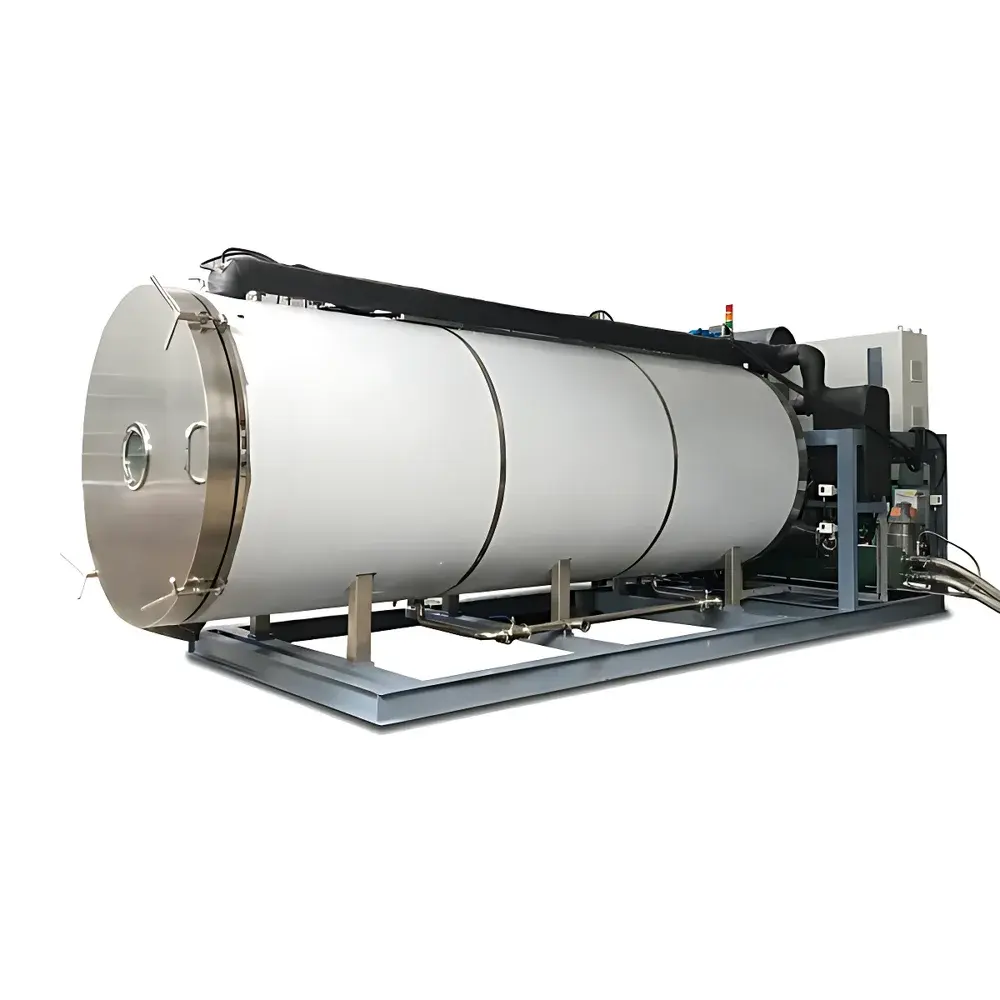
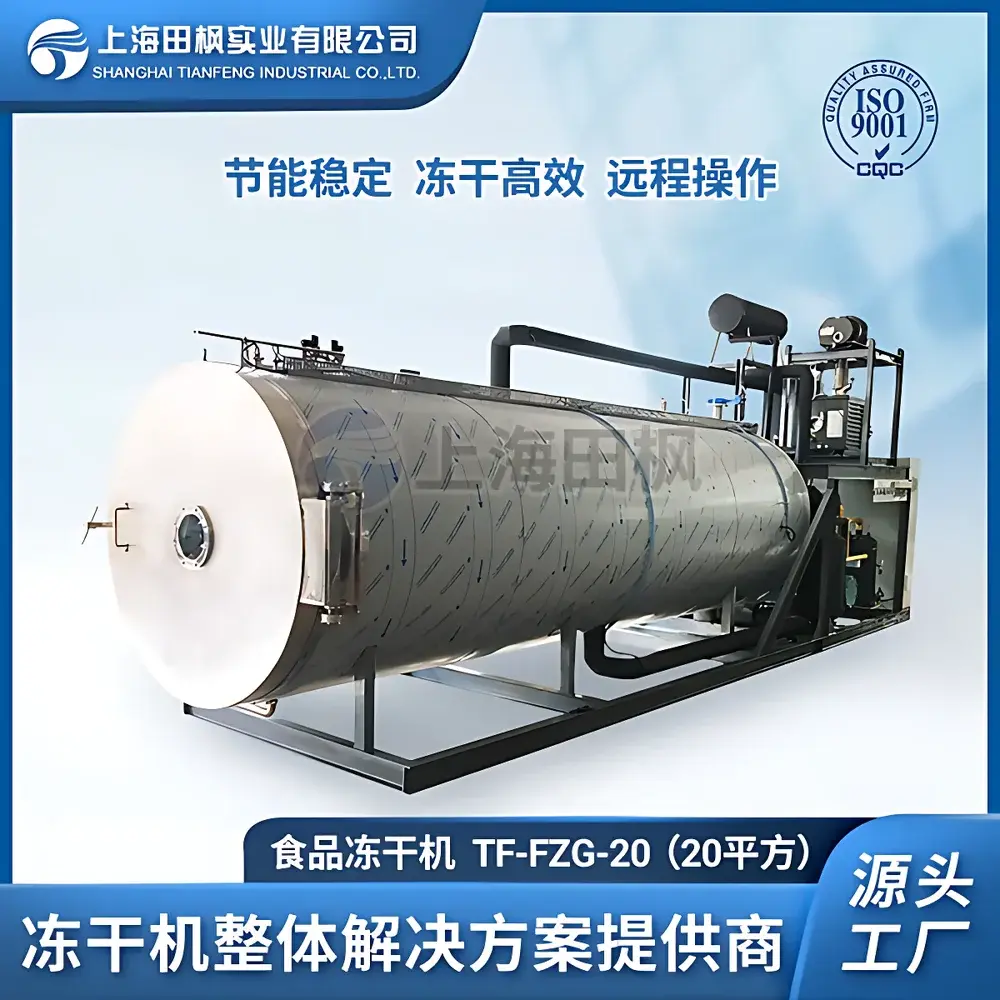
Tianfeng FZG-20 Industrial-Scale Freeze Dryer for Functional Food Powders, Bird’s Nest, and Probiotic Formulations
| Brand | Tianfeng |
|---|---|
| Origin | Shanghai, China |
| Manufacturer Type | OEM/ODM Manufacturer |
| Instrument Type | Shelf-Type Freeze Dryer |
| Application Scope | Production-Scale |
| Lyophilization Area | 20.24 m² |
| Ultimate Vacuum | 2.7 Pa |
| Condenser Temperature | ≤ −65 °C |
| Ice Capacity (24 h) | 400 kg/24 h |
| Chamber Dimensions (W × D) | 1100 × 2300 mm |
| Shelf Temperature Range | −45 to +70 °C |
| Shelf Quantity | 9 (8 working + 1 spare) |
| Shelf Spacing | 65 mm |
| Total Power Consumption | 90 kW |
| Cooling Water Requirement | 37 m³/h |
| Net Weight | 12 t |
Overview
The Tianfeng FZG-20 is an industrial-scale, in-situ freeze dryer engineered for the gentle, high-fidelity stabilization of thermolabile functional ingredients—including edible bird’s nest extracts, meal-replacement powders, and live probiotic cultures. Operating on the fundamental principles of lyophilization—freezing under controlled conditions followed by sublimation under deep vacuum—the system preserves structural integrity, enzymatic activity, volatile compounds, and microbiological viability far more effectively than conventional thermal drying methods. Unlike hot-air or spray drying, which induce denaturation, oxidation, and collapse of porous matrices, the FZG-20 maintains the native conformation of biomolecules and cellular architecture by conducting primary drying below the eutectic point and secondary drying at temperatures ≤60 °C. Its design integrates heat transfer physics, vacuum dynamics, and refrigeration thermodynamics to ensure reproducible batch outcomes across GMP-aligned food, nutraceutical, and bioprocessing applications.
Key Features
- In-situ pre-freezing and drying within a single chamber—eliminating manual transfer and contamination risk.
- Uniform shelf temperature control (±1 °C deviation) via internal circulating heat-transfer medium, enabling precise ramping and hold profiles critical for sensitive probiotics and glycoproteins.
- Dual-stage, internally mounted condensers with alternating operation mode—maximizing ice-trapping efficiency while sustaining stable vacuum during continuous water vapor load.
- Full-liquid refrigerant circulation system for rapid cooldown and consistent condenser performance at ≤−65 °C.
- PLC-based automation with 10.4″ industrial touchscreen HMI—supporting recipe storage, real-time parameter logging (shelf temp, chamber pressure, condenser temp), and alarm management.
- Integrated CIP (Clean-in-Place) and SIP (Sterilize-in-Place) compatibility—facilitating validation-ready cleaning and steam sterilization per FDA 21 CFR Part 11 and EU Annex 1 requirements.
- Hydraulic stoppering interface option for aseptic vial sealing—suitable for clinical-grade powder formulations.
Sample Compatibility & Compliance
The FZG-20 accommodates bulk loads of viscous hydrocolloids (e.g., bird’s nest mucilage), aqueous suspensions of lactic acid bacteria (Lactobacillus spp., Bifidobacterium spp.), and nutrient-dense slurry-based meal replacements. Its 20.24 m² shelf area supports trays up to 200 L total solution volume per cycle. All wetted surfaces are electropolished stainless steel (AISI 316L), compliant with ISO 8573-1 (compressed air purity) and ASME BPVC Section VIII Div. 1 for pressure vessel certification. The system meets CE Machinery Directive 2006/42/EC and conforms to ICH Q5C stability guidelines for biopharmaceutical intermediates. Vacuum integrity and temperature uniformity are validated per ASTM F2476–21 for lyophilizer qualification.
Software & Data Management
The embedded control system records time-stamped process data at 1-second intervals—including shelf temperature setpoints/actuals, chamber pressure (Pirani + capacitance manometer), condenser temperature, and vacuum pump status. Exported CSV files are compatible with LIMS and MES platforms. Optional Ethernet/IP or Modbus TCP interfaces enable remote monitoring and integration into centralized SCADA systems. Audit trails comply with FDA 21 CFR Part 11 requirements, including electronic signatures, user access levels, and immutable record retention. Freeze-drying cycle curves can be replayed, overlaid, or statistically compared using built-in trend analysis tools.
Applications
- Stabilization of Collocalia esculenta extracts—retaining sialic acid content and anti-inflammatory glycopeptides without Maillard degradation.
- Production of shelf-stable probiotic powders with ≥90% post-lyophilization viability (validated via ISO 19344:2021 plate count assays).
- Manufacturing of nutritionally complete meal replacement powders—preserving heat-sensitive vitamins (B12, C), omega-3 fatty acids, and whey protein conformation.
- Processing of fruit-based functional snacks (e.g., strawberry, blueberry)—maintaining anthocyanin profile, crisp texture, and rehydration kinetics.
- Preparation of sterile botanical injectables and diagnostic reagent kits requiring residual moisture ≤1.5% w/w.
FAQ
What is the maximum allowable residual moisture for probiotic formulations processed on this system?
Residual moisture can be consistently maintained at ≤1.2% w/w under optimized secondary drying protocols—verified by Karl Fischer titration (ASTM E203).
Does the FZG-20 support IQ/OQ/PQ documentation packages?
Yes—Tianfeng provides vendor-qualified templates aligned with ISO 13485 and FDA guidance, including sensor calibration logs, vacuum leak test reports, and temperature mapping studies.
Can the system handle organic solvent-based formulations?
With optional explosion-proof configuration (ATEX Zone 1) and condenser coil material upgrade (Hastelloy C-276), it supports low-boiling solvents such as tert-butanol and ethyl acetate.
Is remote firmware update capability available?
Firmware updates are performed locally via USB or secure FTP; over-the-air updates are not supported to maintain regulatory compliance and system integrity.
What maintenance intervals are recommended for the refrigeration circuit?
Oil analysis and filter replacement every 2,000 operating hours; full refrigerant charge verification and leak detection annually per ISO 5149-2.



