
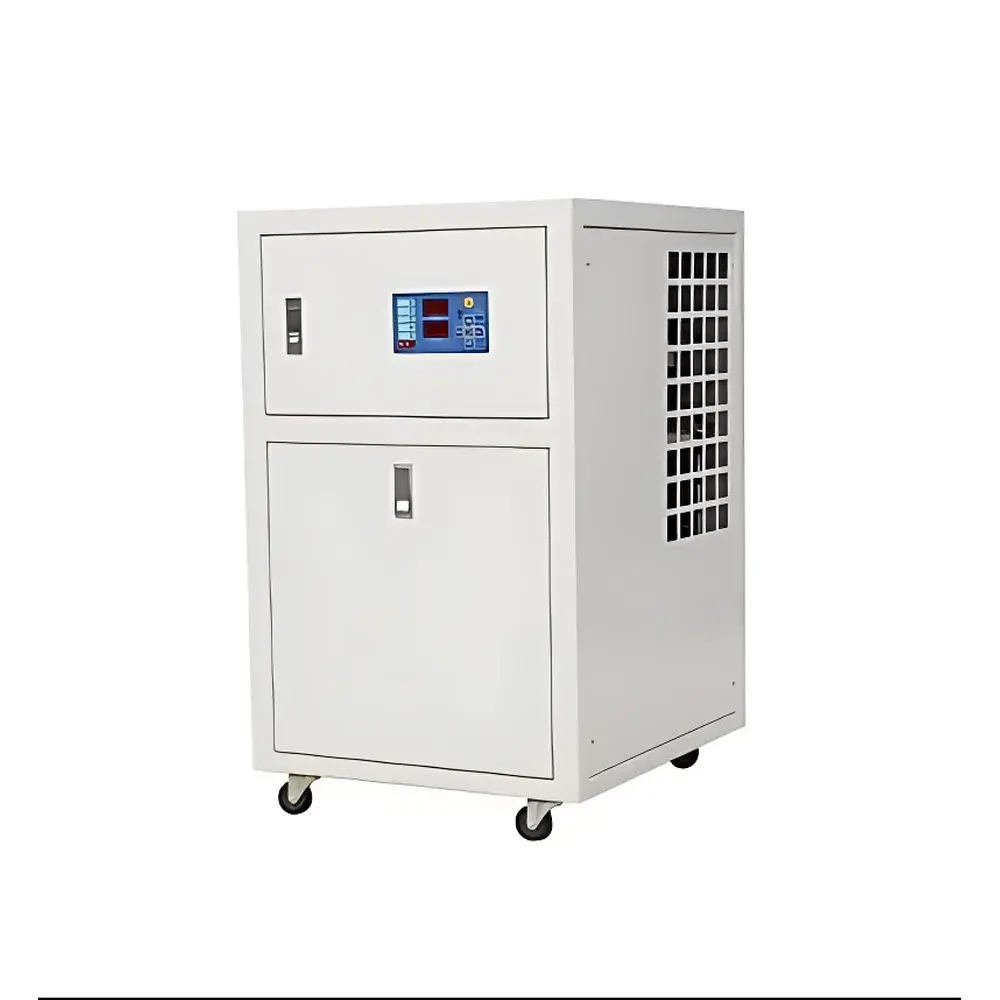
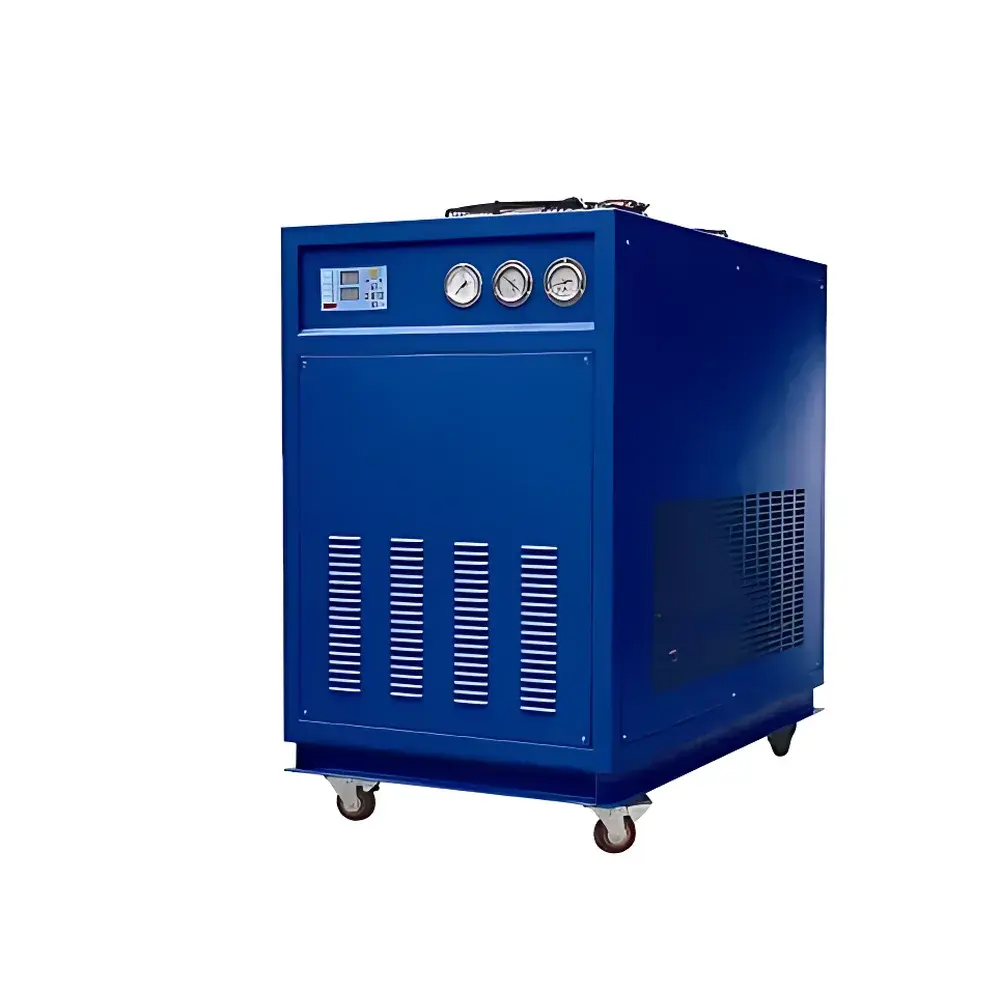
Tianfeng LS-10HP Low-Temperature Screw Chiller
| Brand | Tianfeng |
|---|---|
| Origin | Shanghai, China |
| Manufacturer Type | Direct Manufacturer |
| Equipment Type | Integrated Circulating Chiller |
| Cooling Method | Water-Cooled |
| Temperature Control Range | 0–10 °C |
| Refrigeration Capacity | 32.5 kW |
| Temperature Stability | ±0.1 °C |
| Circulation Pump Pressure | 2.0 bar |
| Circulation Flow Rate | 2 L/min |
| Reservoir Volume | 200 L |
| Operating Mode | Continuous Duty |
| Compressor Type | Scroll (High-Efficiency Industrial Grade) |
| Safety Protections | High/Low Pressure Switches, Compressor Overheat Protection, Overcurrent Protection, High-Temperature Alarm |
| Electrical Supply | 380 V / 50 Hz (Three-Phase) |
| Dimensions (L×W×H) | 1350 × 900 × 1845 mm |
| Net Weight | Approx. 620 kg |
| Refrigerant | R404A or R507 (ODP = 0, compliant with EU F-Gas Regulation Annex I) |
Overview
The Tianfeng LS-10HP Low-Temperature Screw Chiller is an industrial-grade, integrated circulating chiller engineered for precise thermal management of high-heat-load laboratory and production equipment. Unlike conventional air-cooled chillers, this unit employs a water-cooled screw-type refrigeration cycle—optimized for sustained operation at low setpoints (0–10 °C)—to deliver stable, high-capacity cooling with minimal thermal drift. Its core thermodynamic architecture follows ASHRAE Standard 15 and ISO 5149 principles for refrigeration system safety and efficiency. The chiller is designed to maintain constant coolant temperature and flow under dynamic thermal loads, making it suitable for applications requiring tight thermal control, such as analytical instrumentation heat rejection, vacuum system condensation trapping, and precision machining coolant regulation. It operates continuously without duty-cycle limitations, meeting the operational demands of 24/7 laboratory infrastructure and GMP-aligned manufacturing environments.
Key Features
- Industrial scroll compressor with dual-stage oil cooling and built-in discharge temperature monitoring—ensuring extended service life and consistent refrigeration output across ambient temperatures up to 40 °C.
- Stainless steel reservoir (200 L capacity) and circulation pump housing—resistant to corrosion from deionized water, glycol-water mixtures (up to 30% concentration), and mild chemical coolants used in analytical instrument cooling loops.
- Digital PID temperature controller with 0.1 °C resolution and programmable ramp-soak profiles—supporting both fixed-setpoint and adaptive control modes based on real-time return-water temperature feedback.
- Integrated safety suite compliant with IEC 61000-6-2 (EMC immunity) and IEC 60204-1 (machine safety): high/low pressure cutouts, motor overcurrent protection, reservoir low-level shutoff, and overtemperature alarm with dry-contact fault relay output.
- Modular electrical cabinet featuring CE-certified components from Siemens, Schneider Electric, and Omron—including contactors, circuit breakers, and isolation transformers—designed for compatibility with global power grids and integration into PLC-controlled facility systems.
- Acoustically damped enclosure achieving ≤72 dB(A) at 1 m—enabling installation in shared laboratory corridors or near noise-sensitive instrumentation without acoustic mitigation.
Sample Compatibility & Compliance
This chiller is routinely deployed to thermally stabilize high-value analytical platforms including graphite furnace atomic absorption spectrometers (GFAAS), inductively coupled plasma optical emission spectrometers (ICP-OES), ICP-mass spectrometers (ICP-MS), X-ray fluorescence (XRF) spectrometers, X-ray diffractometers (XRD), scanning electron microscopes (SEM), and transmission electron microscopes (TEM). Its 2.0 bar pump head and 2 L/min minimum flow rate meet the inlet pressure and flow specifications of most OEM instrument cooling interfaces per ASTM E2915-21 (“Standard Guide for Thermal Management of Analytical Instruments”). All wetted materials comply with USP Class VI biocompatibility requirements, and the system supports validation protocols aligned with FDA 21 CFR Part 11 (electronic records/signatures) when paired with optional data-logging modules. Design documentation conforms to ISO 9001:2015 quality management standards; factory test reports include refrigerant charge verification, pressure decay testing, and thermal stability validation per ISO 5149-2 Annex D.
Software & Data Management
The chiller’s embedded controller provides local HMI operation via a backlit LCD interface with real-time display of supply/return temperature, flow rate, compressor discharge temperature, and system pressure differentials. Optional RS485 Modbus RTU or Ethernet TCP/IP communication enables integration into centralized building management systems (BMS) or laboratory information management systems (LIMS). When configured with Tianfeng’s optional DataLogger Pro module, the unit records timestamped temperature, pressure, and operational status data at user-defined intervals (1–300 seconds), stores ≥30 days of history onboard, and exports CSV files via USB or FTP—supporting audit-ready traceability for GLP, GMP, and ISO/IEC 17025 compliance. All configuration changes are logged with operator ID and timestamp, satisfying electronic record integrity requirements under 21 CFR Part 11 Subpart B.
Applications
- Laboratory Instrument Cooling: Heat load dissipation for high-power RF generators (ICP), X-ray tubes (XRF/XRD), electron guns (SEM/TEM), and laser excitation sources—preventing thermal lensing, detector drift, and spectral calibration shift.
- Materials Characterization: Stabilizing sample stages and detectors during cryo-TEM, low-temperature XRD, or synchrotron beamline experiments where thermal expansion must remain below 1 µm over 8-hour runs.
- Process Instrumentation: Maintaining constant coolant temperature for online process analyzers (e.g., NIR spectrometers in pharma API crystallization lines) to ensure measurement repeatability per USP <1058>.
- Manufacturing Support: Secondary cooling loop for CNC machine tool spindles, EDM die-sinking systems, and semiconductor wafer bonders—reducing thermal growth errors to <±1.5 µm/m/K as verified per ISO 230-3.
- Vacuum System Integration: Condenser cooling for diffusion pumps and cryopumps operating at base pressures <1×10⁻⁷ mbar, where coolant temperature stability directly impacts ultimate vacuum performance.
FAQ
What is the maximum allowable return water temperature for continuous operation?
The unit is rated for continuous duty with return water temperatures ≤40 °C. Sustained operation above this threshold triggers high-temperature alarm and may reduce compressor lifespan; we recommend maintaining return temperatures ≤35 °C for optimal reliability.
Can this chiller be used with 30% ethylene glycol solution?
Yes—the stainless steel reservoir, pump, and heat exchanger are compatible with aqueous glycol solutions up to 30% by volume. Note that glycol reduces effective refrigeration capacity by ~12% and increases viscosity; flow rate must be verified with inline flow metering.
Is remote monitoring and control supported out of the box?
Standard configuration includes Modbus RTU over RS485. Ethernet/IP and SNMP support require the optional Communication Interface Module (Order Code: TF-CIM-ETH). Configuration software is provided free of charge with driver libraries for LabVIEW, Python, and MATLAB.
Does the chiller meet CE marking requirements for export to the European Union?
Yes—fully compliant with the EU Machinery Directive 2006/42/EC, EMC Directive 2014/30/EU, and Low Voltage Directive 2014/35/EU. Declaration of Conformity and EC Type Examination Certificate are supplied with each unit.
What maintenance intervals are recommended for laboratory-grade reliability?
Compressor oil and filter replacement every 8,000 operating hours or 24 months (whichever occurs first); refrigerant circuit leak check annually; heat exchanger cleaning semiannually if using non-deionized water; full system performance validation per ISO 5149-3 every 3 years.
Related Products



