
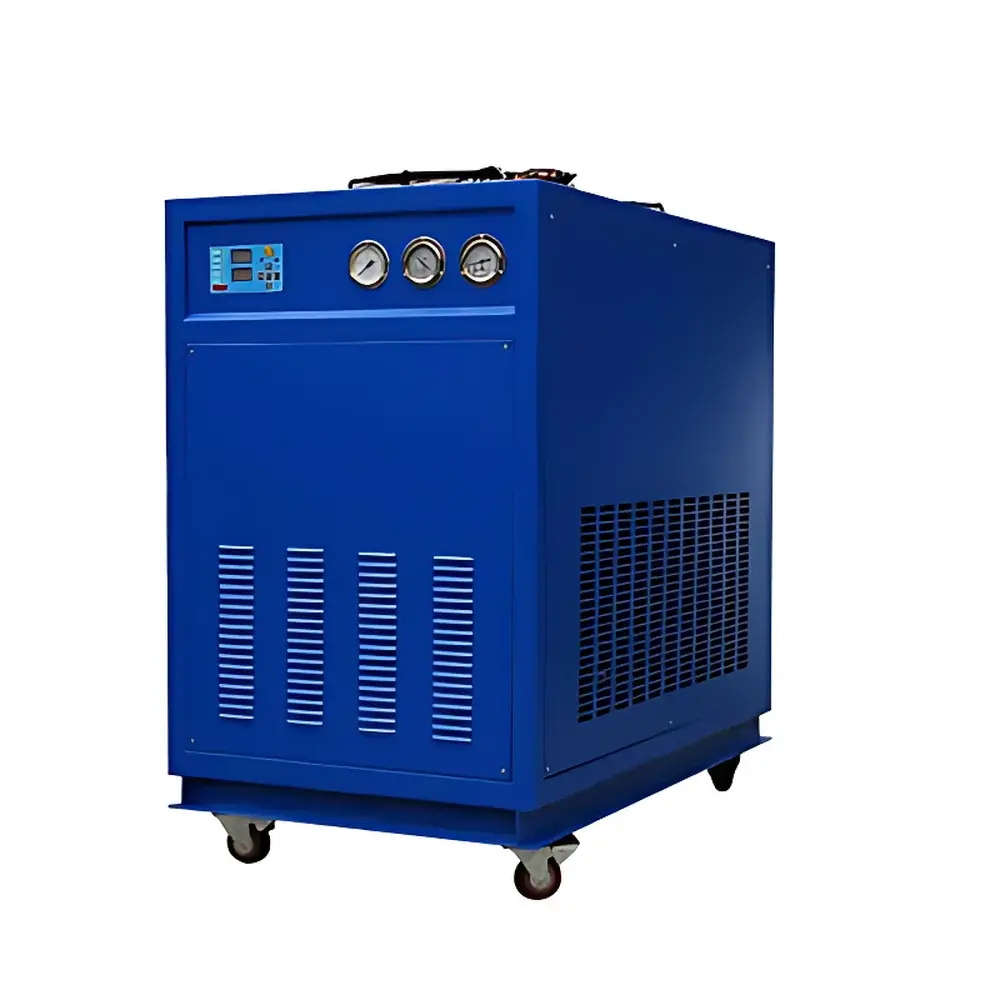
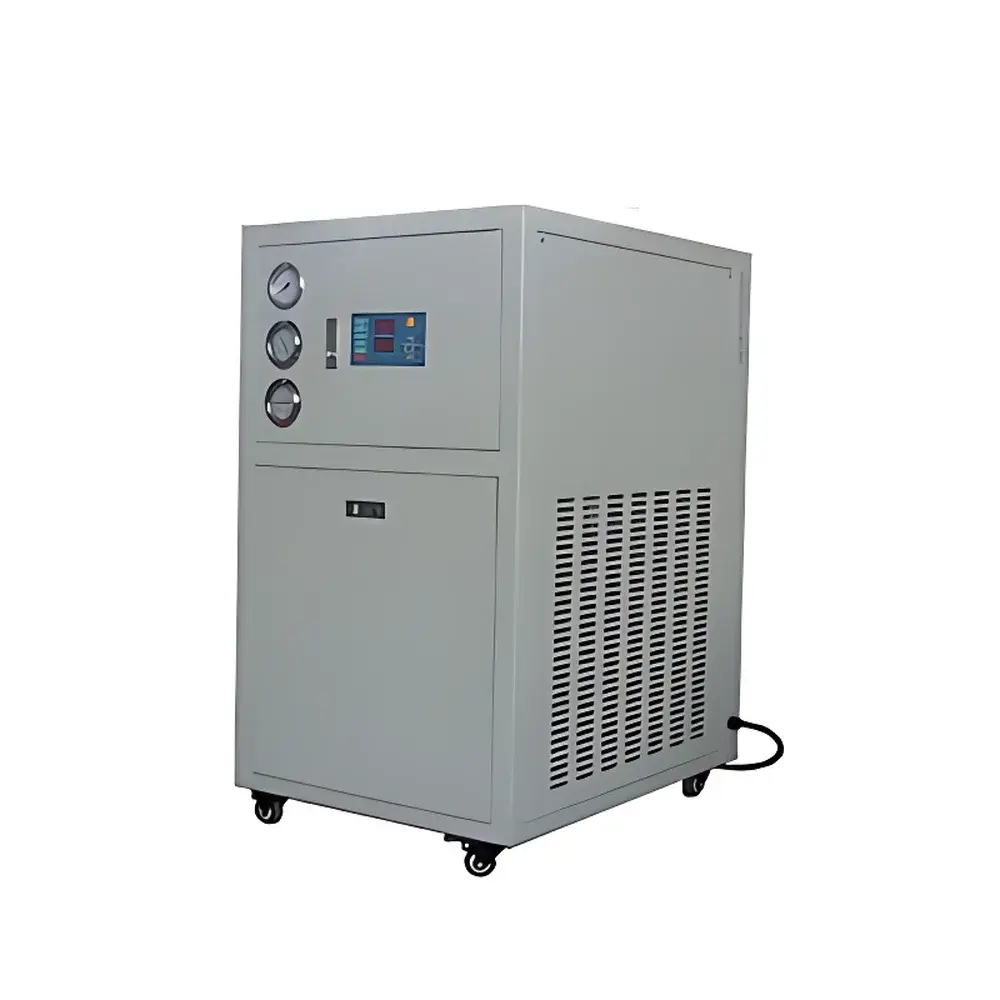
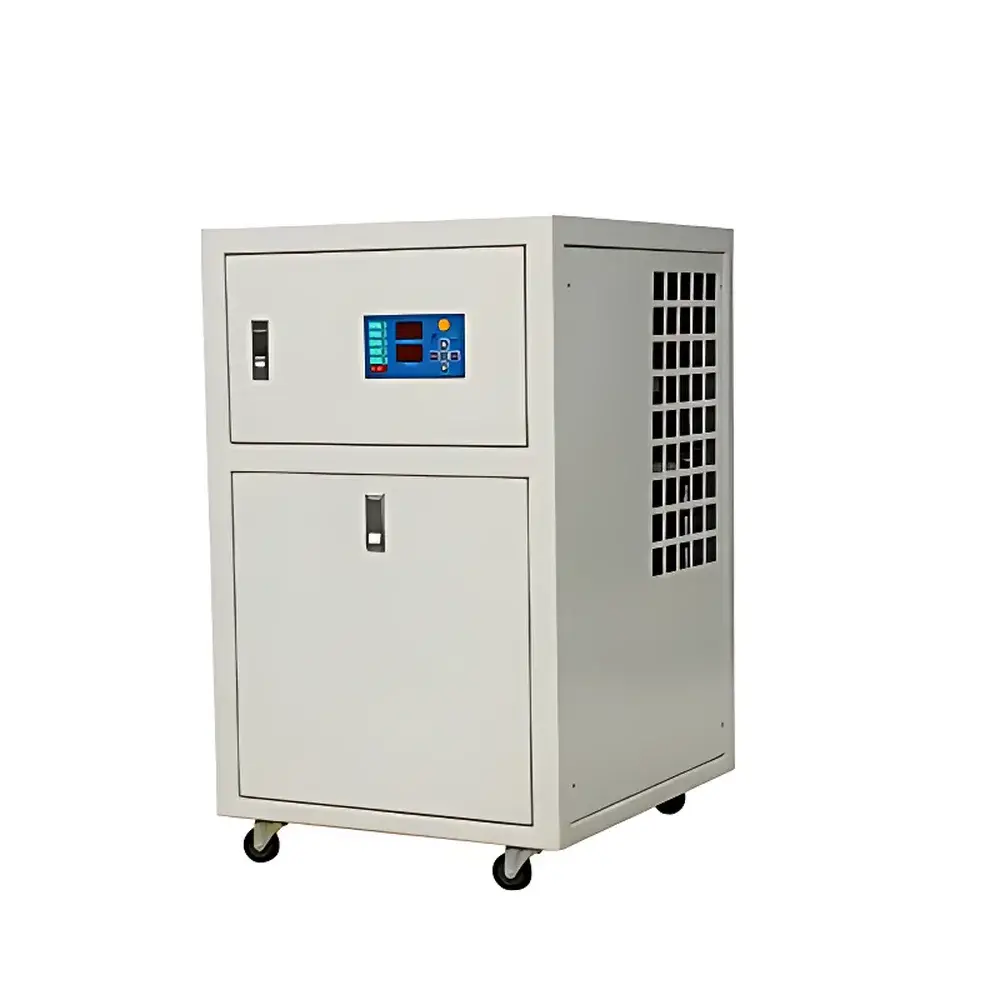
Tianfeng LS-12KW Integrated Circulating Chiller
| Brand | Tianfeng |
|---|---|
| Origin | Shanghai, China |
| Manufacturer Type | Direct Manufacturer |
| Instrument Type | Integrated Circulating Chiller |
| Cooling Method | Water-Cooled |
| Rated Refrigeration Capacity | 12 kW |
| Power Input | 5.1 kW |
| Water Tank Volume | 85 L |
| Pump Flow Rate | 0–60 L/min |
| Pump Pressure | 0–2 kgf/cm² |
| Temperature Control Range | 5–30 °C (Chilled Water Outlet) |
| Temperature Stability | ±0.3 °C (Typical at Steady State) |
| Power Supply | 220 V, 50 Hz |
| Dimensions (L×W×H) | 1200 × 715 × 1105 mm |
| Safety Protections | Compressor Overheat Protection, High/Low Pressure Switches, Overcurrent Protection, Overtemperature Alarm |
| Construction | Stainless Steel Reservoir & Pump, Vortex Compressor, Imported Expansion Valve (Italy/Germany), PLC-Based PID Controller (Optional RKC Japan) |
Overview
The Tianfeng LS-12KW Integrated Circulating Chiller is an engineered thermal management solution designed for precision temperature control of heat-generating laboratory and industrial equipment. Based on vapor-compression refrigeration cycle architecture, it employs a high-efficiency scroll compressor, copper-aluminum finned condenser with optimized airflow design, and a thermostatically regulated expansion valve to deliver stable chilled water output between 5 °C and 30 °C. The unit integrates refrigeration, circulation, temperature sensing, and PID-based feedback control into a single compact enclosure—eliminating external plumbing complexity while maintaining full operational autonomy. Its core function is to absorb waste heat from critical components—including optical benches, plasma sources, X-ray generators, electron beam columns, and laser diode arrays—and reject it via a closed-loop water circuit. This ensures thermal equilibrium in sensitive instrumentation where even sub-degree drift can compromise spectral resolution, detector linearity, or vacuum integrity.
Key Features
- Integrated architecture with stainless steel reservoir (85 L capacity), corrosion-resistant internal piping, and maintenance-accessible service panels
- Vortex-type hermetic compressor delivering consistent 12 kW nominal cooling capacity under standard conditions (chilled water inlet 12 °C / outlet 7 °C; ambient cooling air 30 °C → 40 °C)
- High-precision digital PID controller with real-time display of outlet water temperature, flow rate, and system status codes
- Dual-mode operation: fixed-setpoint constant-temperature mode and adaptive intelligent mode that dynamically adjusts chiller output based on real-time thermal load feedback
- Industrial-grade pump assembly capable of 0–60 L/min flow at adjustable pressure up to 2 kgf/cm² (≈0.2 MPa), supporting long-loop distribution networks
- Comprehensive safety suite including compressor discharge temperature monitoring, high/low refrigerant pressure cutouts, motor overcurrent protection, and reservoir-level sensor interlock
- Electrical compliance with IEC 61000-6-2 (EMC immunity) and IEC 61000-6-4 (EMC emission); component-level certification for contactors (Siemens, Schneider, Omron) and control relays
Sample Compatibility & Compliance
This chiller is compatible with all laboratory instruments requiring recirculated coolant within the specified temperature and flow envelope—including graphite furnace atomic absorption spectrometers (GFAAS), inductively coupled plasma optical emission spectrometers (ICP-OES), inductively coupled plasma mass spectrometers (ICP-MS), X-ray fluorescence (XRF) analyzers, X-ray diffractometers (XRD), scanning electron microscopes (SEM), and transmission electron microscopes (TEM). It meets general-purpose thermal management requirements under ISO/IEC 17025:2017 Clause 6.4.3 (environmental condition control) and supports GLP-compliant operation when paired with validated temperature logging systems. While not intrinsically certified for hazardous locations, its non-sparking construction and grounded chassis comply with EN 61000-3-2 harmonic current limits and UL 61010-1 third-edition safety standards for laboratory electrical equipment.
Software & Data Management
The LS-12KW operates without proprietary software dependencies. All setpoints, alarms, and runtime diagnostics are managed via front-panel membrane keypad and 4-digit LED display. Optional analog 4–20 mA or RS-485 Modbus RTU interface enables integration into centralized building management systems (BMS) or laboratory information management systems (LIMS) for remote status monitoring and alarm event logging. When deployed in regulated environments (e.g., pharmaceutical QC labs), users may configure external data loggers to record outlet temperature, flow rate, and compressor run time—supporting 21 CFR Part 11 audit trails if combined with electronic signature-capable platforms. Firmware updates are performed via physical USB port; no cloud connectivity or automatic telemetry is implemented.
Applications
Beyond analytical instrumentation, this chiller serves thermally demanding industrial processes: mold temperature stabilization in injection molding (reducing part warpage and improving surface finish per ASTM D955), spindle and hydraulic oil cooling in CNC machining centers (minimizing thermal growth-induced geometric error per ISO 230-3), die cooling in extrusion lines, vacuum chamber thermal regulation in PVD/CVD systems, and post-process rapid chilling of food-grade products. In semiconductor fabrication support roles, it maintains stable junction temperatures for high-power RF amplifiers and wafer stage actuators. Its modular design also permits parallel operation for redundancy or staged capacity scaling in multi-instrument lab configurations.
FAQ
What is the maximum allowable return water temperature?
The unit is rated for continuous operation with return water ≤40 °C. Sustained inlet temperatures above this threshold reduce compressor efficiency and accelerate refrigerant oil degradation.
Can the chiller be integrated with existing facility cooling towers?
Yes—its water-cooled condenser accepts facility-supplied cooling water within 25–35 °C range at 2–4 bar pressure; a differential pressure regulator is recommended for variable-flow systems.
Is remote monitoring supported out of the box?
Standard configuration includes dry-contact alarm outputs and optional analog/Modbus interfaces; full SCADA integration requires user-provided gateway hardware and configuration.
Does the unit comply with energy efficiency regulations?
It meets China’s GB 19577-2015 minimum energy performance standard for liquid chillers and exceeds EU Ecodesign Directive Lot 21 Tier 1 requirements for units <150 kW.
What maintenance intervals are recommended?
Condenser coil cleaning every 6 months, refrigerant charge verification annually, and pump seal inspection every 2 years—per manufacturer’s Operation & Maintenance Manual (Rev. 2023).



