
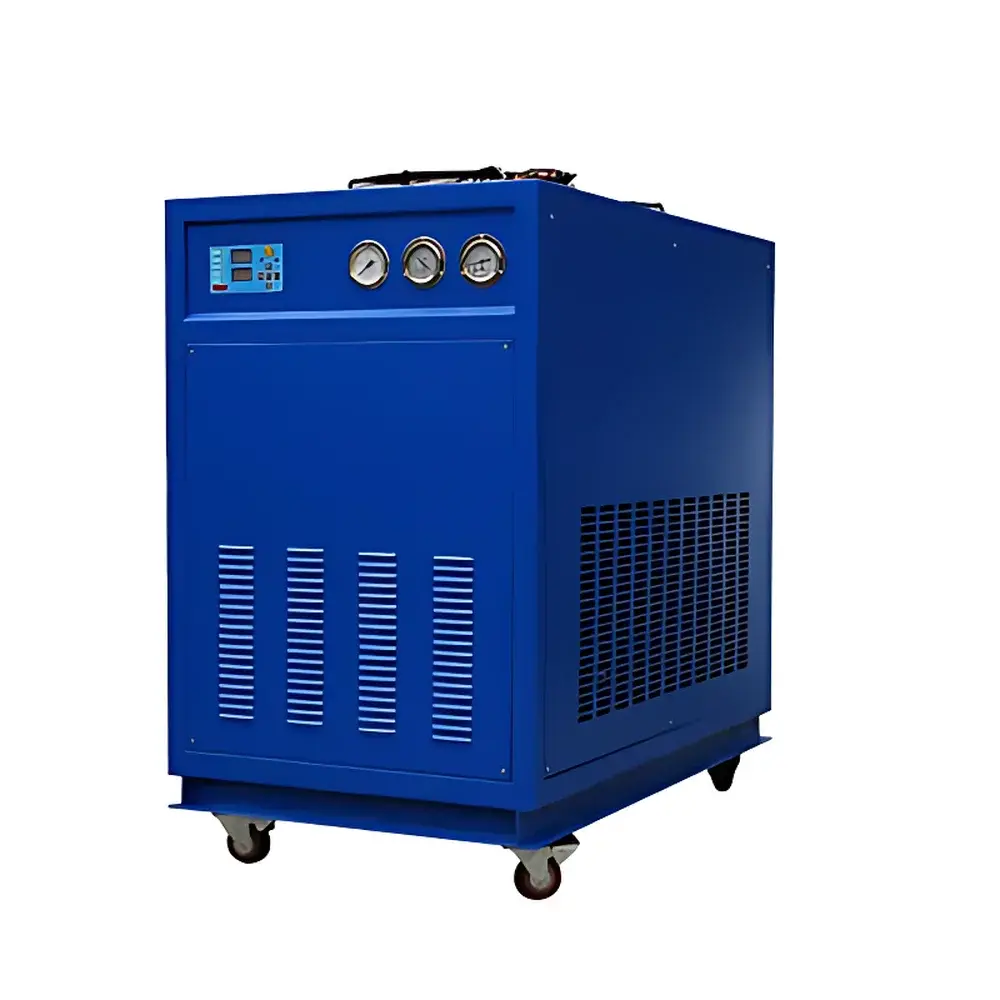
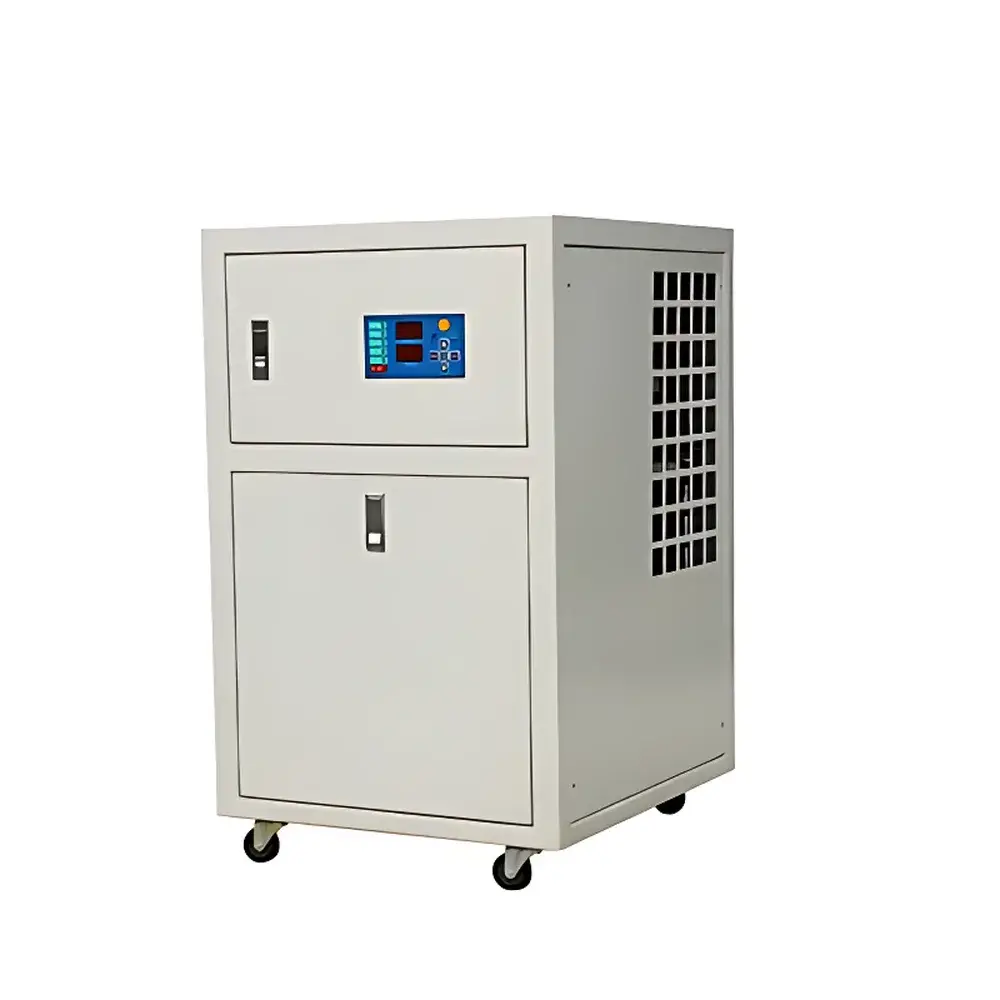
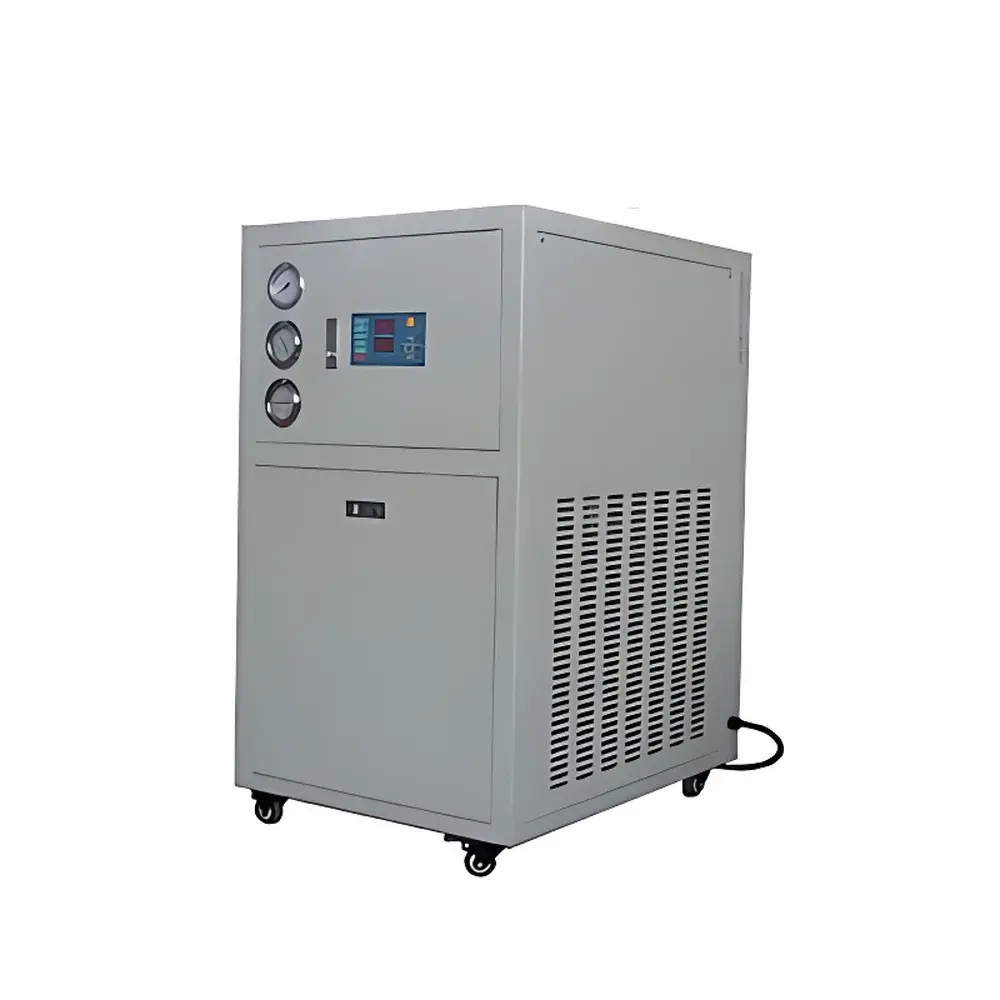
Tianfeng LS-23KW Integrated Circulating Chiller
| Brand | Tianfeng |
|---|---|
| Origin | Shanghai, China |
| Manufacturer Type | Direct Manufacturer |
| Instrument Type | Integrated Chiller |
| Cooling Method | Water-Cooled |
| Temperature Control Range | 0–40 °C |
| Refrigeration Capacity | 23 kW (20,000–25,000 kcal/h) |
| Temperature Stability | ±0.1 °C |
| Circulating Pump Pressure | 0–2.0 bar |
| Circulating Flow Rate | 0–38 L/min |
| Reservoir Volume | 180 L |
| Power Input | 7.8 kW |
| Supply Voltage | 220 V / 50 Hz |
| Dimensions (L×W×H) | 1350 × 900 × 1845 mm |
| Compressor | High-Efficiency Scroll Compressor |
| Safety Protections | Compressor Overheat Protection, High/Low Pressure Switches, Overcurrent Protection, Overshoot Temperature Cut-off |
| Construction | Stainless Steel Reservoir & Pump |
| Control System | Digital PID Temperature Controller (Optional RKC Controller Available) |
| Compliance | ISO 9001:2000 Certified Manufacturing |
| Operating Mode | Continuous Duty |
Overview
The Tianfeng LS-23KW Integrated Circulating Chiller is an engineered thermal management solution designed for precision temperature stabilization of heat-generating laboratory and industrial equipment. It operates on a closed-loop refrigeration cycle using R407C or R410A refrigerant (model-dependent), integrating a high-efficiency scroll compressor, thermostatic expansion valve (imported from Italy or Germany), and a stainless-steel reservoir with corrosion-resistant wetted parts. The chiller maintains precise fluid outlet temperatures between 0 °C and 40 °C with a stability of ±0.1 °C — critical for applications demanding reproducible thermal conditions over extended durations. Its design conforms to fundamental thermodynamic principles of vapor-compression refrigeration, where heat absorption occurs at the evaporator (cooling the circulating water/glycol mixture), followed by compression, condensation (via air- or water-cooled condenser), and expansion prior to re-entry into the evaporator loop. This system enables consistent heat extraction from sensitive instrumentation — including analytical spectrometers, electron microscopes, laser sources, and plasma-based systems — thereby preventing thermal drift, component degradation, and measurement artifacts.
Key Features
- Integrated architecture with compact footprint (1350 × 900 × 1845 mm), optimized for laboratory floor space constraints and integration into equipment racks or utility alcoves.
- Dual-mode operation: precise constant-temperature mode and adaptive intelligent temperature regulation that dynamically adjusts setpoint based on real-time load feedback.
- Stainless steel reservoir (180 L capacity) and pump housing ensure long-term resistance to corrosion, microbial growth, and chemical compatibility with aqueous or 30% ethylene glycol solutions.
- Digital PID controller with backlit LCD interface provides intuitive setpoint entry, real-time display of inlet/outlet temperatures, flow rate, and system status codes.
- Comprehensive safety architecture including compressor discharge temperature monitoring, high/low refrigerant pressure cutoffs, motor overcurrent protection, and thermal overload relays compliant with IEC 60204-1.
- Low-noise operation (<72 dB(A) at 1 m) achieved via vibration-damped compressor mounting, acoustically insulated condenser fan shrouds, and laminar-flow hydraulic design.
- Modular electrical cabinet featuring CE-marked components from Siemens, Schneider Electric, and Omron — supporting 220 V / 50 Hz single-phase input with built-in EMI filtering.
Sample Compatibility & Compliance
The LS-23KW chiller is compatible with a broad range of laboratory instrumentation requiring stable coolant supply at flow rates up to 38 L/min and differential pressures up to 2.0 bar. Verified integration includes graphite furnace atomic absorption spectrometers (GFAAS), inductively coupled plasma optical emission spectrometers (ICP-OES), inductively coupled plasma mass spectrometers (ICP-MS), X-ray fluorescence (XRF) analyzers, X-ray diffractometers (XRD), scanning electron microscopes (SEM), and transmission electron microscopes (TEM). All wetted materials comply with USP Class VI and FDA 21 CFR Part 11 material eligibility guidelines for indirect food contact and pharmaceutical-grade cooling loops. Manufacturing adheres to ISO 9001:2000 quality management standards; documentation packages include Factory Acceptance Test (FAT) reports, refrigerant charge certificates, and electrical safety compliance summaries per EN 61000-6-3 and EN 61000-6-4.
Software & Data Management
While the base unit operates via embedded hardware PID control without external software dependency, optional RS485 Modbus RTU or Ethernet TCP/IP interfaces enable integration into centralized facility monitoring systems (e.g., LabVantage, Thermo Fisher SampleManager, or custom SCADA platforms). Data logging capabilities support timestamped recording of outlet temperature, flow rate, compressor run time, and alarm events — traceable for GLP/GMP audit trails. Optional analog 4–20 mA outputs allow connection to building management systems (BMS) for predictive maintenance scheduling. Firmware updates are performed via secure USB interface; version history and calibration logs are retained in non-volatile memory with write-protection enabled by default.
Applications
- Materials Characterization: Stabilizes detector and source temperatures in XRD and XRF systems to minimize thermal lattice expansion effects on peak position accuracy.
- Elemental Analysis: Maintains graphite tube integrity and plasma torch stability in GFAAS and ICP-MS by regulating coolant temperature within ±0.1 °C across multi-hour analytical sequences.
- Electron Microscopy: Prevents thermal lensing in SEM/TEM column optics and suppresses specimen charging through controlled stage cooling.
- Laser Systems: Dissipates waste heat from DPSS, fiber, and CO₂ lasers used in ablation, LIBS, or confocal microscopy — preserving beam quality and diode lifetime.
- Vacuum & Thin-Film Deposition: Regulates target and substrate temperatures during sputtering and e-beam evaporation to control film stoichiometry and adhesion.
- Pharmaceutical QC: Supports dissolution testers, HPLC column ovens, and stability chambers requiring validated thermal uniformity per USP & ICH Q1 guidelines.
FAQ
What is the recommended maximum return water temperature for continuous operation?
For optimal compressor longevity and system efficiency, return water temperature should not exceed 40 °C. Sustained inlet temperatures above this threshold increase condensing pressure and reduce volumetric efficiency.
Can the chiller operate with 30% ethylene glycol/water mixture?
Yes — the stainless steel reservoir, pump, and heat exchanger are fully compatible with inhibited glycol solutions up to 35% concentration for sub-zero ambient operation or freeze protection.
Is remote monitoring supported out-of-the-box?
Standard configuration includes local digital display only. Remote connectivity requires optional communication module installation and configuration via Modbus register mapping or TCP/IP socket protocol.
Does the unit meet electromagnetic compatibility requirements for use in regulated laboratories?
Yes — certified to EN 61000-6-3 (emission) and EN 61000-6-4 (immunity) standards, with conducted and radiated emissions tested per CISPR 11 Group 1, Class A limits.
What maintenance intervals are recommended for laboratory-grade operation?
Filter driers should be replaced every 24 months; refrigerant oil analysis is advised annually; condenser coil cleaning frequency depends on ambient particulate load but typically ranges from quarterly to semiannually.
Related Products



