
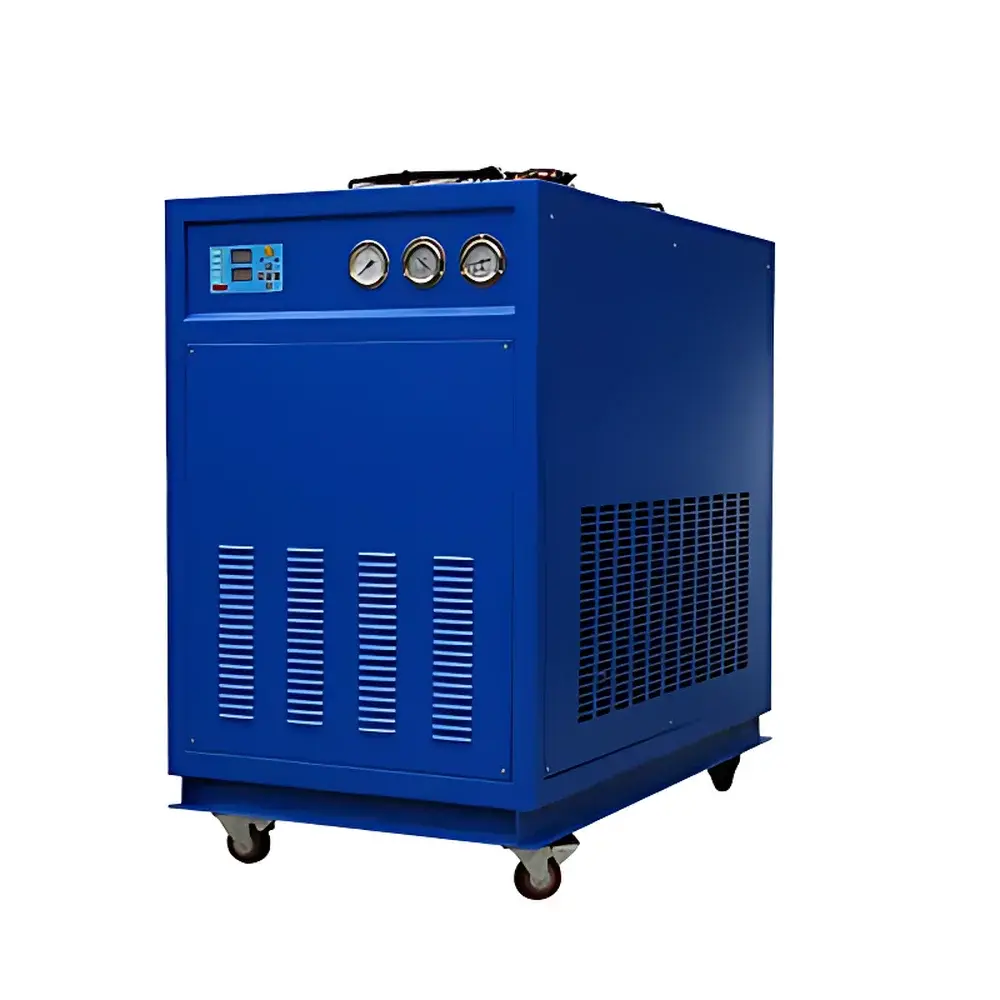
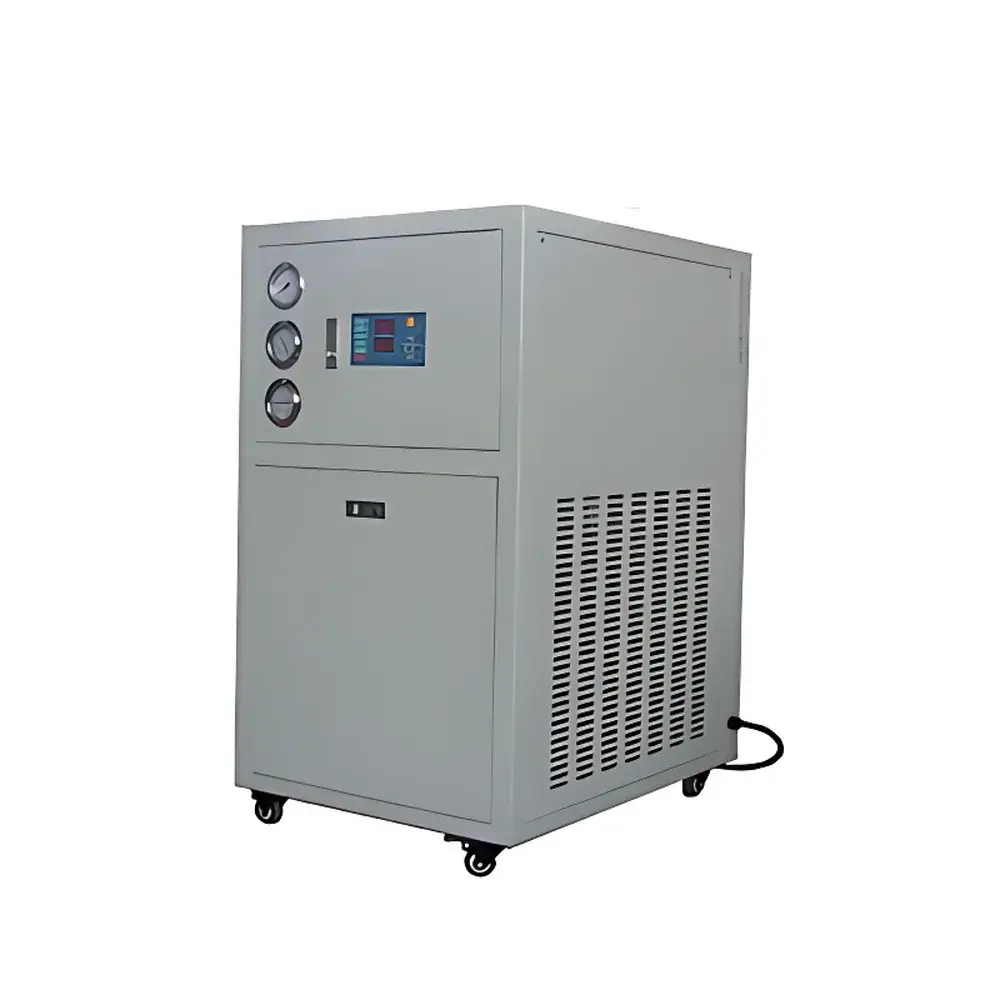
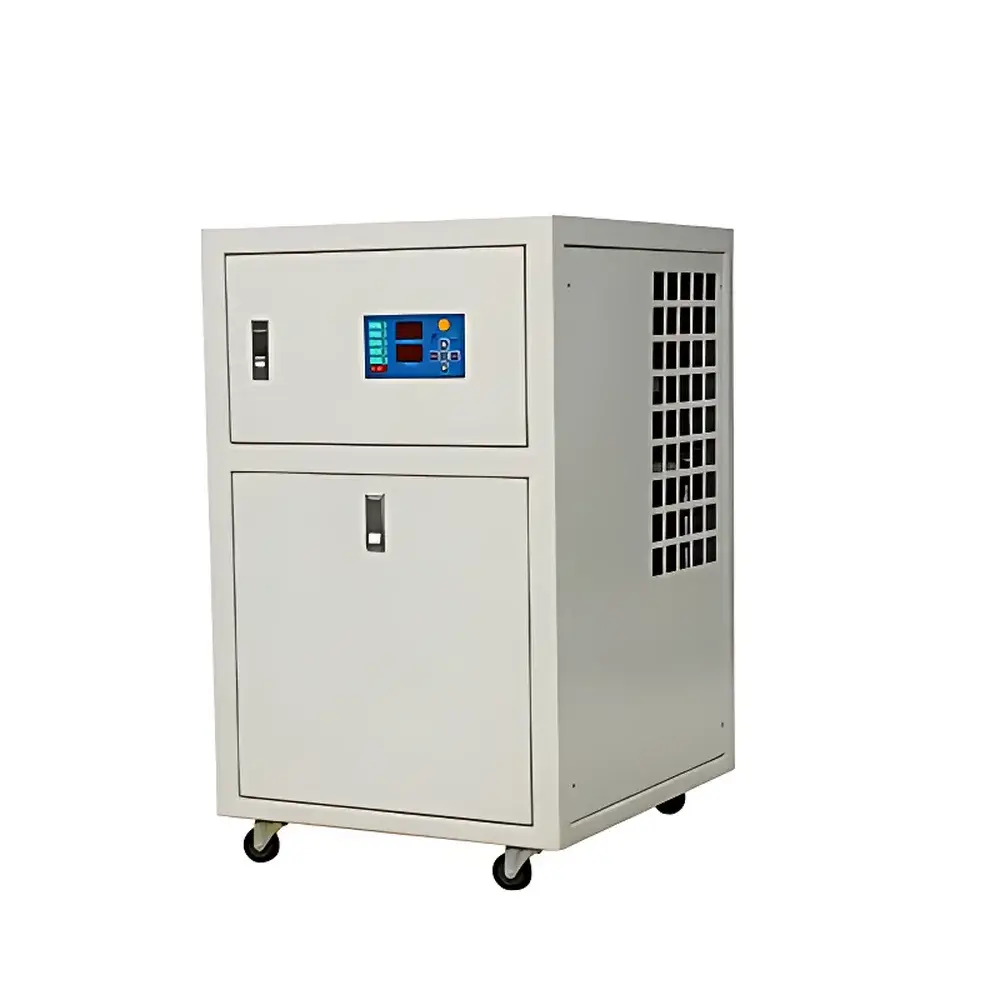
Tianfeng LS-23KW Screw-Type Circulating Chiller
| Brand | Tianfeng |
|---|---|
| Origin | Shanghai, China |
| Manufacturer Type | Direct Manufacturer |
| Equipment Type | Integrated Circulating Chiller |
| Cooling Method | Water-Cooled |
| Refrigeration Capacity | 23 kW (at 7°C/12°C water inlet/outlet, 30°C/40°C ambient) |
| Temperature Stability | ±0.3°C (typical, 5–30°C operating range) |
| Circulating Pump Pressure | 0–2 kgf/cm² |
| Circulating Flow Rate | 0–60 L/min |
| Reservoir Volume | 180 L |
| Power Input | 7.8 kW |
| Voltage/Frequency | 220 V, 50 Hz |
| Dimensions (L×W×H) | 1350 × 900 × 1845 mm |
| Safety Protections | Compressor overheat, overcurrent, high/low pressure, and overtemperature protection |
| Construction | Stainless steel reservoir and pump |
| Control System | Digital PID temperature controller (standard Chinese OEM unit |
| Compressor | High-efficiency scroll compressor |
| Key Components | Italian/German expansion valves & solenoid valves |
| Noise Level | <72 dB(A) at 1 m |
Overview
The Tianfeng LS-23KW Screw-Type Circulating Chiller is an integrated, water-cooled precision cooling system engineered for stable thermal management of high-heat-load laboratory and industrial equipment. It operates on vapor-compression refrigeration cycle with a high-efficiency scroll compressor, delivering consistent cooling capacity of 23 kW under standard conditions (7°C outlet / 12°C inlet chilled water; 30°C ambient inlet / 40°C outlet cooling water). Designed for continuous-duty operation in controlled environments, the unit maintains precise temperature setpoints between 5°C and 30°C with typical stability of ±0.3°C—critical for applications demanding thermal repeatability across analytical instrumentation, vacuum systems, and high-power laser sources. Its compact footprint (1350 × 900 × 1845 mm), stainless-steel fluid path, and integrated pump/reservoir architecture eliminate external plumbing complexity while supporting closed-loop circulation at adjustable flow rates (0–60 L/min) and pressure (0–2 kgf/cm²).
Key Features
- Integrated design with built-in 180 L stainless steel reservoir, corrosion-resistant pump, and digital PID temperature controller for plug-and-play deployment.
- High-reliability scroll compressor paired with internationally sourced refrigeration components—including Italian expansion valves and German solenoid valves—ensuring long-term operational integrity.
- Dual-mode operation: fixed-setpoint constant-temperature mode and adaptive intelligent temperature modulation, dynamically adjusting output based on real-time load feedback.
- Comprehensive safety architecture: compressor overheat protection, high/low refrigerant pressure cutoffs, overcurrent detection, and overtemperature alarm with fault signal output.
- Human-machine interface with large-digit LED display for instantaneous water temperature readout, intuitive parameter adjustment, and status diagnostics.
- Electrical compliance with IEC 61000-6-2/6-4 immunity and emission standards; equipped with Schneider or Omron contactors, Siemens PLC-compatible control logic, and UL-listed terminal blocks.
Sample Compatibility & Compliance
The LS-23KW chiller is compatible with a broad spectrum of heat-generating laboratory instruments requiring stable coolant delivery, including graphite furnace atomic absorption spectrometers (GFAAS), inductively coupled plasma optical emission spectrometers (ICP-OES), ICP-mass spectrometers (ICP-MS), X-ray fluorescence (XRF) and X-ray diffraction (XRD) systems, scanning electron microscopes (SEM), and transmission electron microscopes (TEM). Its thermal output profile meets ASTM E2654-22 requirements for chilled water system performance verification and supports GLP-compliant operation when integrated with validated temperature logging protocols. While not certified to FDA 21 CFR Part 11 out-of-the-box, the unit’s analog/digital alarm outputs and RS485 Modbus RTU interface enable integration into audit-trail-capable SCADA or LIMS platforms for regulated environments.
Software & Data Management
The chiller features native RS485 Modbus RTU communication for integration with building management systems (BMS), lab automation controllers, or custom monitoring software. Optional analog 4–20 mA output signals provide real-time temperature and status feedback to programmable logic controllers (PLCs). Although the base controller lacks embedded data logging, third-party DAQ systems can record timestamps, setpoint deviations, pump flow pulses, and alarm events—supporting ISO/IEC 17025 traceability requirements when paired with calibrated NIST-traceable temperature sensors. Firmware updates are performed via physical USB interface; configuration parameters are retained during power cycling.
Applications
This chiller serves as a primary thermal management solution for both laboratory and light-industrial settings. In analytical laboratories, it stabilizes detector temperatures in XRD and XRF systems to minimize thermal drift in Bragg angle measurements and spectral baseline noise. For electron microscopy, it maintains cold-stage and column cooling circuits within ±0.5°C tolerance—essential for reducing thermal lensing and improving image resolution consistency. In laser-based instrumentation (e.g., femtosecond oscillators, CO₂ cutting lasers), it prevents wavelength shift and power instability caused by diode junction heating. Beyond labs, it cools CNC machine tool hydraulic oil, injection molding dies, and semiconductor process chillers—where maintaining 5–30°C coolant temperature directly impacts dimensional accuracy, surface finish, and cycle time reproducibility per ISO 230-3 machine tool testing standards.
FAQ
What is the maximum allowable return water temperature for continuous operation?
For sustained compressor longevity, return water temperature should not exceed 40°C. Elevated return temperatures increase condensing pressure and reduce volumetric efficiency—potentially triggering high-pressure cutouts.
Can this chiller be integrated into a facility’s central monitoring system?
Yes. The standard RS485 Modbus RTU port enables bidirectional communication with BMS, PLCs, or custom HMI interfaces for remote start/stop, setpoint adjustment, and alarm status polling.
Is the reservoir insulated to minimize ambient heat gain?
The 180 L stainless steel tank includes factory-applied closed-cell elastomeric insulation (25 mm thickness) meeting ASTM C534 thermal conductivity specifications, reducing standby heat ingress by >65% compared to bare-metal tanks.
Does the unit comply with electromagnetic compatibility (EMC) directives for laboratory use?
It conforms to IEC 61000-6-2 (immunity) and IEC 61000-6-4 (emission) standards for industrial environments, ensuring minimal interference with adjacent sensitive measurement electronics.
What maintenance intervals are recommended for optimal service life?
Compressor oil analysis every 4,000 operating hours; refrigerant circuit leak check annually; condenser coil cleaning quarterly in dusty environments; and full system performance validation per ISO 5149-2 every 24 months.



