
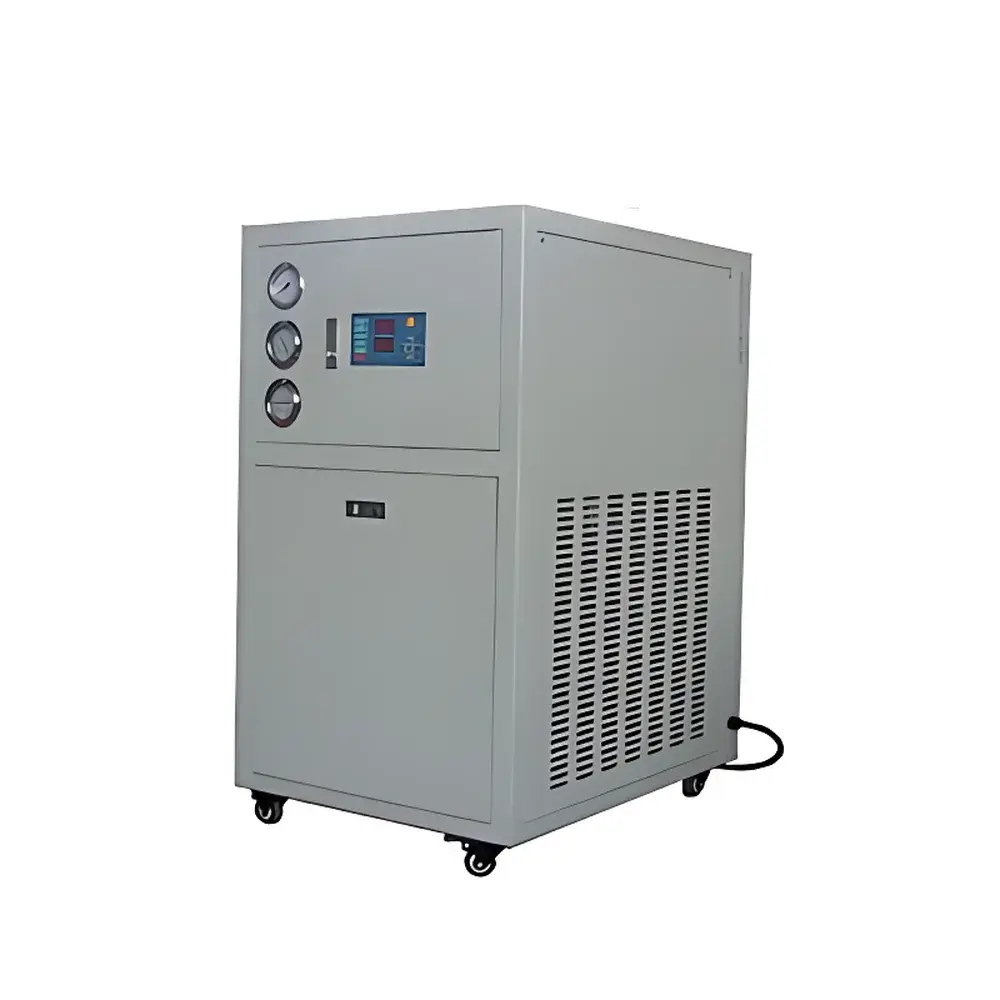
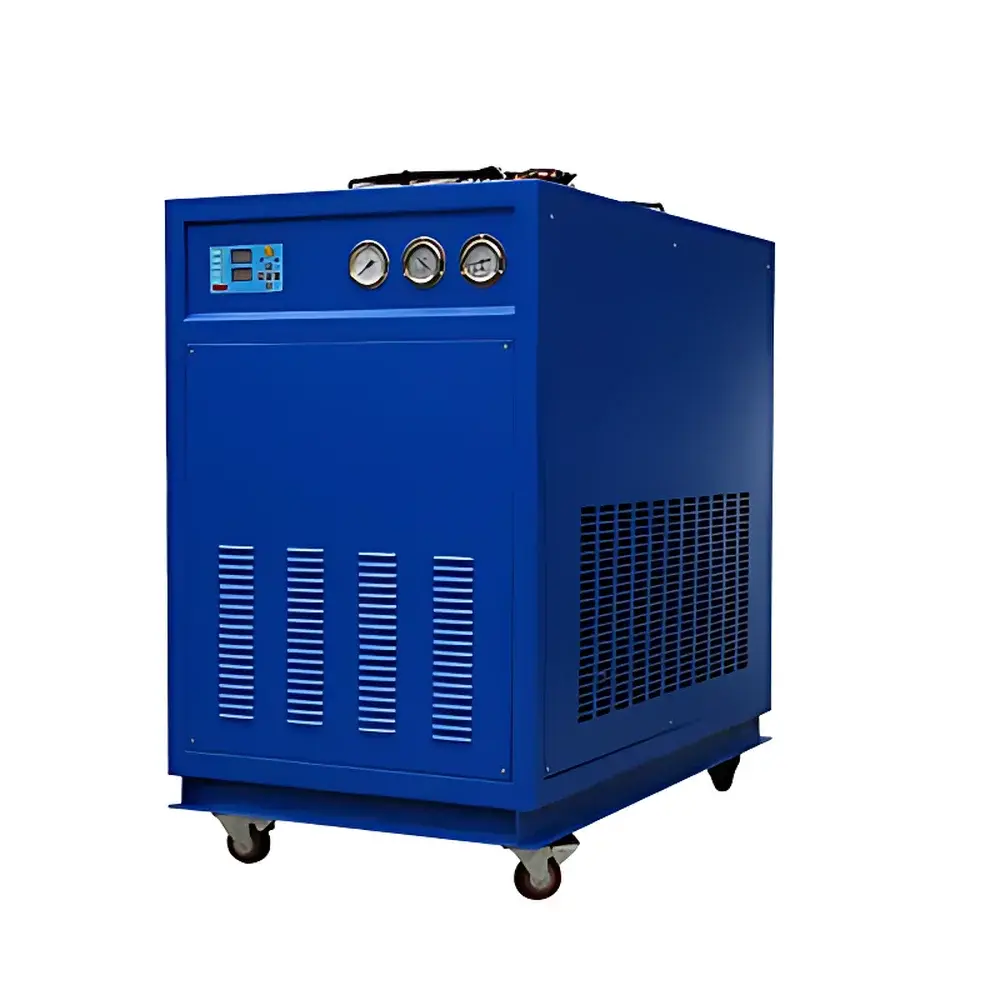
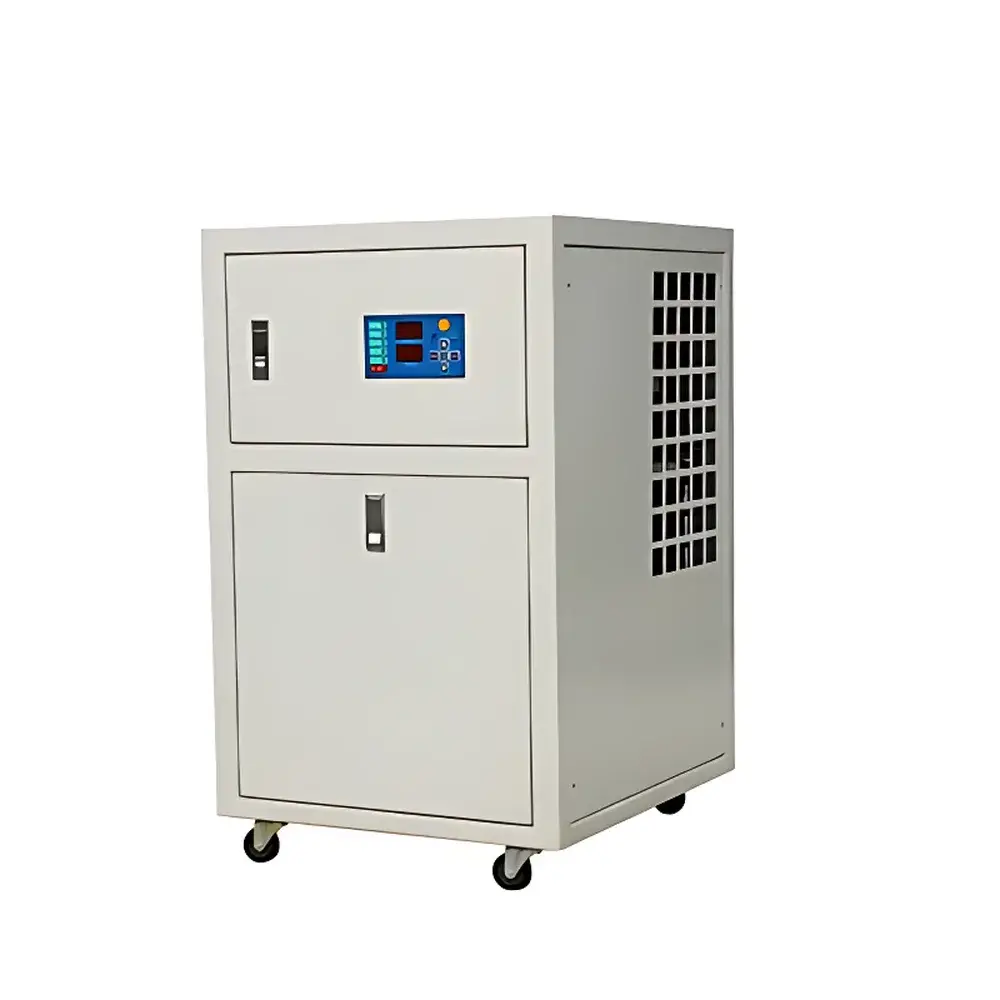
Tianfeng LS-4.5KW Integrated Laser Circulating Chiller
| Brand | Tianfeng |
|---|---|
| Origin | Shanghai, China |
| Manufacturer Type | Direct Manufacturer |
| Product Category | Domestic |
| Model | Tianfeng-LS-4.5KW |
| Instrument Type | Integrated Unit |
| Cooling Method | Water-Cooled |
| Temperature Control Range | 0–40 °C |
| Refrigeration Capacity | 300–9000 W |
| Temperature Stability | ±0.1 °C |
| Circulating Pump Pressure | 2.0 bar |
| Circulating Pump Flow Rate | 38 L/min |
| Reservoir Volume | 45 L |
| Operating Mode | Continuous |
| Compressor Type | Scroll Compressor |
| Power Input | 2.2 kW |
| Voltage/Frequency | 220 V / 50 Hz |
| Dimensions (L×W×H) | 800 × 600 × 1065 mm |
| Safety Protections | Compressor Overheat Protection, Overcurrent Protection, High/Low Pressure Switches, Overtemperature Alarm |
| Construction | Stainless Steel Reservoir & Pump |
| Controller | Digital PID Temperature Controller (Optional RKC Japan) |
| Electrical Components | Siemens / Schneider / Omron |
| Refrigeration Components | Imported Expansion Valve & Solenoid Valve (Italy/Germany) |
Overview
The Tianfeng LS-4.5KW Integrated Laser Circulating Chiller is a precision-engineered refrigeration system designed for stable, continuous thermal management of high-heat-load laboratory and industrial equipment. It operates on a closed-loop vapor-compression cycle utilizing a high-efficiency scroll compressor, R410A refrigerant, and a copper-aluminum finned condenser with optimized airflow dynamics. Unlike air-cooled units, this water-cooled chiller delivers superior heat rejection consistency—critical when ambient temperature fluctuations or spatial constraints compromise performance. Its core function is to maintain process fluid (deionized water or water-glycol mixtures) within a tightly controlled temperature band (0–40 °C, ±0.1 °C stability), ensuring thermal equilibrium in sensitive instrumentation such as laser sources, electron microscopes, X-ray diffractometers, and plasma spectrometers. The unit’s integrated architecture eliminates external piping complexity while preserving service accessibility and minimizing footprint—making it suitable for ISO-classified labs, GMP-compliant analytical suites, and compact manufacturing cells where floor space and acoustic emission are constrained.
Key Features
- High-stability PID temperature control with digital display and real-time setpoint adjustment (resolution: 0.1 °C)
- Stainless steel reservoir (45 L capacity) and corrosion-resistant circulation pump rated for continuous operation at 38 L/min flow and 2.0 bar pressure
- Dual-mode operation: fixed-temperature hold and adaptive intelligent cooling that modulates compressor speed and valve actuation in response to load transients
- Comprehensive safety architecture including dual-stage high/low pressure switches, compressor winding overheat sensors, phase-loss detection, and overtemperature cutoff
- UL-listed electrical components (Siemens contactors, Omron relays, Schneider circuit breakers) and imported thermostatic expansion valves (Italy/Germany) for long-term refrigerant metering accuracy
- Low-noise design (<65 dB(A) at 1 m) achieved via anti-vibration mounting, acoustic insulation, and optimized fan blade geometry
- Modular internal layout enabling field-replaceable subassemblies without full system disassembly
Sample Compatibility & Compliance
This chiller is compatible with a broad spectrum of analytical, materials science, and semiconductor tools requiring precise coolant temperature regulation—including but not limited to graphite furnace atomic absorption spectrometers (GFAAS), inductively coupled plasma optical emission spectrometers (ICP-OES), ICP-mass spectrometers (ICP-MS), X-ray fluorescence (XRF) analyzers, scanning/transmission electron microscopes (SEM/TEM), and laser-based material processing systems (e.g., fiber lasers, CO₂ lasers, ultrafast amplifiers). It meets ISO 9001:2015 quality management system requirements and incorporates design elements aligned with IEC 61000-6-3 (EMC emissions) and IEC 61000-6-2 (immunity). While not certified to FDA 21 CFR Part 11 out-of-the-box, its analog/digital I/O interface supports integration into validated environments when paired with compliant data acquisition hardware and audit-trail-enabled SCADA software.
Software & Data Management
The LS-4.5KW operates autonomously via embedded firmware with no external PC dependency. All operational parameters—including inlet/outlet fluid temperature, pump status, compressor run time, fault logs, and safety interlock states—are stored in non-volatile memory with timestamped event history (retention: ≥10,000 entries). Optional RS485 Modbus RTU or Ethernet TCP/IP communication modules enable remote monitoring and integration into centralized facility management systems (BMS) or LIMS platforms. For regulated environments, optional firmware upgrades support configurable alarm thresholds, password-protected parameter changes, and electronic signature-capable operator logins—facilitating compliance with GLP and GMP documentation requirements. Raw sensor data export (CSV format) is available via USB port for post-acquisition trend analysis.
Applications
- Laboratory Instrument Cooling: Stabilizes thermal drift in high-resolution XRD goniometers, prevents detector saturation in cryo-TEM stages, and maintains optimal gain in photomultiplier tubes used in fluorescence spectrometry.
- Laser Systems: Removes waste heat from diode-pumped solid-state (DPSS) lasers and fiber laser pump diodes, directly influencing beam pointing stability, wavelength reproducibility, and diode lifetime.
- Materials Processing: Controls mold temperature in precision injection molding, reduces thermal deformation in CNC machining centers, and stabilizes dielectric properties during RF plasma etching.
- Pharmaceutical & Biotech: Regulates jacket temperature in bioreactors and chromatography columns; maintains consistent eluent viscosity in HPLC/UHPLC systems.
- Vacuum & Thin-Film Deposition: Manages heat load on magnetron sputtering targets and electron beam evaporation sources to prevent arcing and ensure film stoichiometry.
FAQ
What is the recommended coolant composition for long-term operation?
Deionized water with ≤20% propylene glycol (inhibited, USP-grade) is recommended for sub-ambient operation or freeze protection. Pure deionized water suffices for 5–35 °C applications. Conductivity must remain <5 µS/cm to prevent galvanic corrosion.
Can this chiller be integrated into a building automation system (BAS)?
Yes—via optional Modbus RTU (RS485) or BACnet/IP (Ethernet) interface modules. Configuration includes programmable analog outputs (4–20 mA) for remote temperature feedback and digital inputs for emergency shutdown signaling.
Is the unit suitable for cleanroom environments?
It meets ISO Class 7 particulate limits when installed outside the cleanroom with only coolant lines penetrating the wall. Optional HEPA-filtered intake kits and low-outgassing elastomers are available for Class 5 integration.
What maintenance intervals are required to sustain ±0.1 °C stability?
Quarterly inspection of condenser coil cleanliness and refrigerant charge verification; annual replacement of desiccant filter-drier and calibration of temperature sensors traceable to NIST standards.
Does the chiller support external flow control or pressure regulation?
Yes—the standard 3/4″ BSP inlet/outlet ports accept industry-standard flow meters, pressure regulators, and solenoid valves. An optional external flow switch kit enables interlock-based shutdown if minimum flow is not detected.



