
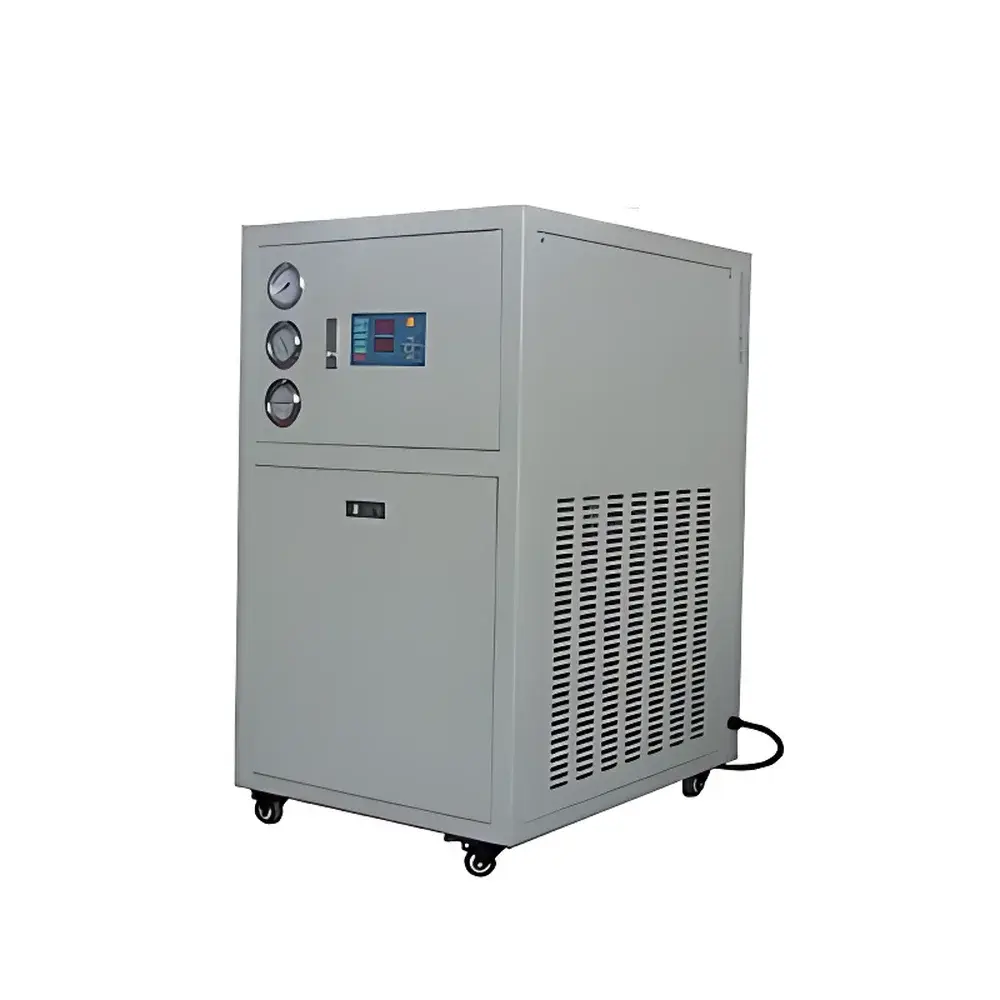
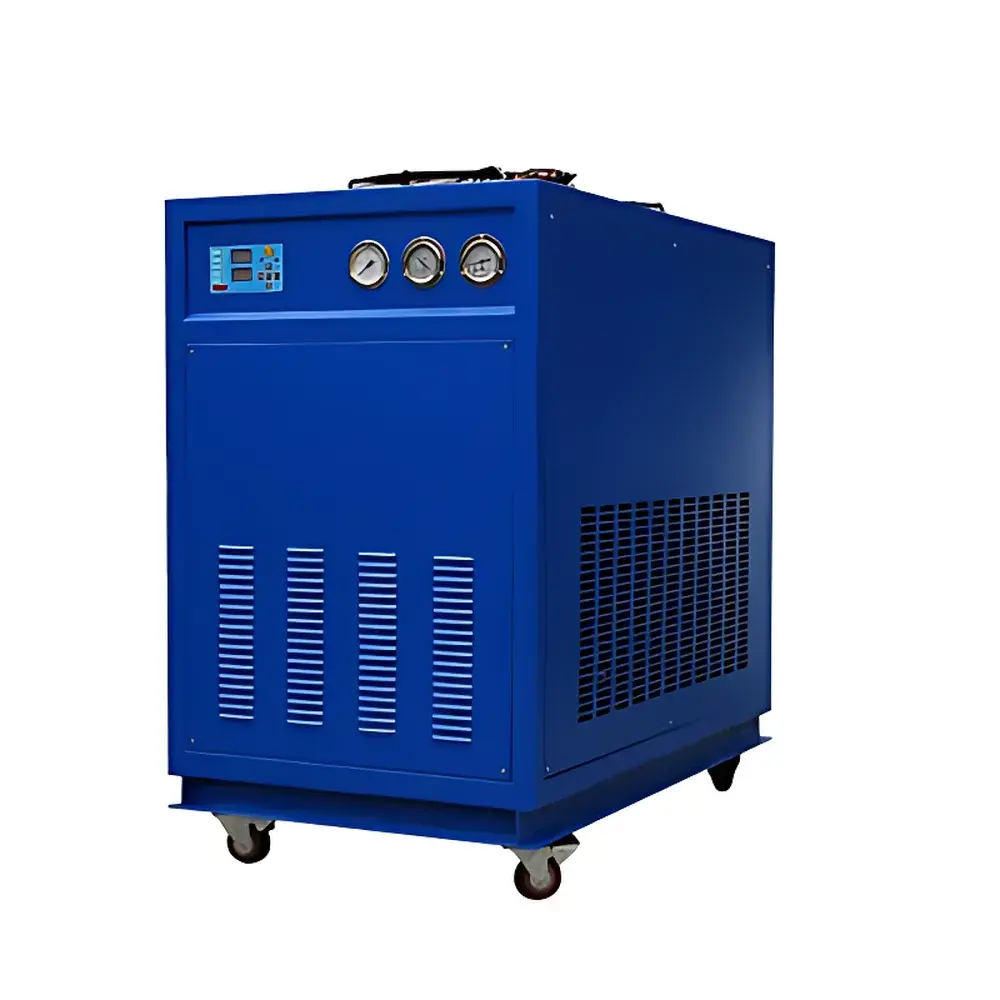
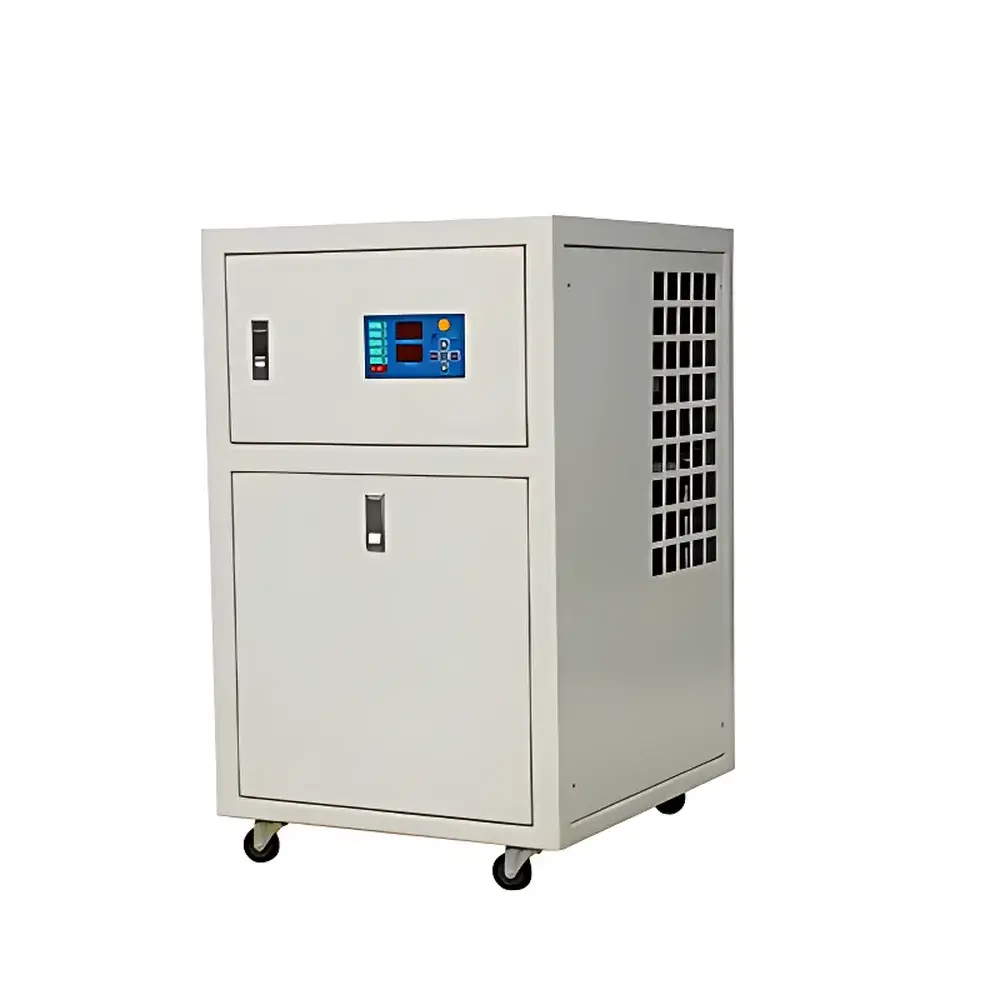
Tianfeng LS-4KW Integrated Circulating Chiller
| Brand | Tianfeng |
|---|---|
| Origin | Shanghai, China |
| Manufacturer Type | Direct Manufacturer |
| Equipment Type | Integrated Circulating Chiller |
| Cooling Method | Water-Cooled |
| Rated Refrigeration Capacity | 4 kW |
| Water Tank Volume | 45 L |
| Circulating Pump Flow Rate | 0–60 L/min |
| Circulating Pump Pressure | 0–2 kgf/cm² |
| Input Power | 1.8 kW |
| Temperature Control Range | 5–30 °C |
| Temperature Stability | ±0.3 °C |
| Power Supply | 220 V, 50 Hz |
| Dimensions (L×W×H) | 800 × 600 × 1065 mm |
| Safety Protections | Compressor Overheat Protection, Overcurrent Protection, High/Low Pressure Switches, Overtemperature Alarm |
| Key Components | Scroll Compressor, Italian/German Expansion Valve & Solenoid Valve, Stainless Steel Reservoir & Pump, Siemens/Schneider/Omron Electrical Controls |
| Optional Controller | RKC (Japan) Temperature Controller |
Overview
The Tianfeng LS-4KW Integrated Circulating Chiller is an engineered solution for precision temperature control in demanding laboratory and industrial environments. Designed using thermodynamic principles of vapor-compression refrigeration, it delivers stable, continuous cooling through a closed-loop water circulation system. Its core function is to absorb heat from process equipment—such as analytical instruments, laser systems, vacuum chambers, or high-speed spindles—and reject it via a water-cooled condenser. This enables consistent thermal management critical for instrument stability, measurement repeatability, and component longevity. The unit operates within a controlled temperature range of 5–30 °C, with typical setpoint stability of ±0.3 °C under steady-state conditions—a specification aligned with ISO/IEC 17025 requirements for environmental conditioning of metrology-critical instrumentation.
Key Features
- Integrated architecture with compact footprint (800 × 600 × 1065 mm), optimized for placement beneath lab benches or adjacent to sensitive equipment.
- High-efficiency scroll compressor delivering reliable 4 kW nominal refrigeration capacity at standard operating conditions (chilled water inlet 12 °C, outlet 7 °C; ambient cooling water inlet 30 °C, outlet 40 °C).
- Stainless steel reservoir (45 L capacity) and corrosion-resistant pump ensure long-term fluid integrity and compatibility with deionized or inhibited coolant solutions.
- Digital PID temperature controller with real-time display of outlet water temperature; optional upgrade to RKC (Japan) controller for enhanced resolution and programmable ramp-soak profiles.
- Multi-layer safety system including compressor overheat detection, high/low refrigerant pressure cutouts, overcurrent protection, and overtemperature alarm with relay output for external interlock integration.
- Adjustable flow (0–60 L/min) and pressure (0–2 kgf/cm²) regulation to match variable thermal loads across diverse instrumentation interfaces.
- Low-noise operation (<65 dB(A) at 1 m), suitable for shared laboratory spaces where acoustic interference must be minimized.
Sample Compatibility & Compliance
The LS-4KW chiller is routinely deployed with high-value analytical platforms requiring active thermal stabilization—including graphite furnace atomic absorption spectrometers (GFAAS), inductively coupled plasma optical emission spectrometers (ICP-OES), ICP-mass spectrometers (ICP-MS), X-ray fluorescence (XRF) and X-ray diffraction (XRD) systems, scanning electron microscopes (SEM), and transmission electron microscopes (TEM). Its design supports compliance with GLP and GMP operational frameworks: temperature setpoints, actual outlet temperatures, alarm events, and runtime logs are recordable via analog/digital outputs or optional RS485 Modbus RTU interface—facilitating audit-ready data traceability per FDA 21 CFR Part 11 when integrated with validated laboratory information management systems (LIMS). All electrical components meet IEC 61000-6-3 (EMC) and IEC 61000-6-4 standards; the unit carries CE marking and ISO 9001:2000 certification for design and manufacturing quality control.
Software & Data Management
While the base configuration features a standalone digital controller, the LS-4KW supports third-party integration via 0–10 VDC analog input/output and Modbus RTU (RS485) communication protocol. This enables remote monitoring and setpoint adjustment from centralized SCADA or LIMS platforms. Optional firmware upgrades provide time-stamped event logging—including compressor start/stop cycles, fault triggers, and temperature deviations—stored internally for up to 30 days. For regulated laboratories, this data stream may be captured by compliant electronic lab notebooks (ELN) or validated data acquisition software to satisfy ALCOA+ (Attributable, Legible, Contemporaneous, Original, Accurate, Complete, Consistent, Enduring, Available) data integrity principles.
Applications
Beyond laboratory instrumentation cooling, the LS-4KW serves cross-sector thermal management needs: in semiconductor fabrication, it stabilizes wafer chuck temperatures during lithography and etching; in medical device manufacturing, it controls coolant temperature for ultrasonic cleaning baths to prevent solvent degradation; in plastics processing, it maintains mold surface temperature within ±0.5 °C to reduce warpage and improve surface finish; in precision machining, it regulates hydraulic oil temperature to minimize thermal drift in CNC coordinate measuring machines (CMMs); and in pharmaceutical R&D, it provides consistent jacket temperature for bioreactors and fermentation vessels operating under cGMP-aligned protocols.
FAQ
What is the recommended maximum return water temperature for continuous operation?
For optimal compressor lifespan and system efficiency, the chilled water return temperature should not exceed 40 °C. Sustained inlet temperatures above this threshold increase discharge pressure and accelerate refrigerant oil degradation.
Can this chiller operate with deionized water?
Yes—its stainless steel reservoir, pump housing, and titanium-plated heat exchanger surfaces are compatible with deionized or glycol-inhibited coolants; however, conductivity monitoring and periodic pH testing are advised to prevent galvanic corrosion in mixed-metal loops.
Is remote monitoring supported out of the box?
Standard units include analog I/O for basic integration; full Modbus RTU capability requires factory configuration and is enabled via optional communication module installation.
What maintenance intervals are recommended for laboratory-grade reliability?
Compressor oil and refrigerant filter driers should be replaced every 24 months under continuous operation; condenser coil cleaning and coolant analysis are recommended quarterly in high-dust or high-humidity environments.
Does the unit comply with energy efficiency regulations for EU export?
Yes—the scroll compressor and optimized refrigerant circuit meet Ecodesign Directive (EU) 2016/2281 requirements for energy-related products, with measured seasonal energy efficiency ratio (SEER) exceeding 3.2 under EN 14825 test conditions.



