
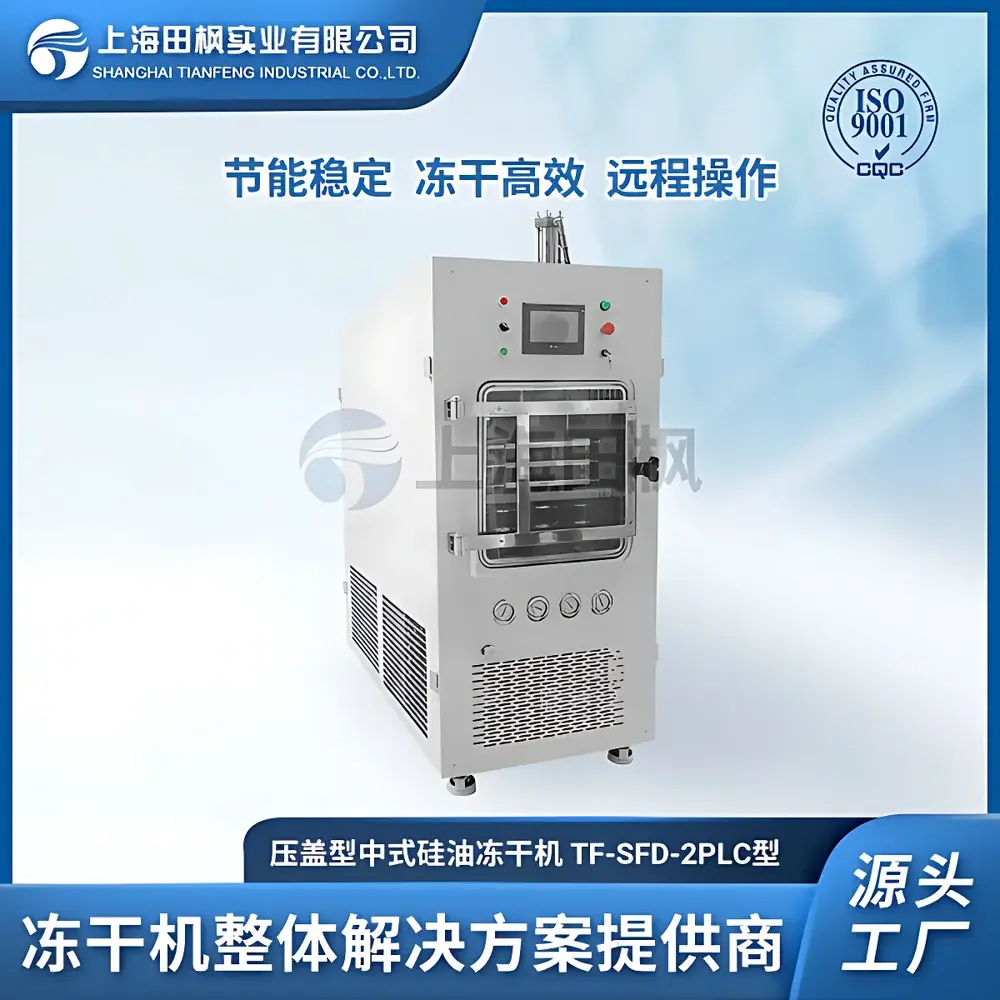
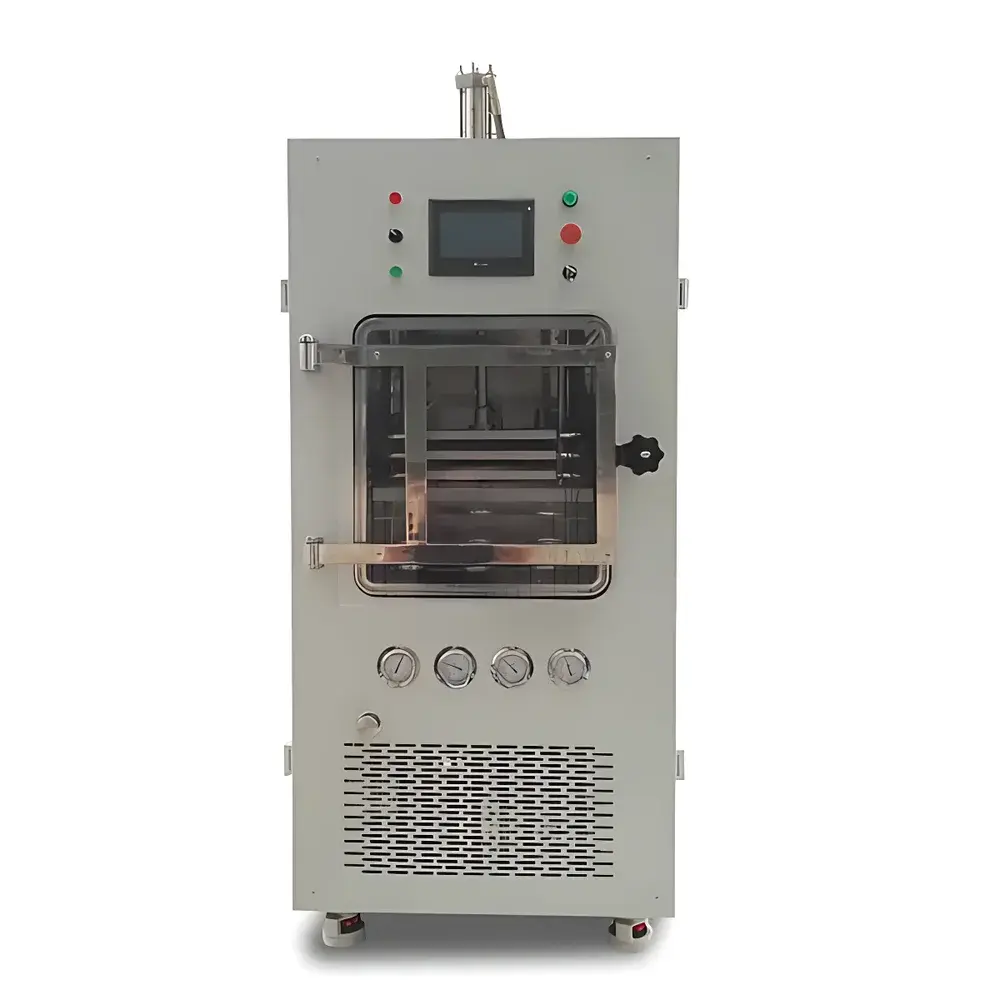
Tianfeng SFD-2 Silicon Oil Heated Pilot-Scale Freeze Dryer
| Brand | Tianfeng |
|---|---|
| Origin | Shanghai, China |
| Manufacturer Type | OEM/ODM Manufacturer |
| Instrument Type | Shelf-Type In-Situ Freeze Dryer |
| Application Scope | Pilot Production & R&D |
| Lyophilization Area | 0.21 m² |
| Ultimate Vacuum | ≤5 Pa |
| Condenser Temperature | ≤−70 °C |
| Ice Capacity (24 h) | 3 kg |
| Shelf Dimensions | 278 mm (W) × 380 mm (L) |
| Shelf Spacing | 70 mm |
| Number of Shelves | 2 + 1 (condenser shelf) |
| Shelf Temperature Range | −50 °C to +80 °C |
| Power Consumption | 3 kW |
| Net Weight | 400 kg |
| Chamber Viewing Window | High-transparency acrylic door |
| Refrigeration System | Cascade refrigeration with imported compressors |
| Heating Medium | Silicone oil (±1 °C uniformity) |
| Control Interface | 7-inch color touch LCD with real-time temperature/pressure curve logging |
| Compliance | ISO 9001:2000 certified design |
Overview
The Tianfeng SFD-2 is a pilot-scale, in-situ silicon oil heated freeze dryer engineered for reproducible lyophilization of heat-sensitive biologicals, pharmaceutical intermediates, and fermentation-derived powders—including veterinary probiotics, microbial cultures, and enzyme preparations. It operates on the fundamental principle of sublimation: aqueous samples are first frozen solid at controlled low temperatures (≤−50 °C), then subjected to deep vacuum (≤5 Pa) while applying precise, uniform conductive heating via silicone oil-circulated shelves. This enables water to transition directly from ice to vapor without passing through the liquid phase—preserving structural integrity, bioactivity, and reconstitution fidelity. Unlike steam-heated or electric-resistance systems, silicone oil delivers exceptional thermal stability (±1 °C across shelf surface) and eliminates hot spots, critical for consistent cake morphology and residual moisture control in GMP-aligned batch processing.
Key Features
- In-situ pre-freezing and drying within a single chamber—eliminates manual transfer, reduces contamination risk, and improves process repeatability.
- Silicone oil heating system with PID-controlled circulation ensures ±1 °C temperature uniformity across all shelves, enabling precise primary and secondary drying ramping.
- Cascade refrigeration architecture using high-efficiency imported compressors achieves ≤−70 °C condenser temperature and 3 kg/24 h ice capture capacity—optimized for high-moisture fermentation broths and viscous suspensions.
- 7-inch color touchscreen interface displays real-time shelf temperature, chamber pressure, condenser temperature, and multi-channel drying curves—supporting intuitive parameter adjustment and protocol recall.
- Stainless steel 304 construction throughout the drying chamber, shelves, and condenser housing ensures corrosion resistance, cleanability, and compliance with ISO 14644-1 Class 7 cleanroom-compatible maintenance protocols.
- Optional features include an integrated inert gas (N₂ or Ar) backfill valve, co-crystallization point detection module, automatic stoppering actuator, and FDA 21 CFR Part 11–compliant temperature data logger with electronic signature support.
Sample Compatibility & Compliance
The SFD-2 accommodates vials (Φ16 mm: up to 858 units/batch; Φ20 mm: up to 432 units), serum bottles, and open trays holding up to 3 L total liquid volume. Its −50 °C to +80 °C shelf range supports freezing of high-sugar or high-salt formulations, controlled annealing steps, and elevated secondary drying for residual moisture reduction (<1.5% w/w typical). The system meets ISO 9001:2000 quality management requirements and is routinely validated per ASTM F2375–22 (Standard Guide for Validation of Freeze Drying Processes) and USP (Sterile Product Manufacturing). When configured with time-stamped, password-protected data logging and change audit trails, it satisfies GLP and GMP documentation expectations for regulatory submissions.
Software & Data Management
Embedded firmware records all critical process parameters at user-defined intervals (1–60 sec resolution) and stores them in encrypted CSV format on internal flash memory or external USB drive. Optional PC-based software enables post-run analysis of drying kinetics, endpoint determination via pressure rise test (PRT), and comparative batch trending. Audit trail functionality logs operator ID, timestamp, parameter modifications, and alarm events—fully compliant with FDA 21 CFR Part 11 requirements when deployed with system-level access controls and electronic signatures.
Applications
This unit is widely deployed in biopharmaceutical R&D labs for lyophilizing monoclonal antibody formulations, live attenuated vaccines, and cell culture supernatants; in agribiotech facilities for stabilizing lactic acid bacteria (LAB) and yeast-based probiotic powders used in livestock feed; and in academic fermentation labs for preserving recombinant enzymes and fungal metabolites. Its 0.21 m² shelf area bridges the gap between benchtop research dryers and industrial production lines—making it ideal for process development, clinical trial material manufacturing, and small-batch commercial release under cGMP conditions.
FAQ
What types of biological materials are most suitable for drying on the SFD-2?
It is optimized for thermolabile substances including bacterial/viral vaccines, probiotic cultures, monoclonal antibodies, diagnostic enzymes, and herbal extracts—especially those requiring rapid freezing and gentle primary drying to retain conformational stability.
Can the SFD-2 be validated for GMP manufacturing use?
Yes—when equipped with IQ/OQ documentation packages, calibrated PT100 sensors (traceable to NIST standards), and optional Part 11–compliant data acquisition, it supports full validation per Annex 15 and ICH Q5C guidelines.
Is the silicone oil system maintenance-intensive?
No—the closed-loop silicone oil circuit requires only annual visual inspection and viscosity testing; no scheduled fluid replacement is needed under normal operation at ≤80 °C.
How does the cascade refrigeration improve cycle time compared to single-stage systems?
By maintaining condenser temperatures ≤−70 °C consistently—even during high-load vapor influx—it prevents vapor saturation and sustains high mass transfer rates, reducing typical cycle duration by 18–25% versus comparable −50 °C condensers.
Does the system support automated stoppering for vial-based workflows?
Yes—an optional hydraulic stoppering module integrates seamlessly with the existing shelf motion control, enabling fully automated compression sealing after drying completion—critical for sterile powder handling.



