
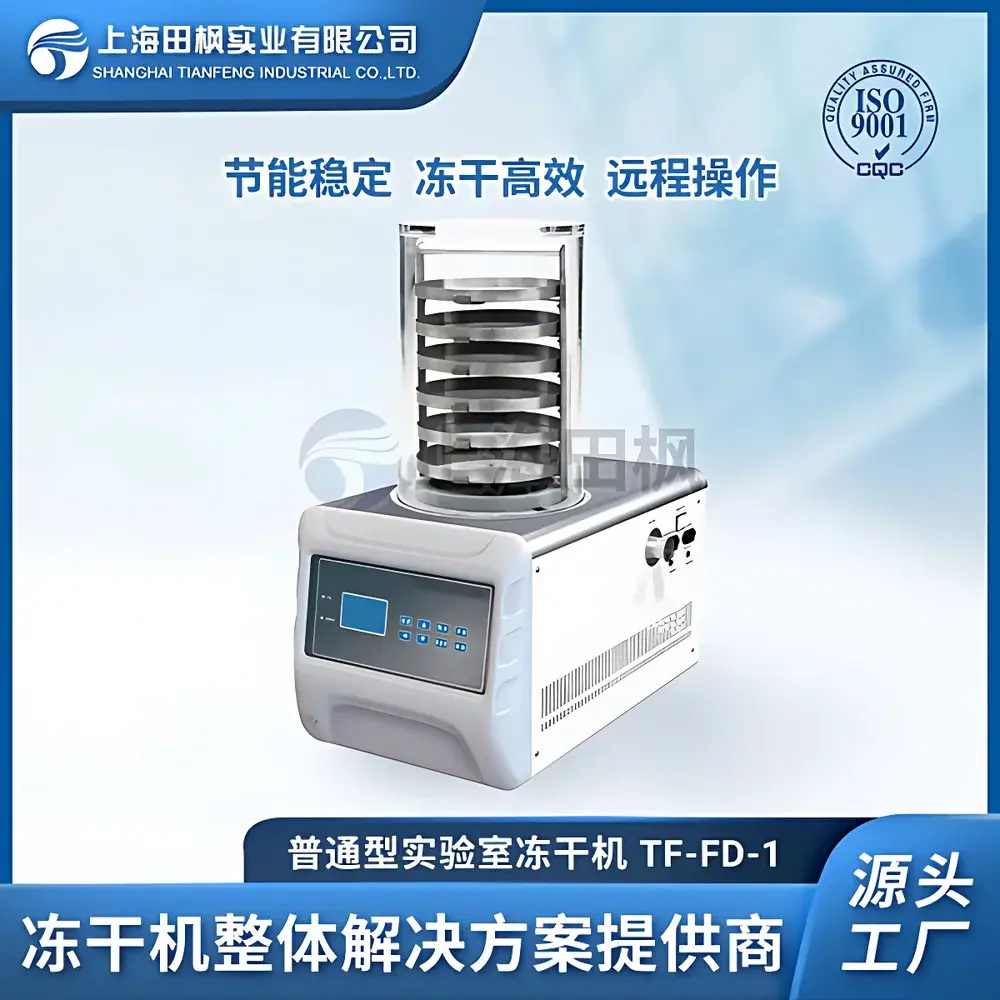
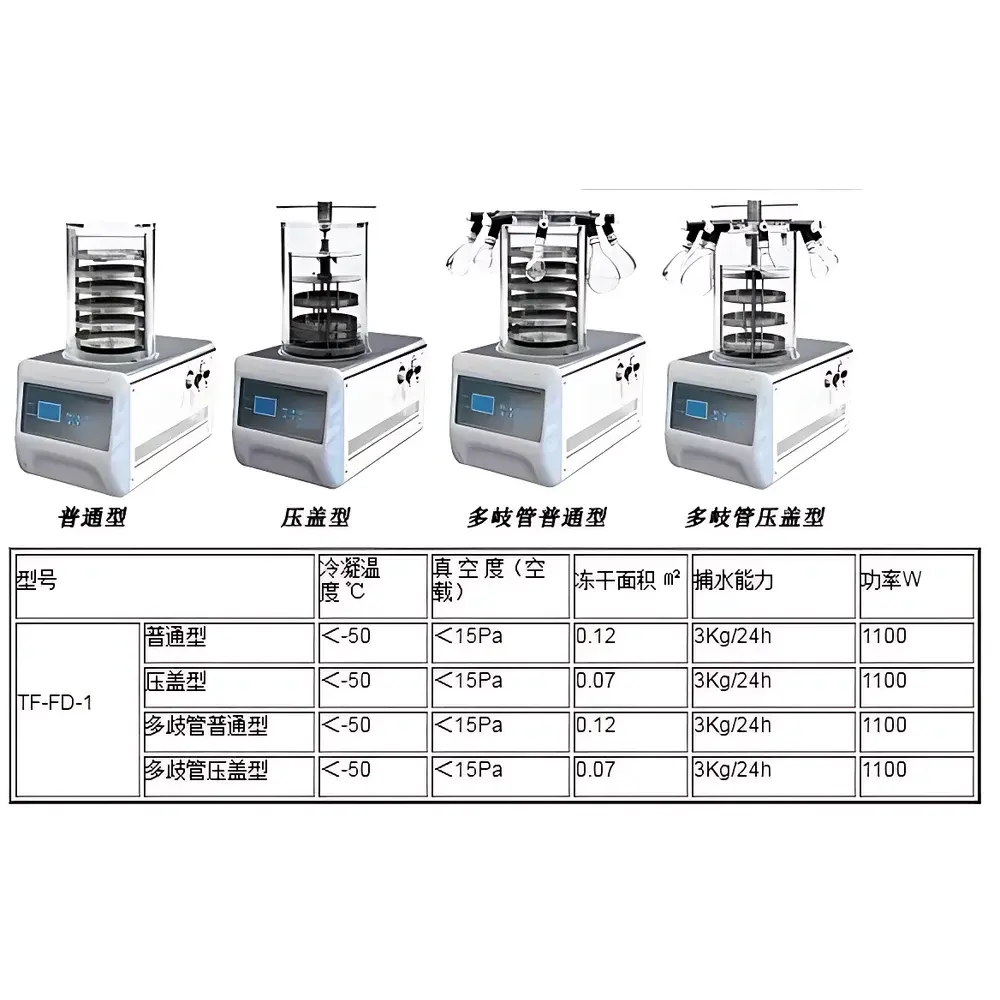
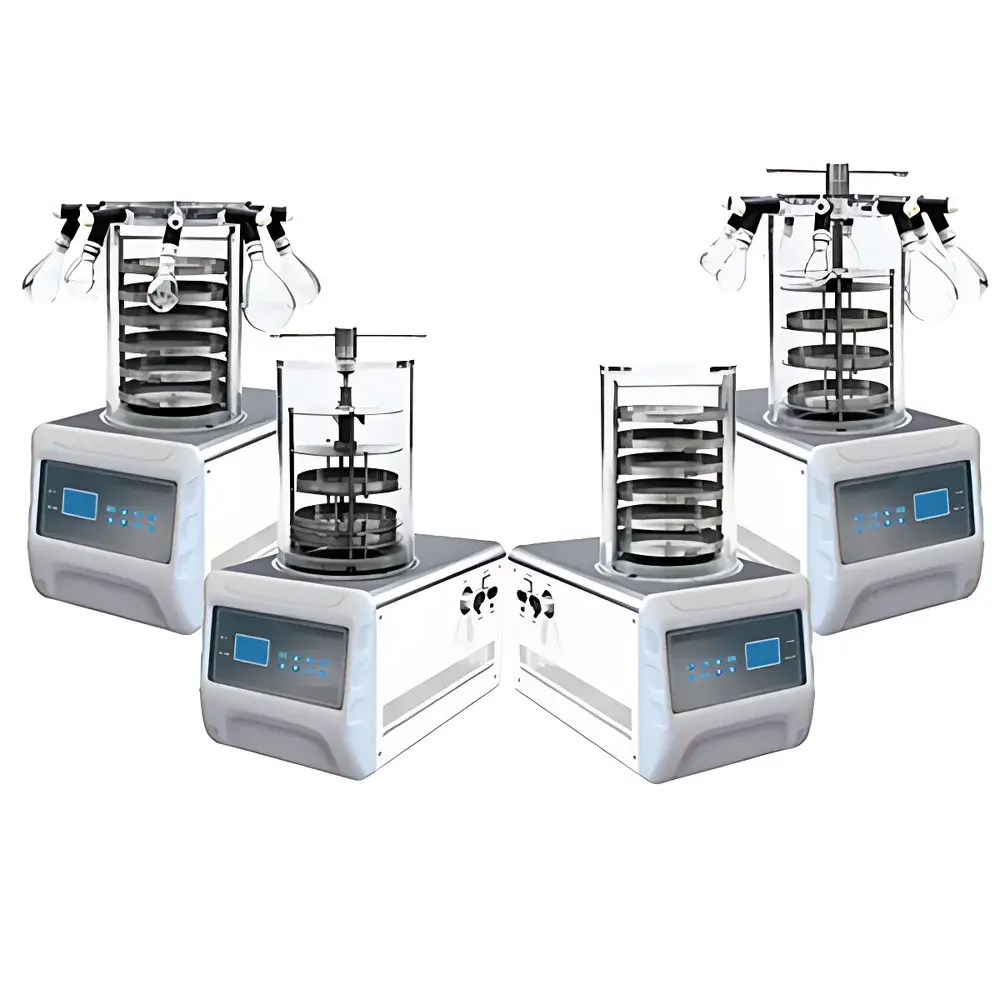
Tianfeng TF-FD-1 (Standard Type) Laboratory Freeze Dryer
| Brand | Tianfeng |
|---|---|
| Origin | Shanghai, China |
| Manufacturer Type | Direct Manufacturer |
| Product Category | Domestic |
| Model | TF-FD-1 (Standard Type) Laboratory Freeze Dryer |
| Instrument Type | Standard Shelf-Type |
| Application Scope | Laboratory Use |
| Lyophilization Area | 0.12 m² |
| Ultimate Vacuum | <15 Pa (at no-load) |
| Condenser Capacity | 3 kg/24 h |
| Condenser Temperature | <−50 °C |
| Power Consumption | 1100 W |
| Dimensions (W×D×H) | 370 × 650 × 360 mm |
| Chamber Material | 304 Stainless Steel |
| Viewing Window | Transparent Acrylic Door |
| Control System | Touchscreen LCD with PID Regulation |
| Pre-freezing | In-situ via condenser |
| Optional Accessories | Temperature Data Logger, Inert Gas Inlet Valve, Eutectic Point Tester, Automatic Stoppering Unit |
Overview
The Tianfeng TF-FD-1 (Standard Type) Laboratory Freeze Dryer is a benchtop lyophilization system engineered for reproducible, low-temperature dehydration of thermolabile biological and pharmaceutical samples under high vacuum. It operates on the fundamental principle of sublimation—where ice transitions directly from solid to vapor phase without passing through liquid state—enabling preservation of structural integrity, enzymatic activity, and immunogenicity in sensitive formulations. Designed for research-grade applications in cosmetics, biopharmaceuticals, diagnostics, and natural product development, this unit integrates a single-stage refrigeration system with an air-cooled condenser capable of reaching ≤−50 °C, ensuring efficient water vapor capture during primary drying. Its in-situ pre-freezing capability eliminates the need for external ultra-low temperature freezers, streamlining workflow while maintaining sample sterility and consistency across freeze-drying cycles.
Key Features
- Stainless steel construction (AISI 304) throughout the chamber, condenser, and shelf assembly ensures corrosion resistance, ease of cleaning, and compliance with GLP laboratory hygiene standards.
- Transparent acrylic drying chamber with front-access door enables real-time visual monitoring of sample morphology, ice crystal formation, and drying front progression.
- Intuitive 7-inch touchscreen interface displays real-time temperature (shelf and condenser), vacuum pressure, and lyophilization time; supports customizable PID parameter tuning for precise thermal control.
- In-situ pre-freezing function allows direct freezing of samples on shelves prior to vacuum initiation—minimizing handling, contamination risk, and thermal shock.
- Integrated inert gas inlet valve (optional) permits backfilling with nitrogen or argon post-drying to stabilize oxygen-sensitive compounds and prevent oxidation during storage.
- Four-tier Φ200 mm stainless steel sample trays provide 0.12 m² total lyophilization area—optimized for vial-based or bulk sample processing in R&D settings.
- Energy-efficient air-cooled condensing system delivers stable performance at ≤−50 °C with noise levels below 65 dB(A), suitable for shared lab environments.
Sample Compatibility & Compliance
The TF-FD-1 accommodates aqueous and low-concentration organic solvent systems (e.g., ethanol/water mixtures up to 15% v/v), making it suitable for cosmetic actives (peptides, hyaluronic acid derivatives), vaccine candidates, monoclonal antibody formulations, herbal extracts, and probiotic cultures. While not certified for GMP manufacturing, its design aligns with key elements of ISO 22000, USP <1211>, and ICH Q5C guidelines concerning stability-indicating drying processes. The unit supports audit-ready documentation when paired with optional temperature data loggers compliant with FDA 21 CFR Part 11 requirements (electronic signatures, event logging, user access controls). All wetted surfaces meet ASTM A240 standards for stainless steel finish and passivation verification.
Software & Data Management
The embedded control firmware records time-stamped data points for shelf temperature, condenser temperature, chamber pressure, and elapsed cycle duration at configurable intervals (1–60 sec). Exportable CSV files facilitate integration with LIMS platforms or statistical process analysis tools (e.g., JMP, Minitab). Optional Ethernet or USB connectivity enables remote monitoring via local network; no cloud dependency or third-party subscription required. Firmware updates are performed offline using FAT32-formatted USB drives—ensuring data sovereignty and regulatory compliance in controlled environments.
Applications
This freeze dryer serves critical roles across multiple scientific domains: stabilization of heat-labile APIs during preformulation studies; long-term storage of reference standards in QC laboratories; preparation of sterile lyophilized powders for dissolution testing per USP <711>; dehydration of botanical extracts without Maillard degradation; and formulation development of topical delivery systems (e.g., collagen scaffolds, nanoliposomal serums). Its consistent performance supports method development aligned with QbD principles, including determination of collapse temperature (Tc), eutectic point (Teu), and optimal primary drying endpoint via pressure rise test (PRT) or manometric temperature measurement (MTM).
FAQ
What types of samples are compatible with the TF-FD-1?
Aqueous buffers, protein solutions, cell lysates, herbal infusions, cosmetic emulsions, and low-boiling-point solvent mixtures (≤15% v/v ethanol, acetone, or ethyl acetate) can be processed effectively.
Is in-situ pre-freezing sufficient for all sample types?
Yes—for most biological and pharmaceutical formulations. However, highly viscous or high-solute-content samples may require preliminary freezing in a −80 °C freezer to ensure uniform crystallization before loading.
Can the system be validated for regulated workflows?
While the base configuration lacks factory-installed IQ/OQ protocols, its modular architecture and deterministic control logic support user-executed validation per ASTM F2697-22 and EU Annex 15 guidelines.
What maintenance is required for sustained performance?
Routine tasks include vacuum pump oil replacement every 3–6 months (depending on usage frequency), condenser defrosting after each cycle, and periodic calibration of PT100 sensors using NIST-traceable references.
Does the unit support automated batch reporting?
Yes—when equipped with the optional data logger module, full-cycle reports—including timestamps, setpoints, deviations, and operator ID—are generated automatically and saved in tamper-evident format.



