
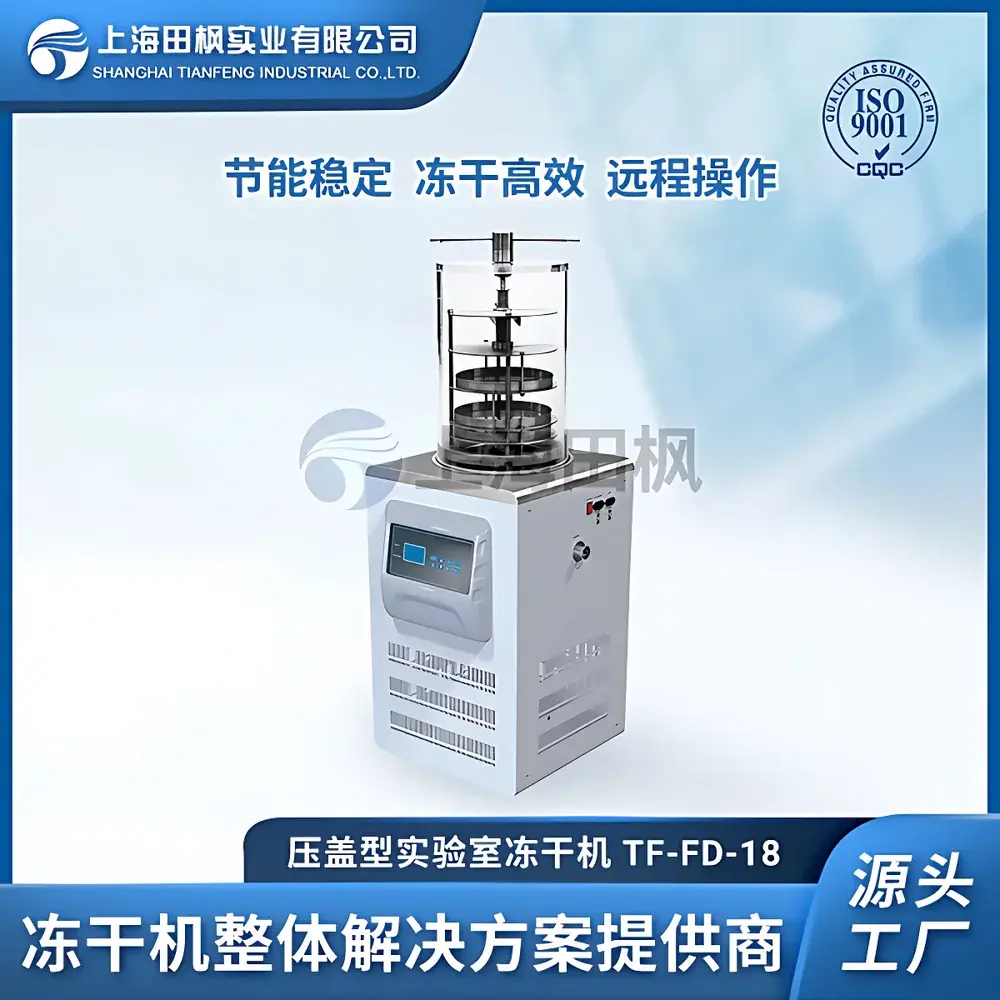
Tianfeng TF-FD-18 (Stoppering Type) Laboratory Benchtop Freeze Dryer
| Brand | Tianfeng |
|---|---|
| Origin | Shanghai, China |
| Manufacturer Type | Direct Manufacturer |
| Equipment Type | Stoppering-Type Lyophilizer |
| Application Scope | Laboratory R&D and Small-Batch Production |
| Shelf Area | 0.11 m² |
| Ultimate Vacuum | <15 Pa (at no-load) |
| Condenser Temperature | <−60 °C |
| Ice Capacity | 6 kg/24 h |
| Power Consumption | 1500 W |
| Dimensions (W×D×H, excl. chamber) | 550 × 550 × 960 mm |
| Chamber Material | 304 Stainless Steel + Transparent Acrylic Door |
| Control System | Touchscreen LCD with PID Regulation & Real-Time Drying Curve Display |
| Pre-freezing | In-situ via Shelf/Cold Trap |
| Optional Accessories | Temperature Data Logger, Co-lyophilization Point Tester, Automatic Stopper Pressing Unit, Inert Gas Purge Valve |
Overview
The Tianfeng TF-FD-18 (Stoppering Type) Laboratory Benchtop Freeze Dryer is a compact, in-situ lyophilization system engineered for reproducible, process-controlled freeze drying of thermolabile biological and pharmaceutical samples under high-vacuum conditions. Based on the fundamental principle of sublimation—where ice transitions directly from solid to vapor phase below the triple point of water (0.01 °C, 611 Pa)—this unit enables primary drying without liquid-phase migration, preserving structural integrity, bioactivity, and reconstitution fidelity of sensitive materials. Unlike conventional thermal drying methods that induce denaturation, oxidation, or collapse, freeze drying maintains molecular conformation by immobilizing samples in a rigid matrix prior to vacuum exposure. The TF-FD-18 employs a dual-stage refrigeration circuit with environmentally compliant refrigerants to achieve stable condenser temperatures below −60 °C, ensuring efficient vapor capture and minimizing backstreaming during extended drying cycles. Its modular architecture supports seamless integration into GLP-compliant laboratory workflows, particularly where batch traceability, temperature uniformity, and process documentation are critical.
Key Features
- In-situ pre-freezing capability: Samples freeze directly on stainless steel shelves or within the condenser chamber—eliminating manual transfer and reducing contamination risk.
- Stoppering-compatible design: Equipped with a hydraulic or pneumatic stopper press mechanism (optional), enabling aseptic vial sealing under vacuum post-drying—essential for sterile pharmaceutical formulations.
- Real-time process monitoring: 7-inch capacitive touchscreen interface displays dynamic drying curves (shelf temperature, chamber pressure, condenser temperature), with programmable PID control for precise ramp/hold profiles.
- Robust condensation system: High-efficiency dual-stage compressor assembly delivers consistent <−60 °C condenser performance and 6 kg/24 h ice capacity—optimized for aqueous and moderately volatile solvent systems.
- Corrosion-resistant construction: Entire drying chamber and condenser housing fabricated from electropolished 304 stainless steel; transparent acrylic observation door permits unobstructed visual monitoring of sublimation front progression.
- Regulatory-ready operation: Supports optional FDA 21 CFR Part 11–compliant data logging (with audit trail, electronic signature, and user access levels) when paired with certified temperature recorders.
- Gas purging functionality: Integrated inert gas (N₂ or Ar) inlet valve allows controlled backfilling to prevent oxidation or moisture reabsorption during vial stoppering or storage.
Sample Compatibility & Compliance
The TF-FD-18 accommodates standard Ø220 mm sample trays across three shelf levels, supporting vials (10–20 mL), petri dishes, and custom containers. It is validated for use with biologics including monoclonal antibodies, plasmid DNA, viral vectors, enzyme preparations, and diagnostic reagents—provided formulations exhibit eutectic temperatures above −45 °C. While not certified for GMP manufacturing, the system meets ISO 22000 and ASTM F2476–18 requirements for laboratory-scale lyophilization validation protocols. Its vacuum integrity (<15 Pa at no-load) and thermal stability (±1 °C shelf uniformity) align with USP guidance for freeze-drying process characterization. All wetted surfaces comply with FDA 21 CFR 178.3570 for food-contact materials, and electrical safety conforms to IEC 61010-1:2010.
Software & Data Management
The embedded control firmware supports up to 10 user-defined drying programs, each configurable with multiple segments (freeze, anneal, primary dry, secondary dry) and real-time parameter logging at 1-second intervals. Exportable CSV files include timestamped shelf temperature, chamber pressure, condenser temperature, and elapsed time—compatible with LIMS and ELN platforms. Optional Ethernet or USB connectivity enables remote supervision via secure HTTP interface. When equipped with an external temperature logger (e.g., Vaisala viewLinc or Omega OM-DAQPRO-5300), the system satisfies ALCOA+ data integrity criteria—including attributable, legible, contemporaneous, original, and accurate records—required for regulatory submissions to EMA, PMDA, or Health Canada.
Applications
This lyophilizer serves analytical and preparative workflows across regulated and academic laboratories: stabilization of reference standards for HPLC calibration; long-term archiving of microbial cultures (ATCC strains); preparation of lyophilized ELISA kits and lateral flow assay components; formulation development of mRNA-LNP vaccines; dehydration of botanical extracts (e.g., ginseng, cordyceps) while retaining glycosidic bond integrity; and preservation of tissue-engineered constructs for regenerative medicine research. Its 0.11 m² shelf area balances throughput and footprint—ideal for method development prior to scale-up on production-grade systems (e.g., 1–5 m² industrial units).
FAQ
What is the minimum recommended sample volume per cycle?
For optimal sublimation efficiency and uniform drying, load ≥30% of maximum shelf area (≥0.033 m²), corresponding to ~1.8 L of aqueous solution at 5–10 mm depth.
Can organic solvents such as ethanol or acetone be processed?
Yes—provided total solvent concentration remains ≤15% (v/v) and boiling point exceeds −20 °C; higher volatility requires optional −80 °C condenser upgrade (TF-FD-1SL series).
Is validation support documentation available?
Tianfeng provides IQ/OQ protocol templates, factory acceptance test (FAT) reports, and material compliance certificates (RoHS, REACH, CE) upon request.
What maintenance intervals are recommended?
Oil-free vacuum pump oil replacement every 6 months; condenser coil cleaning quarterly; refrigerant leak check annually per ISO 5149.
Does the system meet noise emission standards for shared lab environments?
Operating sound pressure level is ≤62 dB(A) at 1 m distance—compliant with ISO 7779 and EU Directive 2000/14/EC for laboratory equipment.
Related Products



