
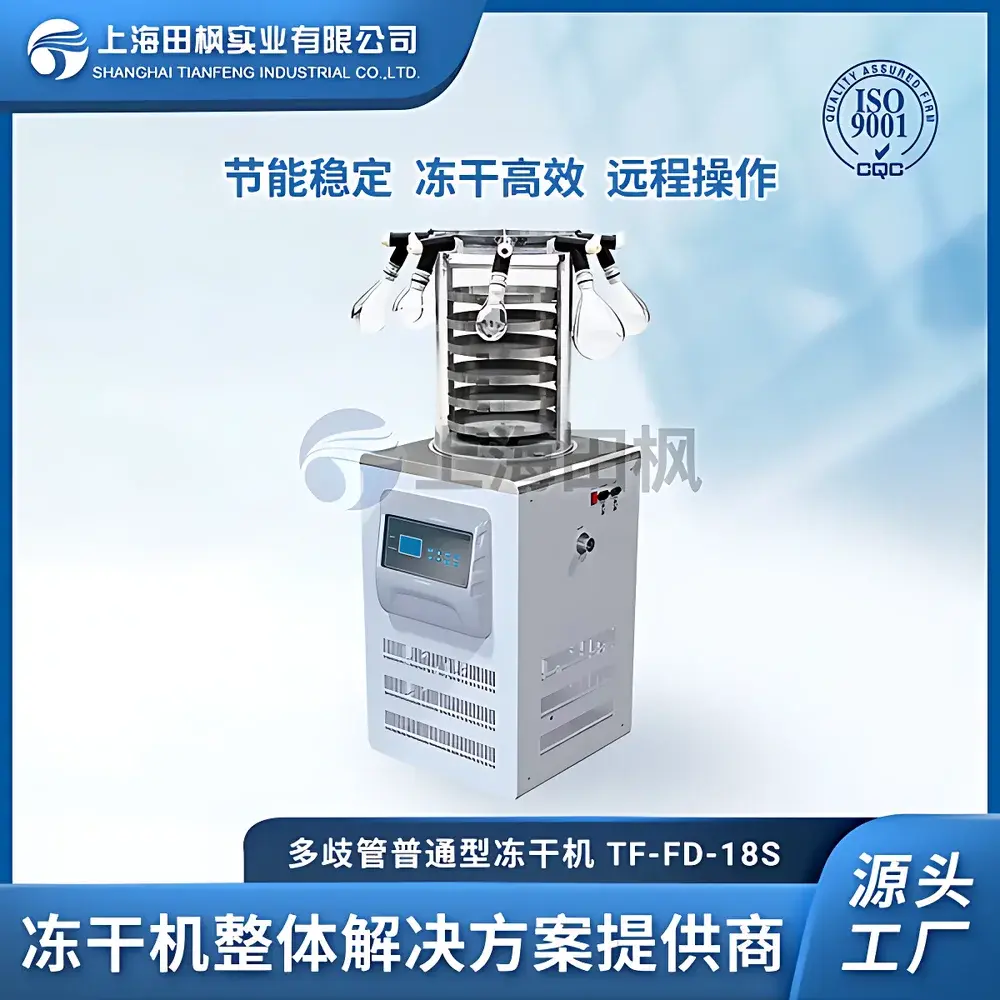
Tianfeng TF-FD-18S Manifold-Type Laboratory Freeze Dryer
| Brand | Tianfeng |
|---|---|
| Origin | Shanghai, China |
| Manufacturer Type | Direct Manufacturer |
| Instrument Type | Manifold-Type Freeze Dryer |
| Application Scope | Laboratory Use |
| Freeze-Drying Area | 0.18 m² |
| Ultimate Vacuum (Empty) | <15 Pa |
| Condenser Temperature | <−60 °C |
| Water Capture Capacity | 6 kg/24 h |
| Power Consumption | 1700 W |
| Dimensions (W×D×H, excl. drying chamber) | 550 × 550 × 960 mm |
| Sample Shelf | Φ240 mm × 4 layers |
| Compatible Flask Sizes | 50, 100, 250, 500, 1000 mL (8 positions) |
| Refrigeration System | Air-Cooled, Cascade Compressor Design |
| Construction | 304 Stainless Steel Condenser & Chamber Interior |
| Control Interface | Touchscreen LCD with Real-Time Graphical Display (Shelf Temp, Chamber Pressure, Humidity Curve) |
| Optional Features | In-Chamber Pre-Freezing, Inert Gas Purge Valve, Temperature Data Logger, Eutectic Point Tester |
Overview
The Tianfeng TF-FD-18S Manifold-Type Laboratory Freeze Dryer is a benchtop lyophilization system engineered for precision, reproducibility, and operational autonomy in research and quality control laboratories. It employs the fundamental principle of sublimation—removing water from frozen samples under deep vacuum while maintaining temperatures below the eutectic point—to preserve thermolabile compounds, structural integrity, and biological activity. Unlike conventional thermal drying methods that induce denaturation, oxidation, or collapse, freeze drying operates primarily at −60 °C or lower during primary drying, with secondary drying stages typically held below 60 °C. This enables near-complete retention of protein conformation, enzymatic function, microbial viability, and chemical stability—critical for pharmaceutical intermediates, diagnostic reagents, vaccine candidates, and natural product extracts.
Key Features
- Manifold configuration with eight independent flask ports (50–1000 mL), enabling parallel processing of diverse sample types without cross-contamination.
- High-efficiency cascade refrigeration system using imported compressors, achieving condenser temperatures below −60 °C and delivering consistent capture of up to 6 kg of ice per 24-hour cycle.
- Ultimate vacuum performance of <15 Pa (empty chamber), optimized for rapid primary drying kinetics and low residual moisture content (<1.5% w/w typical for well-characterized formulations).
- Robust 304 stainless steel construction throughout the condenser chamber and internal surfaces ensures corrosion resistance, cleanability, and compliance with GLP laboratory hygiene standards.
- Intuitive 7-inch touchscreen interface with real-time graphical display of shelf temperature, chamber pressure, and relative humidity trends; supports user-defined drying protocols and multi-stage PID-controlled heating profiles.
- Integrated inert gas purge valve (N₂ or Ar compatible) for oxygen-sensitive applications, including lipid-based formulations and redox-labile biomolecules.
- Optional in-chamber pre-freezing capability eliminates need for external ultra-low temperature freezers, reducing workflow complexity and contamination risk during sample transfer.
Sample Compatibility & Compliance
The TF-FD-18S accommodates a broad spectrum of sample formats—including aqueous solutions, suspensions, emulsions, and viscous gels—across disciplines such as biopharmaceutical development, clinical diagnostics, food science, and materials research. Its manifold design supports standard KIMAX®-style round-bottom flasks (50–1000 mL), ensuring compatibility with existing labware inventories. The system meets essential mechanical and electrical safety requirements per IEC 61010-1 and conforms to electromagnetic compatibility standards (EN 61326-1). While not certified for GMP manufacturing environments out-of-the-box, its architecture supports audit-ready operation when paired with optional data logging and electronic signature modules compliant with FDA 21 CFR Part 11 and EU Annex 11 guidelines.
Software & Data Management
The embedded control software records time-stamped process variables—including condenser temperature, chamber pressure, shelf setpoint, actual shelf temperature, and calculated sublimation rate—at user-configurable intervals (1–60 seconds). All data are exportable via USB to CSV format for integration into LIMS or statistical process analysis platforms (e.g., JMP, Minitab). Optional temperature data loggers provide continuous traceability of critical process parameters, supporting retrospective validation and root cause analysis. When equipped with the eutectic point tester module, users can empirically determine collapse temperature prior to method development—enhancing first-pass success in lyophilization cycle design per ICH Q5C and USP .
Applications
This freeze dryer is routinely deployed in academic and industrial labs for: stabilizing monoclonal antibodies and recombinant enzymes prior to analytical characterization; preparing sterile powders for dissolution testing (USP ); preserving bacterial cultures and fungal spores for long-term cryobanking; producing stable reference standards for ELISA and mass spectrometry; dehydrating botanical extracts without degradation of polyphenols or terpenes; and generating porous scaffolds for tissue engineering research. Its 0.18 m² drying area and 6 kg/24 h capacity make it suitable for batch sizes ranging from 200 mL to 2 L total volume across multiple flasks.
FAQ
What is the maximum sample volume this unit can handle per batch?
With eight 1000 mL flasks installed, the theoretical upper limit is 8 L—but optimal drying performance is achieved with total volumes between 0.5–3 L, depending on solute concentration and vial geometry.
Can this system be used for terminal sterilization of final drug products?
No. The TF-FD-18S is intended for R&D, formulation screening, and non-sterile intermediate processing—not for aseptic fill-finish or regulatory submission batches requiring ISO 5 cleanroom integration.
Is remote monitoring supported?
The base model does not include Ethernet or Wi-Fi connectivity; however, USB-based data export and optional RS-485 interfaces allow integration with building management systems or centralized lab automation networks.
How often should the oil in the vacuum pump be changed?
When using a dedicated dual-stage rotary vane pump (recommended), oil replacement is advised every 500 operating hours or quarterly—whichever occurs first—to maintain ultimate vacuum integrity and prevent backstreaming contamination.
Does the system support automatic defrost cycles?
Yes. A programmable auto-defrost sequence initiates after each drying cycle or upon reaching preset ice load thresholds, minimizing manual maintenance and downtime between runs.



