
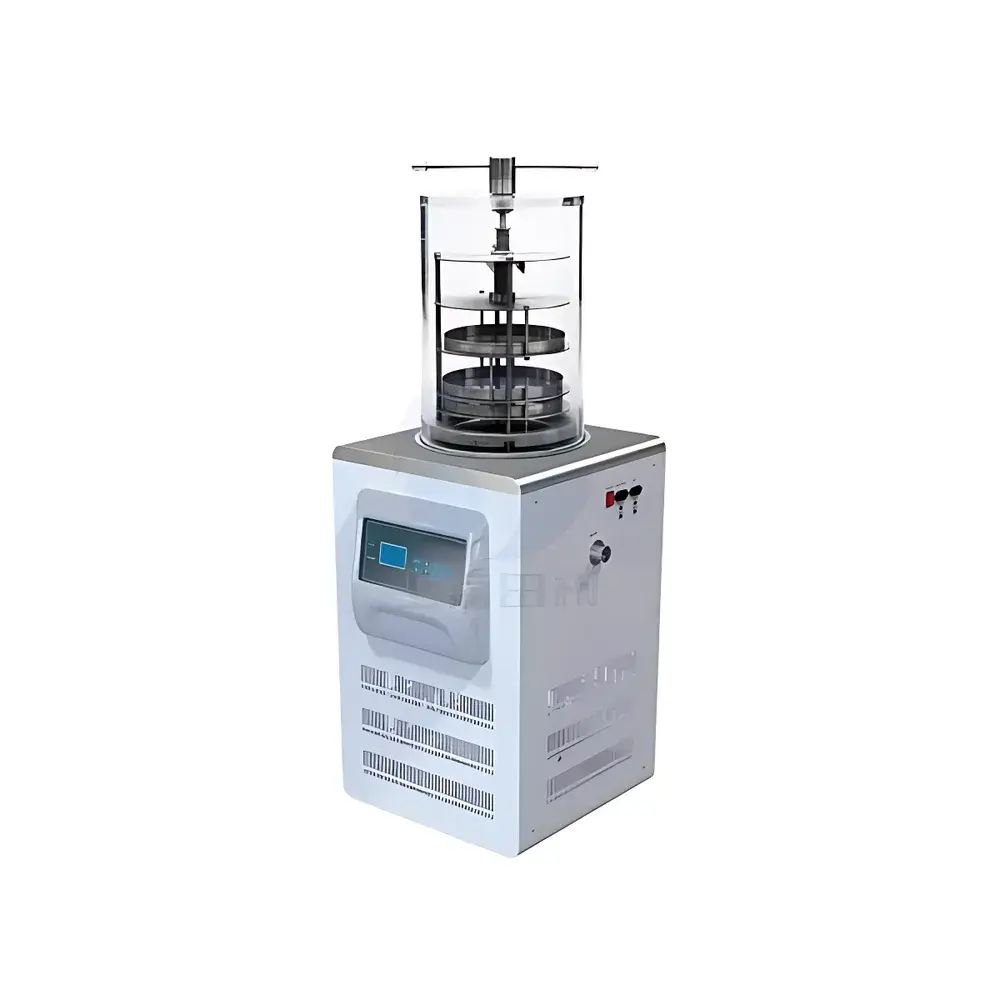
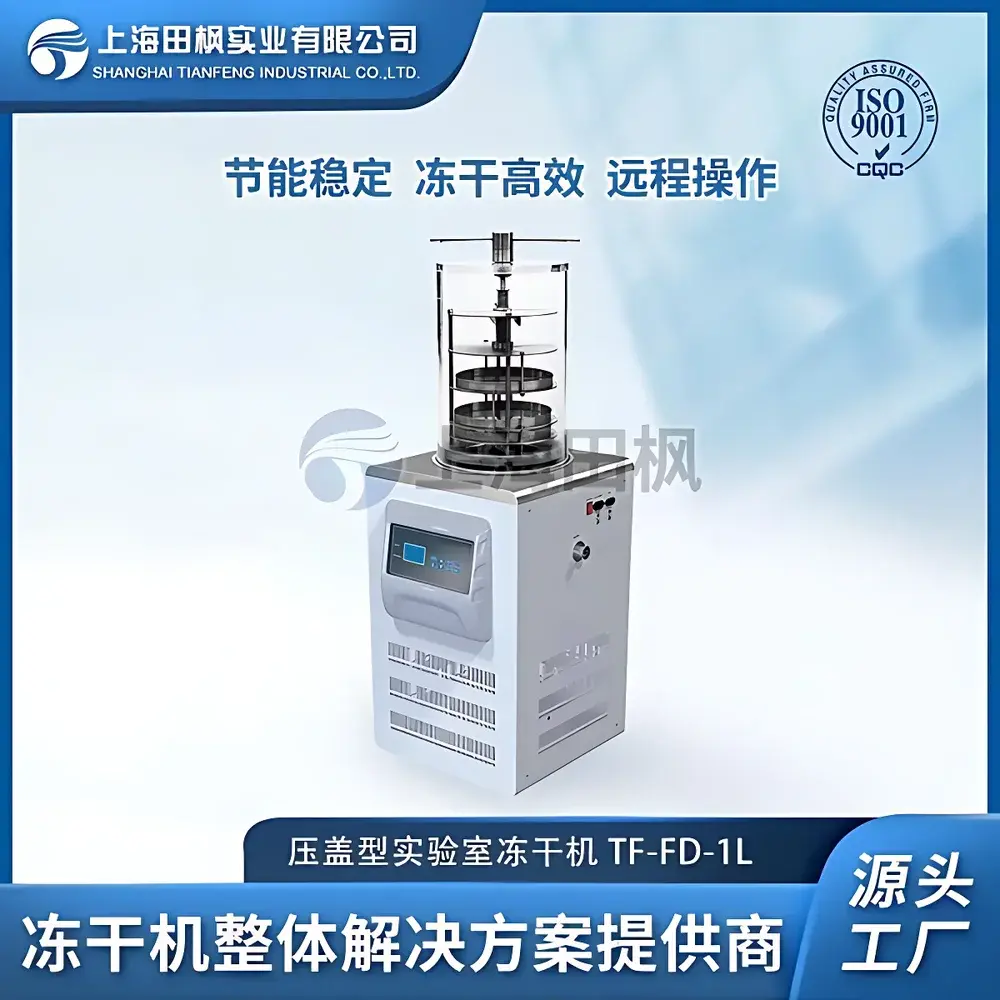
Tianfeng TF-FD-1L Stoppering Freeze Dryer
| Brand | Tianfeng |
|---|---|
| Origin | Shanghai, China |
| Manufacturer Type | Direct Manufacturer |
| Equipment Type | Stoppering (In-Situ) Freeze Dryer |
| Application | Laboratory-Scale Lyophilization |
| Shelf Area | 0.07 m² |
| Ultimate Vacuum | <15 Pa (empty chamber) |
| Condenser Temperature | ≤ −80 °C |
| Ice Capacity | 3 kg/24 h |
| Dimensions (W×D×H) | 600 × 600 × 900 mm |
| Power Supply | 220 V, 50 Hz |
| Rated Power | 1600 W |
| Construction | 304 Stainless Steel Chamber & Condenser |
| Refrigeration System | Dual-Stage Cascade Compressor |
| Pre-freezing Method | In-situ shelf pre-freezing |
| Control Interface | Touchscreen LCD with PID control and real-time drying curve display |
| Optional Features | Inert gas backfill valve, temperature data logger, eutectic point tester, automated stopper press mechanism |
Overview
The Tianfeng TF-FD-1L Stoppering Freeze Dryer is a laboratory-grade, in-situ lyophilization system engineered for reproducible, high-fidelity freeze drying of thermolabile biologicals, pharmaceuticals, and polymer-based materials. Based on the fundamental principles of sublimation under deep vacuum and cryogenic condensation, this unit operates by first freezing samples uniformly on temperature-controlled shelves, then removing ice via primary drying (sublimation) under vacuum conditions below the triple point of water (0.01 °C, 611 Pa), followed by secondary drying (desorption) at elevated shelf temperatures—typically up to 60 °C—to eliminate bound water. The TF-FD-1L employs a dual-stage cascade refrigeration system to achieve a stable condenser temperature of ≤ −80 °C, enabling efficient capture of both aqueous and low-volatility organic solvents (e.g., acetone, ethanol, ethyl acetate), making it suitable for lyophilizing formulations containing co-solvents common in polymer processing and biopharmaceutical development. Its vertical, compact footprint (600 × 600 × 900 mm) and 0.07 m² shelf area support batch processing of vials, serum bottles, or custom trays—ideal for method development, stability studies, and small-batch GMP-aligned production.
Key Features
- In-situ pre-freezing capability: Samples are frozen directly on the stainless steel shelves, eliminating manual transfer and ensuring consistent nucleation and ice crystal morphology.
- Stoppering function: Integrated hydraulic or pneumatic stopper press mechanism enables sterile, vacuum-integrated closure of vials post-drying—critical for aseptic pharmaceutical processing and long-term storage integrity.
- Cascade refrigeration architecture: Dual compressors deliver rapid cooldown and sustained condenser performance at ≤ −80 °C, enhancing ice entrapment efficiency and reducing cycle time by up to 25% compared to single-stage systems.
- Full 304 stainless steel construction: Corrosion-resistant chamber, condenser, and internal components ensure compliance with ISO 14644 cleanroom compatibility and simplify cleaning validation per FDA CGMP Annex 1 guidelines.
- Intuitive touchscreen HMI: Real-time graphical display of shelf temperature, chamber pressure, condenser temperature, and drying curves; PID-controlled ramp/soak profiles support protocol-driven process optimization.
- High-transparency acrylic door: Enables continuous visual monitoring of sample morphology, ice sublimation front progression, and cake formation without compromising vacuum integrity.
- Backfill valve with inert gas option: Supports controlled nitrogen or argon reintroduction to prevent oxidation of sensitive APIs, polymers, or enzymatic formulations during venting.
Sample Compatibility & Compliance
The TF-FD-1L accommodates diverse sample formats—including standard 10–20 mL serum vials (Φ180 mm × 3 shelf layers), custom polymer molds, and flat-bottomed petri dishes—without requiring external freezing equipment. It supports lyophilization of heat-labile biomolecules (monoclonal antibodies, plasmid DNA, viral vectors), sterile drug products (vaccines, antibiotics, hormones), and functional high-molecular-weight polymers (PLGA, PEG-based hydrogels, chitosan scaffolds). Its ≤ −80 °C condenser and <15 Pa ultimate vacuum meet minimum operational thresholds specified in USP , ISO 22058:2021 (freeze-drying equipment validation), and ICH Q5C stability guidance. When configured with optional temperature data logging (21 CFR Part 11 compliant firmware) and electronic audit trail, the system satisfies GLP and early-phase GMP documentation requirements for analytical reference standards and clinical trial material manufacturing.
Software & Data Management
The embedded control system records timestamped process parameters at user-defined intervals (1–60 s), exporting CSV-formatted datasets compatible with LIMS integration and statistical process control (SPC) platforms such as JMP or Minitab. Optional Ethernet/Wi-Fi connectivity enables remote monitoring via secure HTTPS interface. All critical events—including vacuum pump start/stop, shelf heating activation, pressure spikes, and condenser overload alerts—are logged with operator ID and system state metadata. For regulatory submissions, raw data archives include digital signatures, version-controlled firmware logs, and calibration certificate traceability to NIST-traceable standards. The system supports IQ/OQ protocols aligned with ASTM F2665-22 and EU GMP Annex 15, facilitating qualification across academic, CRO, and contract manufacturing environments.
Applications
This freeze dryer serves cross-disciplinary research and development workflows: in biopharmaceutical labs, it enables formulation screening of lyoprotectant matrices for monoclonal antibody stability; in materials science, it produces porous polymer aerogels for drug delivery or tissue engineering scaffolds; in microbiology, it preserves bacterial consortia and fungal spores without viability loss; and in analytical chemistry, it prepares reference standards for LC-MS quantitation with minimal analyte degradation. Its solvent tolerance extends utility to lyophilized organic-inorganic hybrids (e.g., MOF-polymer composites) and nanocellulose dispersions—applications increasingly cited in ACS Applied Materials & Interfaces and Biomaterials journals.
FAQ
What types of solvents can be safely lyophilized using the TF-FD-1L?
The ≤ −80 °C condenser effectively traps water, methanol, ethanol, acetone, and acetonitrile. Chlorinated solvents (e.g., chloroform, DCM) and highly volatile ethers require additional cold trap accessories and are not recommended without prior compatibility testing.
Is in-situ pre-freezing sufficient for crystalline vs. amorphous formulations?
Yes—controlled shelf ramping (−40 °C → −5 °C at 1 °C/min) allows annealing of amorphous phases, while rapid quenching supports vitrification of proteins. Thermal profiling must be validated per formulation using DSC or freeze-dry microscopy.
Can the system be qualified for GMP use?
With optional 21 CFR Part 11-compliant software, calibrated PT100 sensors (±0.3 °C), and documented IQ/OQ protocols, the TF-FD-1L meets baseline requirements for Phase I–II clinical material production under FDA and EMA oversight.
What maintenance intervals are recommended for the cascade refrigeration system?
Compressor oil and filter replacement every 3,000 operating hours; annual leak testing of refrigerant circuits per ASHRAE Standard 15; quarterly verification of vacuum gauge linearity against a calibrated Pirani/capacitance manometer.
How does the stoppering mechanism ensure vial seal integrity?
The pneumatically actuated stopper press applies uniform axial force (adjustable 20–120 N) synchronized with chamber pressure equalization, minimizing glass stress and achieving helium leak rates <1 × 10⁻⁶ mbar·L/s per ISO 11607-2.



