
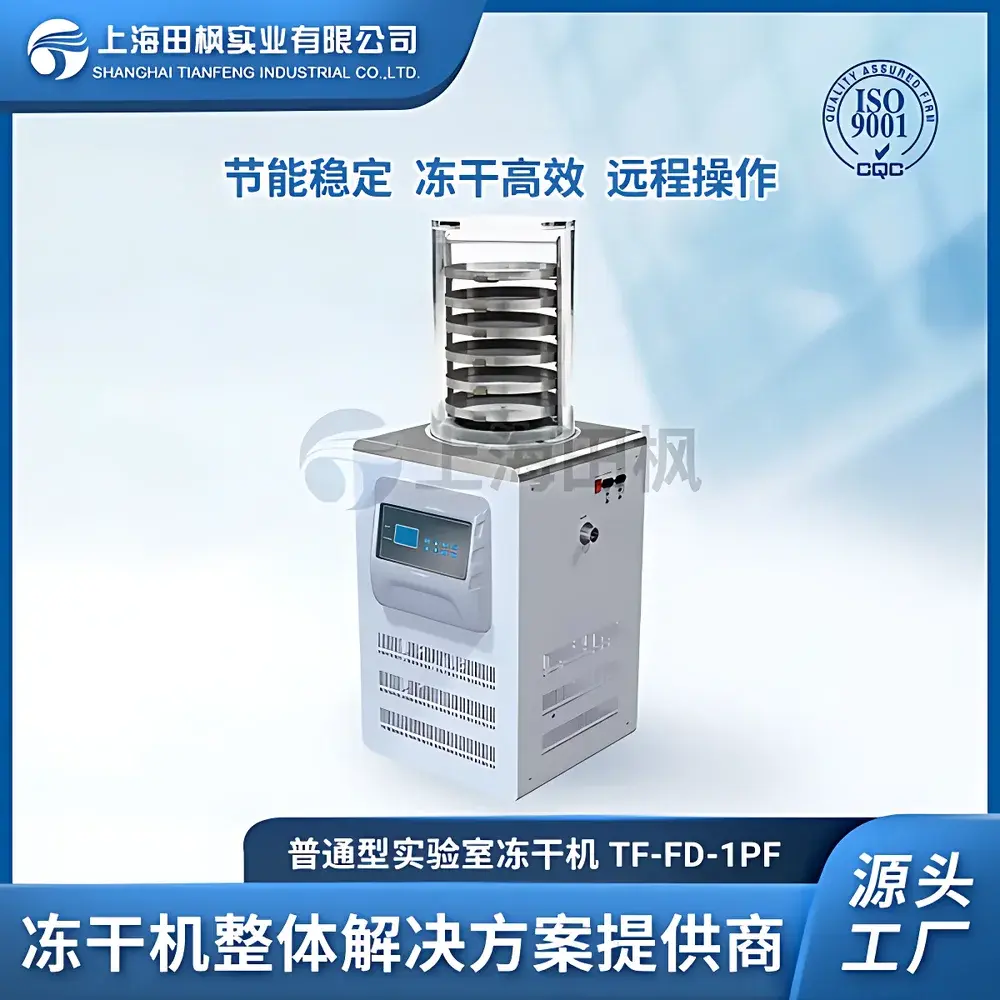
Tianfeng TF-FD-1PF Benchtop Laboratory Freeze Dryer
| Brand | Tianfeng |
|---|---|
| Origin | Shanghai, China |
| Manufacturer Type | Direct Manufacturer |
| Product Category | Domestic |
| Model | TF-FD-1PF Standard Type |
| Instrument Type | Standard Shelf-Type Freeze Dryer |
| Application Scope | Laboratory Use |
| Lyophilization Area | 0.12 m² |
| Ultimate Vacuum | <15 Pa (at no-load) |
| Condenser Temperature | <−50 °C |
| Ice Capacity | 3 kg/24 h |
| Power Consumption | 1100 W |
| Dimensions (W×D×H) | 460 × 460 × 690 mm |
| Chamber Material | 304 Stainless Steel |
| Viewport | High-Transparency Acrylic Door |
| Refrigeration System | Air-Cooled Single-Stage Compressor |
| Pre-freezing | In-situ via Shelf or Condenser |
| Control Interface | Touchscreen LCD with PID Algorithm |
| Compliance | Designed for GLP-compliant workflows |
Overview
The Tianfeng TF-FD-1PF is a compact, air-cooled benchtop freeze dryer engineered for reliable primary and secondary drying of heat-sensitive biological, pharmaceutical, and nutraceutical samples in research laboratories. It operates on the fundamental principle of lyophilization—first freezing the sample below its eutectic or collapse temperature, then sublimating ice under controlled vacuum conditions (typically <15 Pa), followed by desorption of bound water at elevated shelf temperatures. This low-temperature, solvent-free dehydration process preserves structural integrity, enzymatic activity, immunogenicity, and long-term stability—critical for antibiotics, vaccines, probiotics, herbal extracts, and diagnostic reagents. Unlike conventional thermal drying methods that induce denaturation, oxidation, or volume shrinkage, the TF-FD-1PF maintains original morphology and reconstitution fidelity, enabling full activity recovery upon rehydration.
Key Features
- Standard shelf-type configuration with 0.12 m² effective lyophilization area across four Φ200 mm stainless steel trays—optimized for uniform heat transfer and scalable batch processing.
- High-efficiency air-cooled refrigeration system achieving condenser temperatures below −50 °C, ensuring rapid vapor capture and minimizing backstreaming of moisture during primary drying.
- In-situ pre-freezing capability: samples may be frozen directly on shelves or within the condenser chamber, eliminating manual transfer and reducing contamination risk.
- Full 304 stainless steel construction for corrosion resistance, ease of cleaning, and compliance with laboratory hygiene standards.
- Transparent acrylic observation door enables real-time visual monitoring of ice sublimation, cake formation, and endpoint detection without breaking vacuum.
- Intuitive 7-inch touchscreen interface with graphical drying curve display, programmable PID control, and adjustable ramp/hold profiles for shelf temperature and vacuum setpoints.
- Integrated inert gas inlet valve (optional N₂ or argon) for oxygen-sensitive formulations and post-drying headspace purging.
- Modular design supports future upgrades including co-lyophilization monitoring, eutectic point determination kits, and automated stoppering modules.
Sample Compatibility & Compliance
The TF-FD-1PF accommodates aqueous and low-concentration organic solvent-based formulations common in biopharmaceutical development (e.g., buffer systems containing ≤10% ethanol or acetone). Its −50 °C condenser provides sufficient cold trap margin for standard excipients such as mannitol, sucrose, trehalose, and dextran. While not rated for high-boiling solvents (e.g., DMSO, DMF), it meets ISO 22081:2020 guidelines for laboratory-scale lyophilizer performance verification. The unit is designed to support Good Laboratory Practice (GLP) documentation requirements: optional temperature data loggers record shelf and product thermocouple traces with timestamped audit trails. Though not pre-certified for GMP manufacturing, its architecture aligns with FDA Q5C stability testing protocols and USP lyophilization validation fundamentals.
Software & Data Management
The embedded controller records time-stamped shelf temperature, chamber pressure, condenser temperature, and run duration. Exportable CSV files facilitate integration with LIMS or ELN platforms. Optional firmware enables user-defined alarm thresholds (e.g., vacuum breach >20 Pa, condenser overload), email alerts via Ethernet, and password-protected method libraries. For regulated environments, third-party 21 CFR Part 11–compliant software packages are available for electronic signatures, change control logs, and role-based access management—ensuring traceability from method creation through cycle execution.
Applications
This freeze dryer serves diverse R&D applications: stabilization of monoclonal antibodies and recombinant proteins; formulation screening of lyoprotectants for nasal/vaccine delivery; dehydration of microbial cultures (Lactobacillus, Bifidobacterium) for probiotic powder production; preservation of botanical actives (ginsenosides, curcuminoids) without thermal degradation; and preparation of calibration standards for mass spectrometry and HPLC analysis. It is routinely deployed in university pharmacology labs, CROs conducting preclinical stability studies, and nutraceutical startups scaling pilot batches prior to contract manufacturing.
FAQ
What is the maximum sample volume per batch?
With four Φ200 mm trays, the TF-FD-1PF supports up to 1.2 L of 5–10 mm deep aqueous solution—equivalent to ~300 g of frozen mass, assuming typical density and fill height.
Can I dry samples containing ethanol or acetone?
Yes—up to 10% v/v concentrations are compatible provided the total solvent load remains within the 3 kg/24 h ice capacity and the condenser is maintained below −50 °C throughout the cycle.
Is in-chamber pre-freezing supported?
Yes. The shelf cooling function allows direct in-situ freezing down to −45 °C, eliminating handling steps and preserving sterile integrity for aseptic workflows.
Does the system include vacuum pump compatibility information?
It requires a two-stage oil-sealed rotary vane pump (minimum 4 m³/h pumping speed, ultimate vacuum ≤5 × 10⁻² Pa) with an inline solvent trap; recommended models include Edwards RV8 or Leybold DRA 10.
What maintenance intervals are recommended?
Oil changes every 500 operating hours; refrigerant leak checks annually; silicone oil calibration verification semiannually; and full validation (leak rate, temperature uniformity, vacuum hold) before critical study initiation.



