
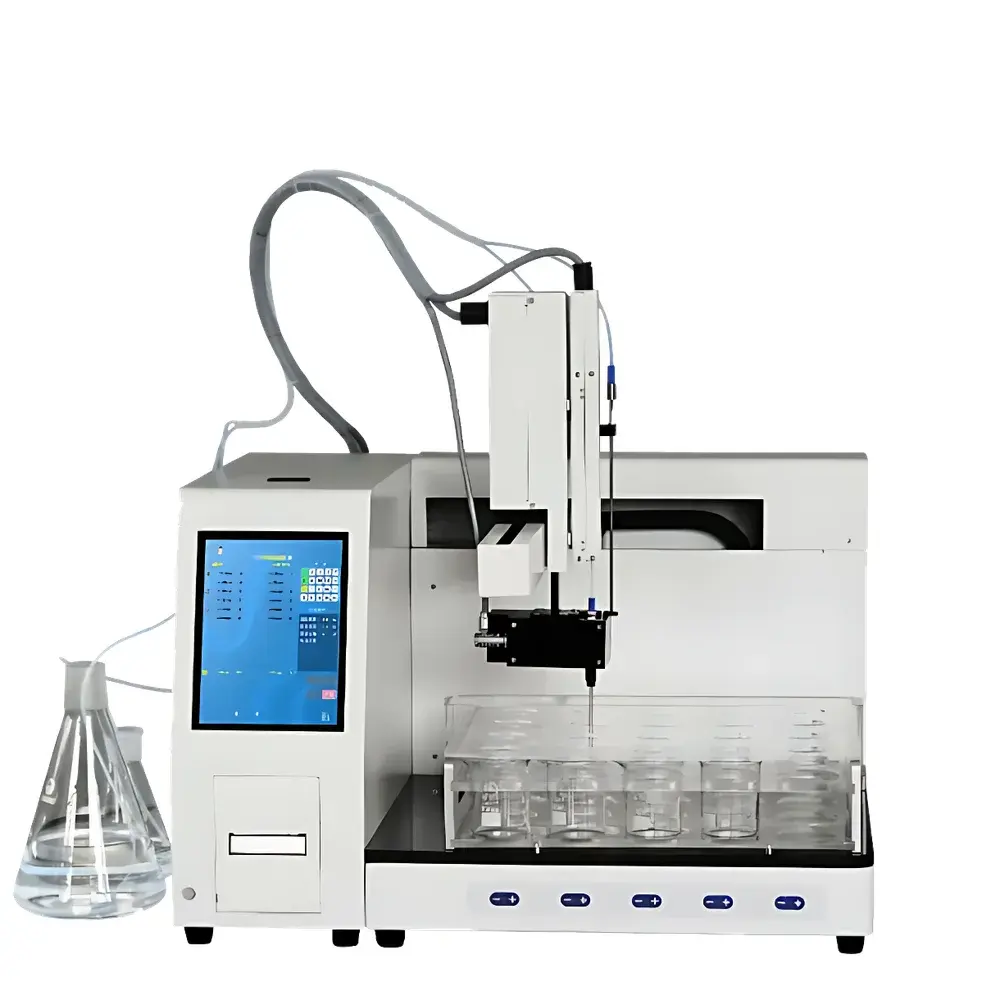
Tianhe GWF-9D Series Optical Particle Counter
| Brand | Tianhe |
|---|---|
| Origin | Tianjin, China |
| Manufacturer Type | Authorized Distributor |
| Product Category | Domestic |
| Model | GWF-9D Series |
| Pricing | Upon Request |
| Instrument Type | Optical Particle Counter |
Overview
The Tianhe GWF-9D Series Optical Particle Counter is a precision-engineered instrument designed for quantitative detection and size-resolved counting of insoluble particulate matter in parenteral pharmaceuticals, medical devices, and liquid raw materials. It operates on the principle of light obscuration (also known as single-particle optical sensing, or SPOS), where particles suspended in a liquid medium pass through a precisely defined laser beam path, causing transient attenuation of transmitted light proportional to particle cross-sectional area. This signal is converted into electrical pulses, enabling real-time classification and enumeration across ≥10,000 discrete sizing channels. The system complies with pharmacopoeial requirements for particulate contamination control—including Chinese Pharmacopoeia (ChP) General Chapter 0903, United States Pharmacopeia (USP) and , European Pharmacopoeia (Ph. Eur.) 2.9.19, Japanese Pharmacopoeia (JP) XIX, and ISO 21501-4:2018 for calibration traceability and measurement uncertainty management.
Key Features
- Laser-based light obscuration detection with automatic optical power compensation—ensures consistent sensitivity across colorless, tinted, and highly transparent samples without manual gain adjustment.
- Fluidic pathway constructed from imported 316L stainless steel and PTFE—chemically resistant to organic solvents, oil-based formulations, and mildly acidic or alkaline solutions commonly encountered in biopharmaceutical processing.
- Integrated XYZ robotic sampling arm—enables unattended sequential analysis of up to 96 vials or syringes, reducing operator intervention and inter-sample variability.
- Dual-channel aspiration system—provides continuous, pulse-free sample draw with volumetric accuracy better than ±1.5% per 5 mL draw, supporting high-throughput QC workflows.
- Embedded high-performance processor with real-time data acquisition firmware—supports simultaneous capture of particle count, size distribution histogram, and flow-rate synchronized event logging.
- Automated calibration routine compliant with ChP, USP, and ISO 21501-4 reference standards—performed using NIST-traceable polystyrene latex (PSL) microspheres and validated via multi-point verification protocol.
- Onboard auto-cleaning cycle with programmable rinse volume and dwell time—minimizes carryover risk between samples and extends fluidic component service life.
- Optional integrated dilution module—enables on-the-fly 1:2 to 1:100 dilution with gravimetric accuracy, eliminating manual pre-dilution errors for highly concentrated suspensions.
- Role-based user access control (RBAC) with audit trail logging—meets ALCOA+ data integrity principles and supports 21 CFR Part 11-compliant electronic records when deployed with validated software configuration.
Sample Compatibility & Compliance
The GWF-9D Series accommodates a broad range of sample matrices including injectable drug products (e.g., monoclonal antibodies, vaccines, small-molecule APIs), infusion sets (per GB 8368–2018), dialysis fluids, ophthalmic solutions, and sterile excipients. Its wetted materials meet USP Class VI biocompatibility requirements. All calibration, verification, and operational procedures align with Good Manufacturing Practice (GMP) Annex 11, WHO Technical Report Series No. 961, and ICH Q5C stability guidance. Regulatory documentation packages—including IQ/OQ/PQ protocols, traceable calibration certificates, and raw data export logs—are available upon request for regulatory submissions.
Software & Data Management
The instrument is operated via Tianhe’s proprietary ParticleView™ software (v3.2+), which provides full GLP/GMP functionality: electronic signatures, configurable report templates (PDF/CSV/XLSX), metadata tagging (operator ID, batch number, environmental conditions), and secure database storage with encrypted backups. Data export supports direct integration with LIMS platforms via ASTM E1384-compliant structured files. Audit trails record all critical events—including parameter changes, calibration actions, and user logins—with immutable timestamps and operator attribution.
Applications
- Final container testing of sterile injectables per USP and ChP 0903
- Particulate evaluation of medical device leachables (e.g., IV tubing, filters, stoppers)
- In-process monitoring of filtration efficiency during bioreactor harvest and purification steps
- Stability-indicating assay for subvisible particle formation under accelerated stress conditions
- Raw material qualification of excipients such as mannitol, lactose, and polysorbates
- Comparative assessment of container closure integrity using particle challenge studies
FAQ
Does the GWF-9D Series support 21 CFR Part 11 compliance?
Yes—when configured with validated ParticleView™ software, enabled audit trail, and role-based electronic signatures, it fulfills electronic record and signature requirements for regulated environments.
Can the system analyze samples containing ethanol or DMSO?
Yes—the 316L/PTFE fluidic path is compatible with common organic solvents, including ethanol, isopropanol, and dimethyl sulfoxide (DMSO), up to 100% concentration.
What reference standards are used for calibration verification?
NIST-traceable polystyrene latex (PSL) spheres certified to ISO 21501-4:2018, with nominal sizes ranging from 2 µm to 100 µm, supplied with CoA and uncertainty budgets.
Is remote diagnostics supported?
Yes—via secure TLS-encrypted VNC connection; remote support requires prior customer authorization and network policy alignment.
How often does the system require recalibration?
Per regulatory best practice, daily system suitability testing is recommended; full calibration verification is performed at start-up, after maintenance, and at defined intervals per SOP (typically weekly or per batch sequence).
Related Products



