
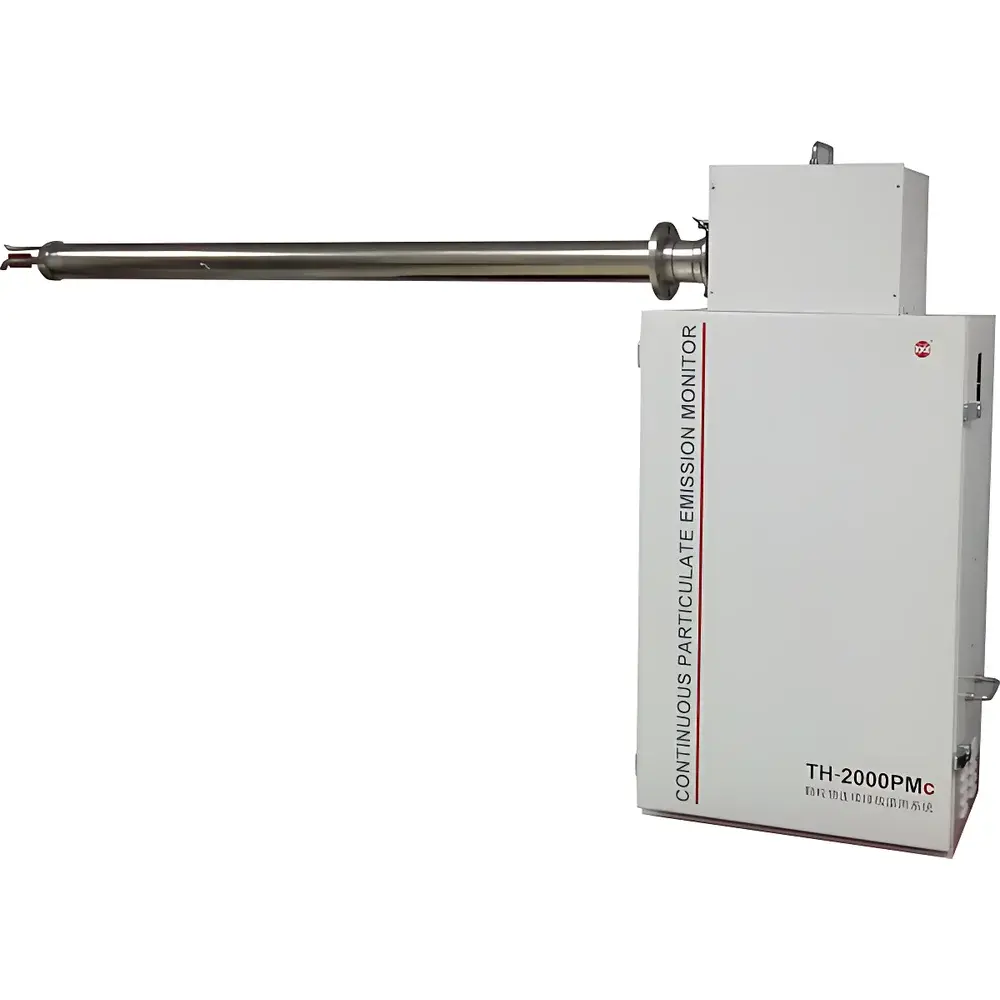
Tianhong TH-2000PMd Low-Concentration Ambient Particulate Matter Monitor
| Brand | Tianhong |
|---|---|
| Origin | Hubei, China |
| Model | TH-2000PMd |
| Instrument Type | Continuous Emission Monitoring System (CEMS) for Particulate Matter |
| Measurement Principle | β-ray attenuation with Dynamic Heating System (DHS) |
| Measurable Fractions | TSP, PM₁₀, PM₂.₅, PM₁.₀ |
| Display | 7-inch capacitive touchscreen (Chinese UI) |
| Data Storage | ≥1 year internal flash memory |
| Communication | Embedded GPRS module, digital (RS485/RS232) and analog (4–20 mA) outputs |
| Environmental Rating | IP55-rated enclosure, operational without external shelter |
| Temperature Control | Integrated thermostatic chamber |
| Compliance | HJ 653–2013, HJ 655–2013, HJ 93–2013 |
| Response Time | ≤1 min (T₉₀) |
| Accuracy | ±1 µg/m³ (as per HJ 653–2013 reference method validation) |
| Repeatability | ≤1% RSD |
| Long-term Drift | ≤1 µg/m³/30 days |
Overview
The Tianhong TH-2000PMd is a regulatory-grade, low-concentration ambient particulate matter monitor engineered for continuous, unattended measurement of total suspended particles (TSP), PM₁₀, PM₂.₅, and PM₁.₀ in outdoor and semi-outdoor environments. It operates on the β-ray attenuation principle—where beta radiation passes through a continuously deposited particle-laden filter tape, and the attenuation coefficient is quantitatively correlated to mass concentration via calibrated absorption algorithms. Integrated with a Dynamic Heating System (DHS), the instrument actively controls sampling line and filter temperature to minimize hygroscopic bias and ensure stable performance under high-humidity conditions—critical for accurate long-term monitoring in coastal, industrial, or monsoon-affected regions. Designed to meet China’s national standard HJ 653–2013 for automatic PM monitoring systems, the TH-2000PMd supports both fixed-site deployment (e.g., rooftop monitoring stations, traffic corridors, tunnel portals) and rapid-response emergency setups (e.g., post-incident air quality assessment near chemical spills or fire zones). Its robust IP55-rated chassis, internal thermostatic chamber, and self-regulating flow control eliminate dependency on external shelters or climate-controlled enclosures.
Key Features
- β-ray + DHS dual-compensation architecture ensures trace-level sensitivity (detection limit < 1 µg/m³) and humidity-resilient accuracy across seasonal variations
- Simultaneous real-time quantification of TSP, PM₁₀, PM₂.₅, and PM₁.₀ on a single filter tape using programmable cut-point switching
- Integrated 7-inch capacitive touchscreen with intuitive Chinese-language interface—no PC required for field calibration, diagnostics, or data review
- Onboard 32-bit ARM-based microcontroller with deterministic real-time OS for precise volumetric flow regulation (±1% setpoint stability), tape advancement timing, and thermal management
- GPRS-enabled remote telemetry with configurable reporting intervals (1-min to 24-h); supports firmware OTA updates and alarm-triggered event uploads
- Modular analog (4–20 mA) and digital (RS485/RS232) I/O ports enable seamless integration with meteorological sensors (wind speed/direction, temperature/humidity), SCADA networks, or central CEMS servers
- Internal non-volatile storage retains ≥12 months of 1-minute averaged data (mass concentration, flow rate, temperature, pressure, tape position, diagnostic flags)
Sample Compatibility & Compliance
The TH-2000PMd is validated for use with standard quartz fiber or PTFE membrane filters compliant with HJ 93–2013. Its sampling inlet meets ISO 10473:2001 specifications for isokinetic aspiration and inertial separation efficiency. The system satisfies all functional and metrological requirements outlined in HJ 653–2013 (performance verification), HJ 655–2013 (installation and acceptance protocols), and GB/T 15432–1995 (ambient air quality standards implementation). While not certified to EU EN 12341 or US EPA EQPM-0805-162, its core β-ray methodology aligns with internationally accepted gravimetric equivalence principles. All internal calibration routines—including zero/span checks using certified NIST-traceable attenuation films—are logged with timestamps and operator IDs to support GLP-compliant audit trails.
Software & Data Management
The TH-2000PMd communicates with Tianhong’s proprietary Central Monitoring Platform (CMP v3.2), a web-accessible dashboard supporting multi-station aggregation, automated QA/QC flagging (e.g., flow deviation >±5%, temperature excursion >±2°C), and customizable report generation (PDF/CSV). Data export conforms to HJ 212–2017 communication protocol for environmental information systems. Local data retrieval is possible via USB mass storage mode or SD card hot-swap. Firmware logs include full diagnostic histories—tape motor current, detector voltage drift, heater duty cycle—enabling predictive maintenance scheduling. Remote access supports role-based permissions (operator, technician, administrator) and encrypted TLS 1.2 transmission.
Applications
- Urban ambient air quality networks (AAQNs) operated by municipal EPBs or provincial monitoring centers
- Industrial fence-line monitoring for cement plants, coal-fired power stations, steel mills, and waste incinerators
- Transportation-related exposure assessment: roadside, highway tunnel, port logistics zones
- Emergency response: real-time dispersion modeling input during hazardous material releases or wildfire smoke events
- Research-grade longitudinal studies requiring sub-µg/m³ resolution over multi-year deployments
- Validation of satellite-derived AOD (aerosol optical depth) products via ground-truth correlation
FAQ
What regulatory standards does the TH-2000PMd comply with?
It fully adheres to China’s HJ 653–2013, HJ 655–2013, and HJ 93–2013 technical specifications for PM monitoring systems.
Can the instrument operate without external power conditioning or climate control?
Yes—the integrated thermostatic chamber and IP55-rated housing allow direct outdoor mounting in temperatures from –20°C to +50°C and relative humidity up to 95% RH (non-condensing).
Is meteorological sensor integration mandatory?
No—wind speed/direction sensors are optional; however, their input enables wind-sector analysis and conditional data filtering in post-processing.
How is calibration traceability maintained?
Each unit ships with a factory-applied NIST-traceable β-ray attenuation film certificate; field zero/span checks are recorded with metadata for audit readiness.
Does the system support third-party data acquisition software?
Yes—via Modbus RTU over RS485 or ASCII protocol over RS232; documented register maps and command syntax are provided in the technical manual.







