
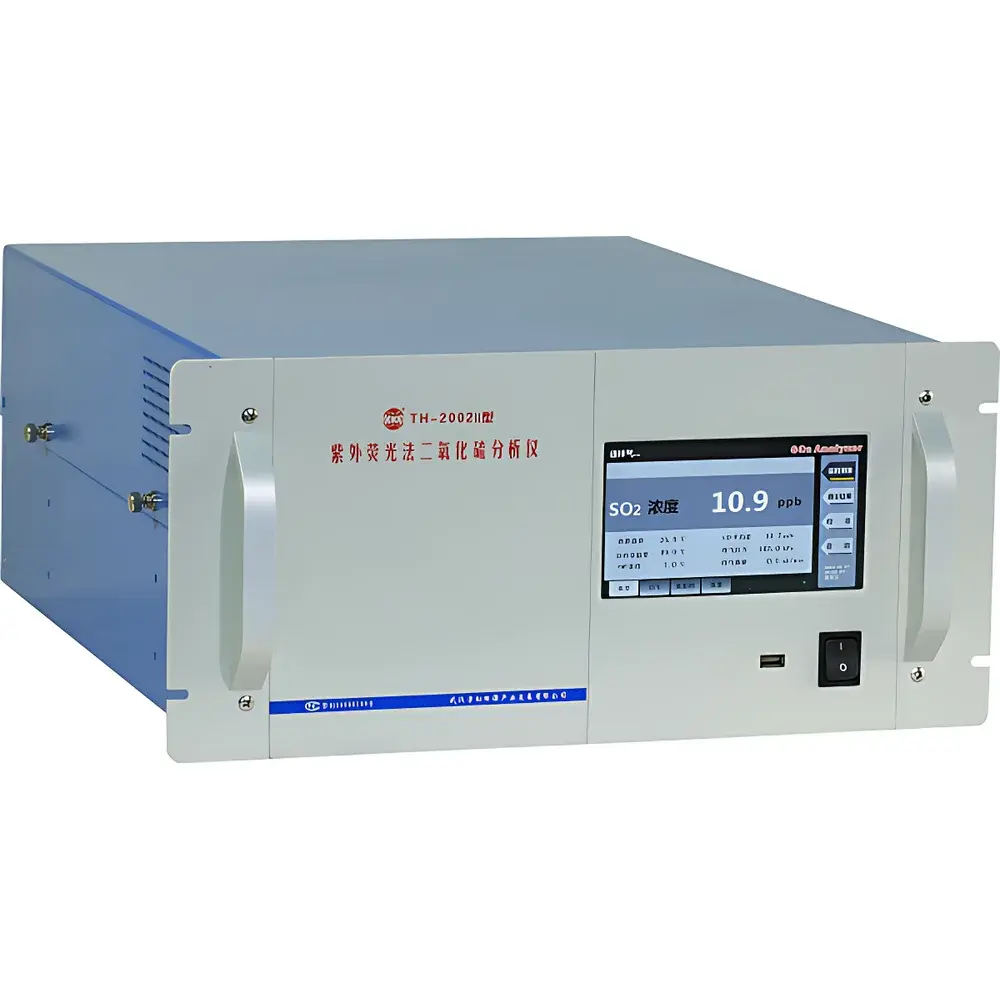
Tianhong TH-2002H UV Fluorescence Sulfur Dioxide (SO₂) Analyzer
| Brand | Tianhong |
|---|---|
| Model | TH-2002H |
| Measurement Principle | UV Fluorescence at 214 nm excitation / 330 nm emission |
| Detection Range | ppb to ppm level (auto-ranging) |
| Display | 7-inch full-touch color LCD |
| Units | ppb, ppm, µg/m³, mg/m³ (user-selectable) |
| Data Logging | One record per 5 minutes with long-term storage |
| Compensation | Automatic temperature & pressure compensation |
| Light Source Monitoring | Dual-path Zn lamp intensity tracking and real-time reference correction |
| Remote Capability | Remote calibration verification and internal parameter diagnostics |
| Alarm | Multi-threshold configurable alarms |
| Compliance Support | Designed for continuous ambient air quality monitoring per EPA Method PS-1, ISO 7935, and GB/T 15262–2010 |
Overview
The Tianhong TH-2002H UV Fluorescence Sulfur Dioxide (SO₂) Analyzer is a high-stability, field-deployable gas analyzer engineered for continuous, real-time quantification of sulfur dioxide in ambient air, stack emissions, and indoor environments. It operates on the well-established ultraviolet fluorescence principle: SO₂ molecules are excited by monochromatic UV radiation at 214 nm (generated by a stabilized zinc vapor lamp), and subsequently emit characteristic fluorescence at ~330 nm upon relaxation. The emitted photon flux is directly proportional to the SO₂ concentration within the reaction chamber. To ensure metrological integrity under variable environmental conditions, the system implements dual-beam optical architecture — one path measures sample-induced fluorescence intensity, while the second continuously monitors lamp output drift and compensates in real time. This design minimizes baseline drift and enhances long-term measurement reproducibility without requiring frequent manual recalibration.
Key Features
- 7-inch full-touch color LCD interface with intuitive Chinese menu navigation and responsive graphical user experience
- Multi-unit display capability: seamless switching between ppb, ppm, µg/m³, and mg/m³ — automatically scaled based on current concentration range
- Intelligent auto-ranging algorithm dynamically selects optimal gain and integration time to maintain signal fidelity across low-ppb background levels and high-concentration industrial plumes
- Real-time graphical trend display with pinch-to-zoom functionality for temporal analysis of concentration profiles over hours or days
- Integrated temperature and barometric pressure sensors enable real-time volumetric correction to standard reference conditions (e.g., 25°C, 101.325 kPa)
- Adaptive signal processing algorithm optimizes response time (T₉₀ < 120 s typical) while maximizing signal-to-noise ratio through dynamic filtering and baseline subtraction
- Zinc lamp intensity is continuously tracked via reference photodiode; output variations are compensated mathematically to preserve photometric linearity
- Remote diagnostic access enables validation of internal operating parameters (lamp voltage, PMT gain, detector temperature, flow rate) and supports remote calibration verification
Sample Compatibility & Compliance
The TH-2002H is compatible with ambient air, diluted stack gas, and conditioned laboratory air streams. Sample inlet accepts standard 1/4″ OD PTFE or stainless-steel tubing with flow rates adjustable from 0.5 to 2.0 L/min. Internal sampling path features heated components (optional) to prevent condensation in high-humidity environments. The analyzer meets technical requirements for continuous emission monitoring systems (CEMS) as referenced in U.S. EPA Performance Specification 1 (PS-1) for SO₂ analyzers and aligns with ISO 7935:1990 (Stationary source emissions — Determination of sulfur dioxide — Ultraviolet fluorescence method). It also conforms to China’s national standard GB/T 15262–2010 for ambient air quality monitoring instrumentation. While not inherently 21 CFR Part 11 compliant, audit-trail-ready data logging and password-protected configuration settings support GLP/GMP-aligned operational protocols when deployed in regulated QA/QC laboratories.
Software & Data Management
Data acquisition and instrument control are managed via embedded firmware with non-volatile memory supporting ≥12 months of 5-minute interval records (timestamped, concentration, temperature, pressure, lamp status, alarm flags). Export is supported via USB flash drive in CSV format for offline analysis. Optional RS-232/RS-485 and Ethernet interfaces allow integration into SCADA or central air quality management platforms using Modbus RTU/TCP or custom ASCII protocols. Firmware updates are performed via secure OTA (over-the-air) or local file upload. All configuration changes and calibration events are logged with user ID, timestamp, and pre/post values — enabling traceability during regulatory audits.
Applications
- Ambient air quality monitoring networks (AQN) operated by environmental protection agencies
- Continuous emissions monitoring systems (CEMS) for coal-fired power plants, cement kilns, and metallurgical facilities
- Indoor air quality assessment in industrial hygiene and occupational safety programs
- Method validation and reference measurement in metrology laboratories
- Research applications involving SO₂ kinetics, atmospheric chemistry modeling, and sensor cross-interference studies
FAQ
What is the detection limit of the TH-2002H?
The instrument achieves a lower detection limit (LDL) of ≤0.5 ppb (3σ) under optimized operating conditions with 120-second averaging.
Does it require periodic zero/span calibration?
Yes — daily or weekly zero/span checks are recommended per EPA and ISO guidance; however, the dual-beam compensation reduces frequency dependency compared to single-beam designs.
Can it operate unattended for extended periods?
Yes — designed for 24/7 operation with robust thermal management and built-in watchdog circuitry; mean time between failures (MTBF) exceeds 8,000 hours.
Is ozone interference corrected internally?
No — the TH-2002H does not include catalytic scrubbers; users must verify absence of ozone or apply external quenching if present in sample matrix.
What maintenance is required?
Routine tasks include quarterly optical window cleaning, annual PMT gain verification, and biannual replacement of particulate filters and desiccant cartridges.







