
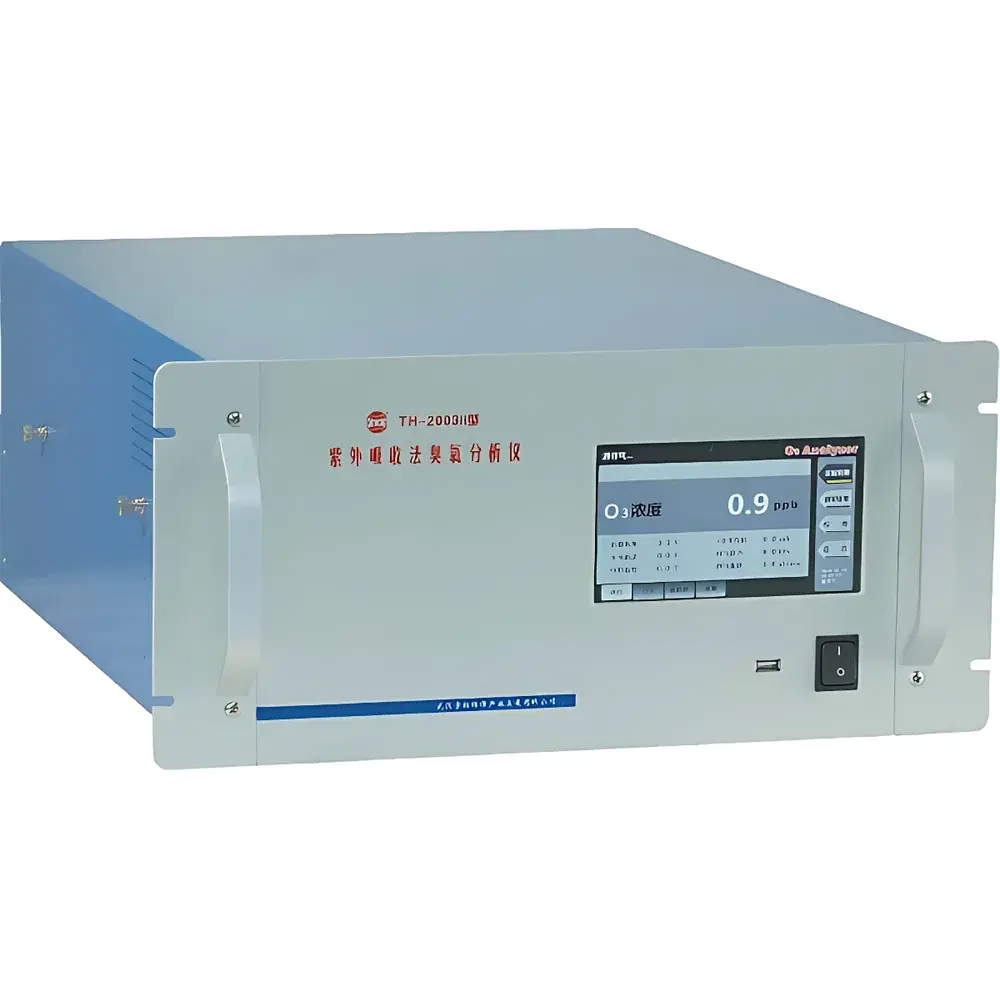
Tianhong TH-2003H UV Absorption Ozone Analyzer
| Brand | Tianhong |
|---|---|
| Origin | Hubei, China |
| Model | TH-2003H |
| Instrument Type | Online |
| Measurement Range | 0–1000 ppb (configurable) |
| Detection Limit | <1 ppb |
| Response Time | <30 s (T90) |
| Zero Drift | ±1 ppb/24 h |
| Resolution | 0.1 ppb |
| Operating Temperature | 5–40 °C |
| Pressure Compensation | Built-in absolute pressure sensor |
| Temperature Compensation | Integrated NTC thermistor |
| Display | 7-inch capacitive touchscreen |
| Data Logging | Internal storage for ≥1 year (one record per 5 min) |
| Communication | RS232/RS485, Modbus RTU, optional Ethernet |
| Gas Path Materials | PTFE (Teflon®) valves, fittings, and sample lines |
| Alarm Outputs | 4 programmable relay outputs |
| Compliance | CE-marked, RoHS-compliant, designed per IEC 61000-6-3 (EMC) and IEC 61000-6-2 (immunity) |
Overview
The Tianhong TH-2003H UV Absorption Ozone Analyzer is an online, continuous gas-phase monitoring instrument engineered for high-stability, trace-level ozone (O3) quantification in ambient air, cleanroom environments, municipal water treatment off-gas streams, and industrial process control applications. It operates on the fundamental principle of ultraviolet absorption spectroscopy at 254 nm — a wavelength strongly absorbed by ozone molecules in accordance with the Beer–Lambert law. The analyzer employs a dual-beam optical architecture: one beam passes through the sample gas stream containing ozone; the other traverses a dynamically generated reference stream from which ozone has been catalytically removed. This real-time differential measurement eliminates drift caused by lamp aging, window fouling, or electronic gain variation. A low-pressure mercury vapor lamp serves as the stable UV source, while photodiode detectors capture transmitted intensity on both paths. The integrated microprocessor computes ozone concentration using calibrated extinction coefficients and applies simultaneous temperature and absolute pressure compensation to ensure metrological traceability under variable environmental conditions.
Key Features
- Dual-beam UV photometry with active reference channel for continuous source drift correction
- 7-inch high-resolution capacitive touchscreen interface with intuitive Chinese/English bilingual menu navigation
- Multi-unit display capability: ppb, ppm, µg/m³, and mg/m³ — selectable per user preference with automatic unit conversion
- Adaptive signal processing algorithm optimizing response time (<30 s T90) and signal-to-noise ratio without manual tuning
- Automatic range switching across sub-ppb to low-ppm levels, eliminating manual span adjustments during operation
- Real-time graphical trend display with pinch-to-zoom, pan, and time-window selection for historical waveform analysis
- Internal data logger storing ≥1 year of 5-minute averaged records (timestamped, with audit-ready metadata)
- Remote diagnostics and zero/span calibration support via secure serial or Modbus protocol — compatible with SCADA and DCS integration
- Full-wetted-path construction using PTFE (Teflon®) valves, ferrules, and flow cells to prevent ozone adsorption, catalytic decomposition, or surface memory effects
- Four programmable alarm relays with configurable thresholds, latching/non-latching modes, and event logging
Sample Compatibility & Compliance
The TH-2003H is validated for use with ambient air, filtered plant exhaust, ozone generator output, and post-oxidation off-gas streams. It accommodates sample dew points up to 10 °C and particulate loadings ≤0.3 µm (with optional inline filter). All wetted materials meet USP Class VI and FDA-relevant extractables criteria for low-interference gas analysis. While not certified to EN 14625 or ISO 11337 for regulatory ambient monitoring, its design adheres to core metrological principles referenced in those standards — including linearity verification (R² > 0.999 over full range), repeatability (<±0.5% of reading), and long-term stability assessment per ISO 5725-2. The instrument supports GLP-compliant operation through timestamped calibration logs, user-accessible firmware versioning, and tamper-evident configuration locks.
Software & Data Management
Data acquisition and configuration are managed via embedded firmware compliant with IEC 62443-3-3 SL1 cybersecurity baseline. Raw photometric signals, compensated concentration values, diagnostic flags (e.g., lamp intensity, flow rate, temperature/pressure status), and alarm events are logged with UTC timestamps. Export formats include CSV and XML via USB host port or serial interface. Optional PC-based software provides spectral view, calibration curve management, report generation (PDF/Excel), and audit trail review — supporting 21 CFR Part 11 readiness when deployed with role-based access control and electronic signature modules. Firmware updates are performed via signed binary packages to prevent unauthorized modification.
Applications
- Ambient air quality monitoring networks (urban, suburban, background stations)
- Ozone destruction efficiency verification in semiconductor fab abatement systems
- Real-time feedback control of ozone generators in municipal drinking water disinfection
- Indoor air quality assessment in hospitals, laboratories, and HVAC commissioning
- Research-grade ozone kinetics studies requiring stable, low-drift baselines
- Calibration transfer standard for portable ozone monitors (via dynamic dilution validation)
FAQ
What is the recommended calibration frequency for routine compliance monitoring?
For ambient air applications under EPA or EU directive frameworks, quarterly zero/span verification with NIST-traceable ozone standards is advised. Annual full calibration with primary standard generator is recommended.
Can the TH-2003H operate unattended for extended periods?
Yes — designed for 24/7 operation with internal diagnostics, auto-compensation, and non-volatile memory. Mean time between failures exceeds 12,000 hours under typical environmental conditions.
Does the analyzer require external gas scrubbers or conditioning systems?
No — integrated catalytic ozone scrubber provides reference gas on-demand. Optional external particulate and moisture filters may be added upstream depending on sample matrix severity.
Is the firmware upgradeable in the field?
Yes — firmware updates are delivered as digitally signed binaries and installed via USB or serial interface with rollback capability.
How is measurement uncertainty quantified for this instrument?
Combined standard uncertainty is ≤±2.0% of reading (k=2) at 100 ppb, derived from contributions of photometric noise, pressure/temperature sensor accuracy, calibration standard uncertainty, and linearity deviation — documented in the factory calibration certificate.
Related Products







