
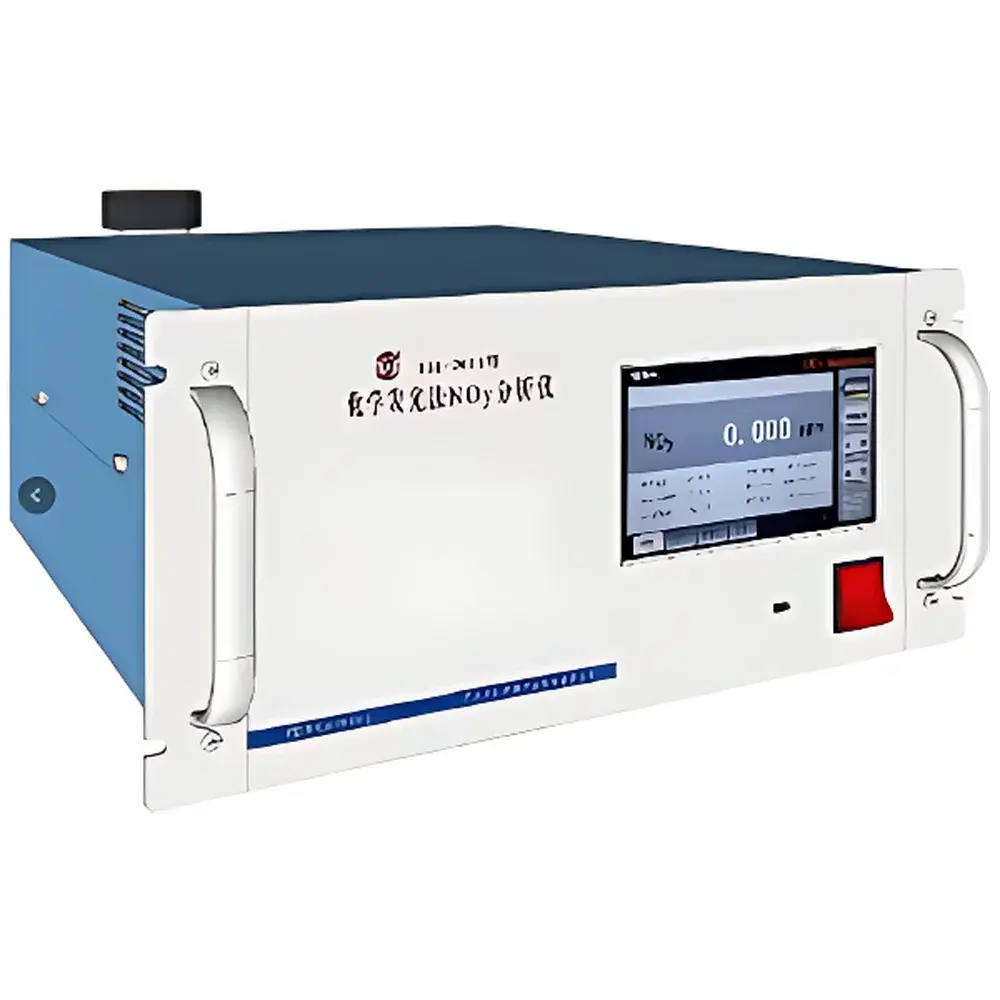
Tianhong TH-2011 Chemiluminescence-Based NOy Analyzer
| Brand | Tianhong |
|---|---|
| Origin | Hubei, China |
| Model | TH-2011 Chemiluminescence NOy Analyzer |
| Detection Principle | Gas-phase chemiluminescence (NO + O₃ → NO₂* + O₂) |
| Measured Species | NO, NOz, NOy (via catalytic reduction to NO) |
| Output Interfaces | RS-232, RS-485 |
| Compliance | HJ 654–2013, Q/WYH 01–2013 |
| Operating Mode | Continuous automatic ambient air monitoring |
| Display | Touchscreen with Chinese GUI |
| Design | Modular hardware architecture |
| Data Processing | Digital filtering (MSE-optimized response time & SNR) |
Overview
The Tianhong TH-2011 Chemiluminescence-Based NOy Analyzer is a dedicated ambient air monitoring instrument engineered for the continuous, real-time quantification of reactive nitrogen oxide species—specifically nitric oxide (NO), nitrogen dioxide (NO₂), and the sum parameter NOy (total reactive nitrogen oxides)—in outdoor atmospheric environments. It operates on the well-established gas-phase chemiluminescence detection principle, wherein gaseous NO reacts stoichiometrically with ozone (O₃) to produce electronically excited nitrogen dioxide (NO₂*). As NO₂* relaxes to its ground electronic state, it emits photons predominantly in the near-infrared region (peak intensity near 1100 nm), with measurable emission spanning 600–3000 nm. A photomultiplier tube (PMT) detects this luminescent signal; under conditions of excess ozone and constant reaction temperature, the PMT output current exhibits linear proportionality to the NO concentration in the sampled gas stream. To quantify NOy—which includes NO₂, HNO₃, PANs, N₂O₅, and other thermally labile nitrogen-containing compounds—the analyzer incorporates a high-efficiency catalytic reduction furnace (typically molybdenum or stainless steel at ~325 °C) that quantitatively converts all NOy species to NO prior to chemiluminescent detection. By alternating sample flow between direct (NO-only) and reduced (NOy-derived NO) paths via precision solenoid valves, the system delivers concurrent, time-synchronized measurements of NO and NOy with inherent stoichiometric accuracy.
Key Features
- Gas-phase chemiluminescence detection with proven specificity for NO and quantitative NOy conversion via thermal catalysis
- Modular mechanical architecture enabling rapid field maintenance, component-level replacement, and minimal downtime
- Integrated touchscreen interface with native Chinese-language menu navigation—designed for operational efficiency in domestic environmental monitoring stations
- Digital signal processing employing minimum mean-square error (MMSE)-optimized digital filtering to simultaneously maximize signal-to-noise ratio (SNR) and minimize system response time
- Dual-channel concentration display showing real-time NO and NOy values on a single interface
- Standardized serial communication interfaces (RS-232 and RS-485) compliant with national ambient air monitoring network protocols for seamless integration into multi-analyzer substation architectures
- Automated fault diagnostics with on-screen alert generation and error code identification for accelerated troubleshooting
Sample Compatibility & Compliance
The TH-2011 is validated for continuous operation in ambient air matrices meeting typical urban and rural background particulate and humidity profiles. It complies with the technical specifications and verification procedures defined in China’s Ministry of Ecology and Environment standard HJ 654–2013 (“Technical Requirements and Test Methods for Continuous Automatic Monitoring Systems of Gaseous Pollutants in Ambient Air: SO₂, NO₂, O₃, CO”) and enterprise standard Q/WYH 01–2013. While not certified to ISO/IEC 17025 or EPA PS-1/PS-2 equivalency, its design aligns with internationally recognized performance criteria for chemiluminescence-based NOx analyzers—including linearity (<±2% full scale), zero drift (<±0.5 ppb/24 h), span drift (<±1% full scale/24 h), and response time (T₉₀ < 120 s)—as verified during factory calibration against NIST-traceable gas standards. The instrument supports routine calibration using certified NO and NO₂ permeation tubes or dynamic dilution systems per HJ 654–2013 Annex B.
Software & Data Management
Data acquisition and instrument control are managed through embedded firmware supporting configurable sampling intervals (1–60 s), averaging periods (1–60 min), and alarm thresholds. Raw and processed data are timestamped and stored locally in non-volatile memory with capacity for ≥30 days of 1-minute resolution records. Communication with substation data loggers occurs via ASCII-based protocol over RS-232/RS-485, supporting Modbus RTU framing for interoperability with SCADA and EMS platforms. All transmitted datasets include metadata tags for measurement mode (NO or NOy), calibration status flags, and diagnostic codes. While the native software does not implement FDA 21 CFR Part 11-compliant audit trails or electronic signatures, its deterministic data logging architecture satisfies GLP-aligned record integrity requirements for long-term trend analysis and regulatory reporting under Chinese environmental statutes.
Applications
The TH-2011 serves as a core analytical module in national and provincial ambient air quality monitoring networks, particularly where regulatory compliance requires NOy-speciated data for ozone formation potential assessment and source apportionment modeling. Its primary deployment contexts include fixed-site urban background stations, roadside traffic monitoring sites, industrial fence-line monitoring installations, and regional transport studies requiring speciated nitrogen oxide budgets. Due to its robustness in variable ambient temperature and humidity, it is routinely deployed across diverse climatic zones within mainland China—from humid subtropical basins to arid northwestern regions—without active sample conditioning beyond standard particle filtration and moisture removal.
FAQ
How does the TH-2011 differentiate between NO and NOy?
It uses timed valve switching to route ambient air either directly (measuring NO) or through a heated catalytic converter (converting all NOy species to NO), then calculates NOy as the difference between the two measured signals.
What is the typical detection limit for NO under standard operating conditions?
Based on manufacturer specifications and HJ 654–2013 validation reports, the instrument achieves a lower limit of detection (LLD) of ≤0.3 ppb (1σ, 60-s average) for NO in clean synthetic air matrix.
Is ozone generation integrated into the analyzer?
Yes—the TH-2011 includes an internal silent corona discharge ozone generator with adjustable output, calibrated to maintain stoichiometric excess relative to maximum expected NO concentration.
Can the TH-2011 be operated remotely via Ethernet or cellular modem?
No—the native interface supports only RS-232/RS-485; remote access requires external protocol converters or substation-level gateway integration.
Does the analyzer require periodic catalyst replacement?
The Mo-catalyst reduction furnace is rated for ≥12 months of continuous operation under typical ambient conditions; replacement interval depends on sulfur dioxide exposure and must be verified by post-conversion efficiency testing per HJ 654–2013 Section 7.3.







