
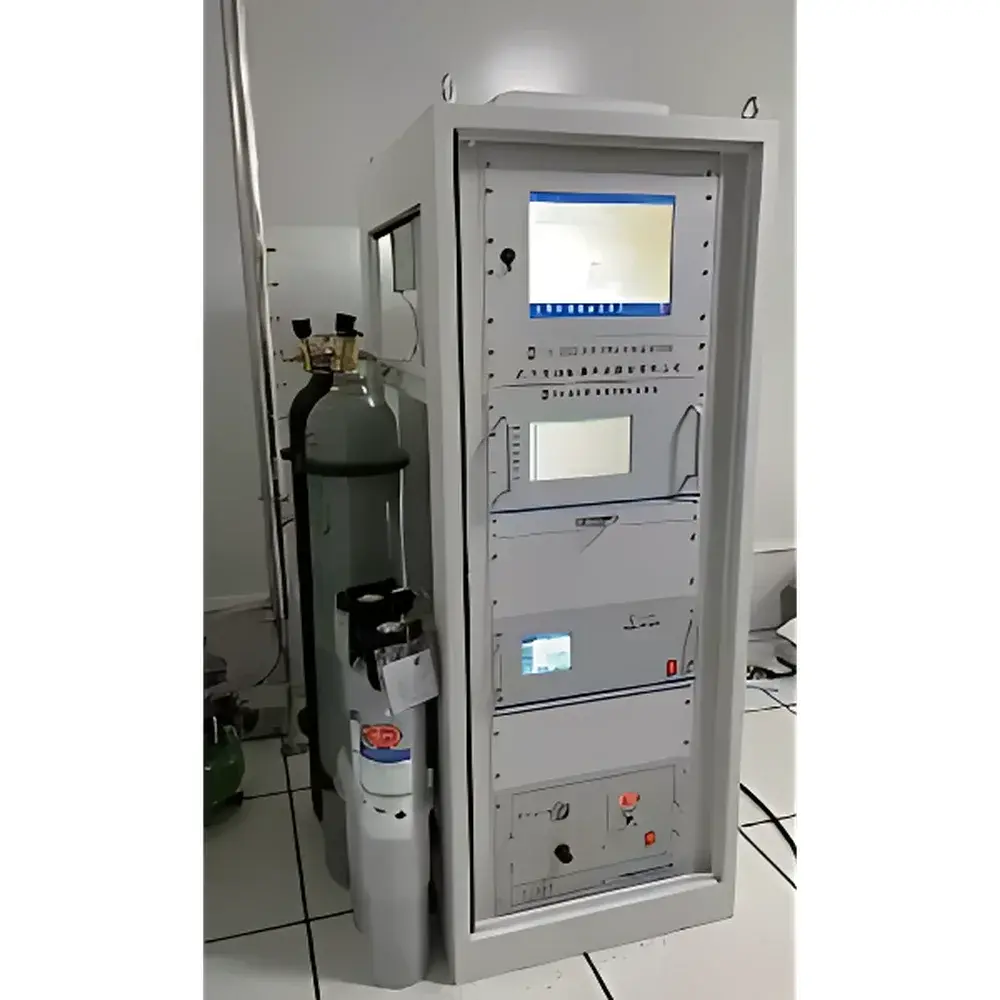
Tianhong TH-2020 Atmospheric PANs Online Monitoring System
| Brand | Tianhong |
|---|---|
| Origin | Hubei, China |
| Manufacturer Type | Authorized Distributor |
| Country of Origin | China |
| Model | TH-2020 Atmospheric PANs Online Monitoring System |
| Price Range | USD 110,000 – 205,000 |
| Detection Principle | Gas Chromatography with Electron Capture Detection (GC-ECD) |
| Calibration Method | On-site Photochemical Synthesis of PAN Standard Gas |
| Detection Limit | ≤ 50 ppt (PAN) |
| Analysis Cycle | ≤ 5 min |
| Temperature Control | TEC-cooled column oven down to 5 °C |
| Carrier Gas Control | Electronic Pressure Control (EPC) |
| Calibration Accuracy | ±1% F.S. (MFCs) |
| PAN Generation Efficiency | >96% |
| Compliance | DB35/T 1521–2015, JJG 1055–2009 |
Overview
The Tianhong TH-2020 Atmospheric PANs Online Monitoring System is a dedicated, field-deployable gas chromatographic analyzer engineered for continuous, real-time quantification of peroxyacyl nitrates (PANs) in ambient air. PANs—including peroxyacetyl nitrate (PAN), peroxypropionyl nitrate (PPN), and peroxy-methacryloyl nitrate (MPAN)—are secondary atmospheric pollutants formed exclusively through photochemical reactions between volatile organic compounds (VOCs) and nitrogen oxides (NOx) under solar irradiation. Unlike ozone or NO2, PANs possess no direct emission sources; their presence is therefore a highly specific and sensitive indicator of active photochemical processing in the troposphere. As thermally labile compounds with half-lives ranging from minutes to hours depending on temperature, PANs require precise thermal management during sampling, separation, and detection—making robust low-temperature GC-ECD architecture essential. The TH-2020 implements a fully integrated, cabinet-mounted design compliant with national Chinese standards DB35/T 1521–2015 (for continuous PAN monitoring) and JJG 1055–2009 (verification procedures for online GC instruments), ensuring metrological traceability and operational reliability in regulatory-grade air quality networks.
Key Features
- Integrated thermoelectric cooling (TEC) module maintains column oven temperature as low as 5 °C, minimizing thermal degradation of PANs during chromatographic separation
- Electron capture detector (ECD) optimized for electronegative analytes, delivering sub-part-per-trillion (ppt) sensitivity—PAN detection limit ≤ 50 ppt (signal-to-noise ratio ≥ 3)
- Electronic pressure control (EPC) system for carrier gas (typically high-purity N2 or Ar/CH4), enabling stable flow and programmable pressure ramping across analysis cycles
- Automated six-port switching valve with fixed-volume sample loop ensures reproducible injection volume and minimal carryover
- On-demand photochemical calibration unit synthesizes PAN standard gas in situ via controlled UV irradiation of NO and acetone vapor, achieving >96% conversion efficiency and long-term output stability
- High-precision mass flow controllers (MFCs) with ±1% full-scale accuracy, compensated for ambient temperature and barometric pressure fluctuations
- Modular cabinet architecture supports wall-mount or floor-standing installation; front-access service layout simplifies routine maintenance and consumables replacement
Sample Compatibility & Compliance
The TH-2020 is validated for unattended, continuous operation in ambient air matrices across diverse climatic zones—from urban monitoring stations to mountain-top observatories. Sample air is drawn through a heated stainless-steel inlet line (optional heating up to 50 °C to prevent condensation), filtered via a 0.2-µm PTFE membrane, and introduced directly into the GC system without pre-concentration. The instrument meets DB35/T 1521–2015 requirements for linearity (R² ≥ 0.999 over 0.1–10 ppb range), repeatability (RSD ≤ 5% at 1 ppb), and zero drift (< 0.02 ppb/24 h). While not certified to ISO/IEC 17025 or EPA TO-15 protocols, its analytical methodology aligns with principles outlined in EPA Method TO-11A (for PAN measurement by GC-ECD) and supports data compatibility with national air quality information platforms (e.g., CNEMC AQS). All calibration records, system logs, and raw chromatograms are timestamped and stored locally with optional secure FTP export for audit readiness.
Software & Data Management
The embedded Linux-based controller runs Tianhong’s proprietary PANView™ software, providing intuitive web-browser interface (HTTPS-enabled) for remote configuration, real-time chromatogram visualization, and event-driven alarm management (e.g., pressure deviation, detector saturation, calibration overdue). Data output follows standardized ASCII format (CSV) with UTC timestamps, compatible with third-party environmental data acquisition systems (EDAS) and SCADA platforms. Audit trails record all user actions—including method changes, calibration events, and manual interventions—with immutable timestamps. Optional 21 CFR Part 11-compliant firmware upgrade enables electronic signatures, role-based access control, and encrypted data archiving for GLP/GMP-aligned research applications.
Applications
- Regulatory monitoring of PANs at national and provincial environmental monitoring stations for photochemical smog early warning
- Field studies of VOC–NOx–O3 chemical regimes in megacities, industrial corridors, and rural background sites
- Validation of regional chemical transport models (e.g., CMAQ, WRF-Chem) requiring speciated PANs input
- Long-term trend analysis of tropospheric oxidation capacity, particularly in boundary layer and free troposphere interface zones
- Support for health impact assessments linking PAN exposure to ocular irritation, phytotoxicity, and potential mutagenicity pathways
FAQ
What is the primary detection mechanism for PANs in this system?
The TH-2020 employs gas chromatography coupled with electron capture detection (GC-ECD), leveraging the high electron affinity of PANs for selective, sensitive quantification in complex ambient air matrices.
Does the system require external calibration gas cylinders?
No—it features an integrated photochemical calibrator that generates certified PAN standard gas on demand using NO, acetone, and UV light, eliminating cylinder dependency and associated logistical constraints.
Can the TH-2020 measure individual PAN analogues (e.g., PPN, MPAN) separately?
Yes—the cryogenically assisted GC separation resolves PAN, PPN, and MPAN as baseline-separated peaks under optimized temperature programming, enabling speciated reporting.
Is the system suitable for unattended operation in remote locations?
Yes—designed for 24/7 operation with internal diagnostics, auto-recovery from power interruption, and optional cellular or satellite telemetry for status monitoring and data retrieval.
What maintenance intervals are recommended for routine operation?
ECD source cleaning every 6 months, column bake-out quarterly, and MFC calibration verification semiannually—full preventive maintenance schedule provided in the technical manual.







