
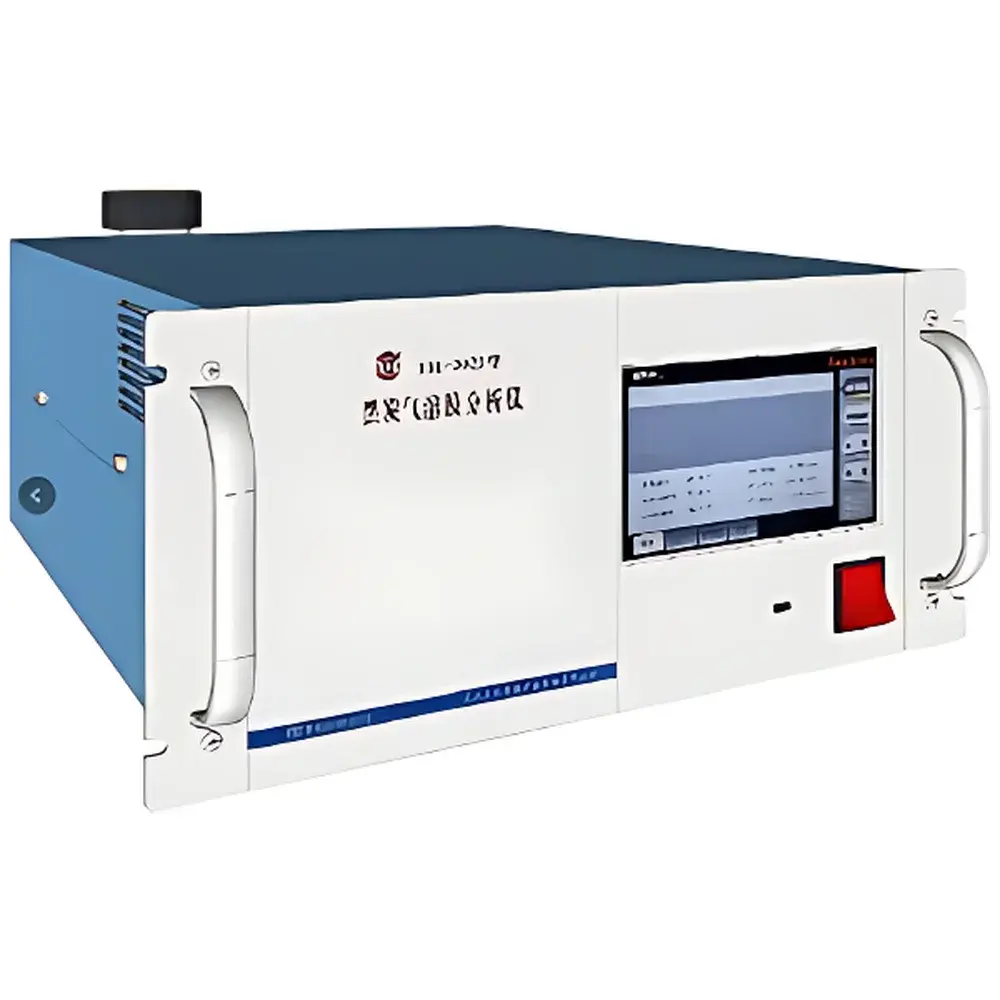
Tianhong TH-2025 Black Carbon Aerosol Analyzer
| Brand | Tianhong |
|---|---|
| Origin | Hubei, China |
| Model | TH-2025 |
| Instrument Type | Black Carbon Aerosol Analyzer |
| Measurement Principle | Optical Attenuation (Filter-Based Transmission at 7 Wavelengths) |
| Wavelength Range | 370–950 nm |
| Detection Unit | ng/m³ |
| Flow Rate | 2–6 L/min (internal/external pump configurable) |
| Data Storage | External SD card (7-channel BC time series) |
| Communication Interfaces | RS-232, RS-485, Ethernet |
| Compliance Context | Designed for long-term unattended operation in atmospheric background monitoring stations |
Overview
The Tianhong TH-2025 Black Carbon Aerosol Analyzer is a filter-based, multi-wavelength optical attenuation instrument engineered for continuous, quantitative measurement of elemental carbon (EC) mass concentration in ambient aerosols. It operates on the fundamental photometric principle that black carbon—comprising graphitic, light-absorbing carbonaceous particles from incomplete combustion—exhibits strong, spectrally dependent absorption across the near-ultraviolet to near-infrared spectrum (370–950 nm). As sampled air passes through a quartz fiber or Teflon-coated glass fiber filter tape, particulate matter—including black carbon—is deposited. A collimated light source sequentially illuminates the loaded filter at seven discrete wavelengths, and the transmitted intensity is measured by a high-stability photodetector. The attenuation (ΔI/I₀) is converted to black carbon mass loading using wavelength-specific mass absorption cross-sections (MAC), calibrated against reference standards traceable to NIST SRM 1648a (Urban Dust) and intercompared with AE33 aethalometer protocols. The system calculates real-time black carbon concentration in ng/m³, referenced to standard temperature and pressure (STP), with integrated volumetric flow correction and temperature/pressure compensation.
Key Features
- Seven-wavelength optical attenuation detection (370, 470, 520, 590, 660, 880, and 950 nm) enables spectral absorption analysis for source apportionment and coating correction.
- Automated filter tape advancement with adaptive stepping: algorithm-driven paper transport minimizes tape consumption based on real-time attenuation rate, extending operational autonomy to >30 days at typical background concentrations.
- Integrated dual-pump configuration support: internal diaphragm pump (2–6 L/min, ±2% flow accuracy) or external pump interface for high-flow or pressurized sampling lines.
- High-resolution 7-inch capacitive touchscreen interface with localized English firmware; full local control without PC dependency.
- Digital signal processing architecture featuring FPGA-accelerated real-time filtering, RMS noise suppression, and dynamic baseline drift compensation per channel.
- Onboard data logging with timestamped, checksum-verified records stored on removable industrial-grade SD cards (up to 128 GB); supports CSV export and metadata tagging (flow, temperature, RH, status flags).
Sample Compatibility & Compliance
The TH-2025 is validated for use with standard 47-mm quartz fiber filters (e.g., Pallflex Tissuquartz QAT-UP) and compatible glass fiber tapes. It meets functional requirements for long-term operation in Class I atmospheric background stations (per WMO GAW guidelines) and complies with instrumental specifications referenced in EPA OTM-32, EMEP/EEA Air Pollution Monitoring Guidelines, and ISO 12103-1 (test dust classification). While not certified under EU CE or US EPA EQOA, its design incorporates fail-safe mechanisms—including flow interruption alarms, filter saturation detection, and thermal runaway protection—for unattended deployment. Data output formats align with ICOS and ACTRIS metadata schemas, supporting interoperability in international atmospheric networks. All firmware logs include immutable UTC timestamps, operator ID fields, and change history—enabling GLP-compliant audit trails when deployed in regulated environmental research settings.
Software & Data Management
The analyzer communicates via ASCII-based serial protocol over RS-232/RS-485 or TCP/IP Ethernet, enabling integration into SCADA, CR1000X, or custom Python-based acquisition systems. Tianhong’s optional TH-DataLink software provides remote configuration, real-time visualization of all seven channels, spectral absorption Ångström exponent (AAE) calculation, and automated QA/QC flagging (e.g., negative attenuation, flow deviation >5%). Raw data files include header metadata compliant with CF-1.8 NetCDF conventions. For regulatory reporting, the system exports time-aggregated (1-min, 1-hr, 24-hr) concentration files with uncertainty estimates derived from flowmeter calibration certificates and photodetector linearity validation reports. Audit logs record all parameter modifications, firmware updates, and manual interventions—supporting FDA 21 CFR Part 11 readiness when paired with network-authenticated user accounts and electronic signature modules.
Applications
- Long-term black carbon trend analysis at Global Atmosphere Watch (GAW) stations and regional background sites.
- Source attribution studies leveraging spectral absorption signatures (e.g., distinguishing diesel vs. biomass burning via AAE and 370/950 nm ratio).
- Co-location campaigns with CO, NOₓ, and PM₂.₅ monitors to quantify combustion-derived aerosol contributions.
- Indoor air quality assessment in occupational health settings (e.g., tunnel maintenance, foundries, fire stations).
- Field validation of satellite-retrieved aerosol absorption optical depth (AAOD) products (e.g., MODIS, POLDER, SPEXone).
- Supporting radiative forcing modeling inputs in IPCC AR6-relevant climate simulations.
FAQ
What calibration standards are recommended for routine verification?
NIST-traceable EC reference materials (e.g., SRM 1648a) or laboratory-generated diesel soot deposits on filters, with annual intercomparison against co-located AE33 or MAAP instruments.
Can the TH-2025 distinguish brown carbon from black carbon?
No—it measures total light-absorbing carbon at each wavelength; spectral deconvolution requires complementary instrumentation (e.g., UV-Vis spectrophotometry of solvent extracts) or multi-instrument inversion algorithms.
Is the instrument suitable for shipboard or mobile platform deployment?
Yes, with vibration-dampened mounting and external power conditioning; flow stability must be maintained within ±3% during motion-induced pressure fluctuations.
How is humidity interference mitigated during sampling?
The system includes optional heated inlet (50 °C) and Nafion dryer integration; post-processing corrections based on concurrent RH measurements are supported in TH-DataLink.
What is the minimum detectable concentration (MDC) under typical background conditions?
Approximately 50 ng/m³ (1-hour average, 95% confidence, based on 1σ noise floor of transmission signal at 880 nm with 5-L/min flow and 5-min integration).







