
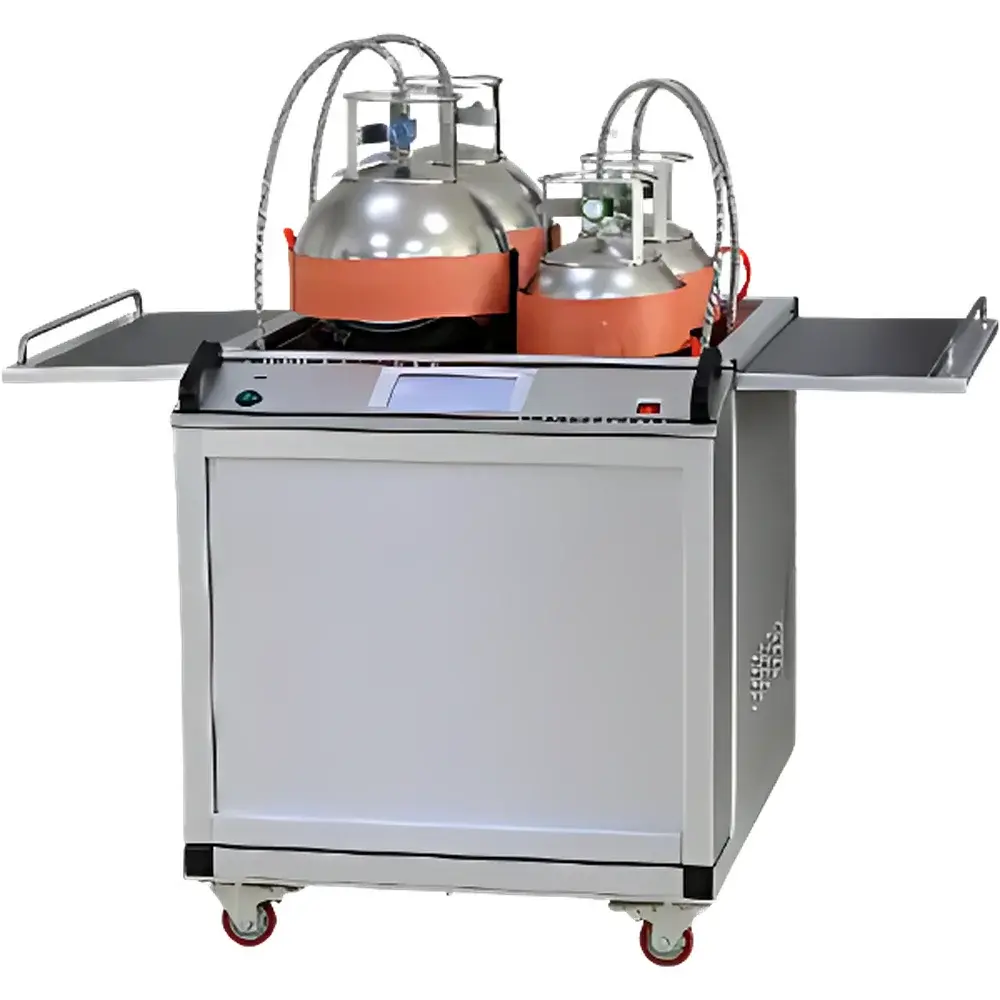
Tianhong TH-302B Sampling Canister Cleaning System
| Brand | Tianhong |
|---|---|
| Origin | Hubei, China |
| Model | TH-302B Sampling Canister Cleaning System |
| Vacuum Performance | ≤50 mtorr (base pressure), 100 L/min free-air displacement |
| Capacity | Simultaneous cleaning of up to 4 × 15 L canisters (expandable to 8) |
| Display | 7-inch capacitive touchscreen interface |
| Construction Materials | SS316 and PTFE throughout gas path (valves, fittings, tubing) |
| Compliance | Designed per HJ 759–2015 “Determination of Volatile Organic Compounds in Ambient Air — Canister Sampling GC-MS Method” |
Overview
The Tianhong TH-302B Sampling Canister Cleaning System is an engineered solution for laboratory-scale regeneration of electropolished stainless steel SUMMA®-type canisters used in ambient air VOC monitoring. It operates on a dual-stage vacuum evacuation and inert gas purge principle: first establishing high vacuum via a scroll pump backed by a turbomolecular pump, then introducing ultra-high-purity nitrogen or helium to desorb residual analytes from internal surfaces. This process restores canister background levels to meet stringent method-defined cleanliness thresholds—critical for trace-level VOC analysis where blank contamination directly compromises detection limits and data integrity. The system is purpose-built for compliance-driven environmental laboratories conducting routine canister preparation under regulatory frameworks including HJ 759–2015 and aligned with U.S. EPA TO-14A/TO-15 protocols.
Key Features
- Dual-stage vacuum architecture: Integrated scroll pump (primary stage) and turbomolecular pump (high-vacuum stage) achieve base pressures ≤50 mtorr, enabling effective removal of adsorbed water vapor, oxygen, and low-volatility organics.
- Scalable canister throughput: Standard configuration supports concurrent cleaning of four 0.5–15 L canisters; modular design allows expansion to eight positions without hardware modification to the core vacuum manifold.
- Full-material compatibility: All wetted components—including solenoid valves, Swagelok®-style fittings, and internal tubing—are constructed from electropolished 316 stainless steel or virgin PTFE, minimizing surface area for analyte adsorption and eliminating leachable contaminants.
- Intuitive human-machine interface: 7-inch industrial-grade capacitive touchscreen provides real-time visualization of vacuum pressure (mtorr), purge gas flow rate (SLPM), cycle time remaining, and system fault diagnostics.
- Programmable cleaning sequences: Users define custom multi-step protocols—including evacuation duration, inert gas fill pressure (up to 30 psig), dwell time, and number of purge cycles—stored as named methods with timestamped execution logs.
Sample Compatibility & Compliance
The TH-302B accommodates standard 0.5 L, 1 L, 3 L, 6 L, and 15 L electropolished stainless steel canisters with threaded NPT or UNF ports. It supports both single-port and dual-port configurations. Its operational parameters and material specifications are aligned with the technical requirements of HJ 759–2015, which mandates canister blank concentrations ≤0.05 ppbv for C2–C12 VOCs after cleaning. While not certified to ISO/IEC 17025, the system’s deterministic vacuum performance, traceable pressure transducers, and method-controlled operation support GLP-compliant documentation workflows when integrated with laboratory information management systems (LIMS). All purge gas inlets include dual-stage filtration (0.003 µm particulate + hydrocarbon trap) to prevent reintroduction of contaminants during regeneration.
Software & Data Management
The embedded firmware records every cleaning cycle with metadata including operator ID (via optional RFID badge reader), canister serial numbers (manually entered or barcode-scanned), start/end timestamps, achieved base pressure, total purge volume, and pass/fail status against user-defined acceptance criteria. Audit trails are exportable in CSV format for integration into electronic lab notebooks (ELN) or LIMS. The system does not require external PC connectivity for operation but supports optional Ethernet or RS-485 interfaces for remote monitoring and centralized fleet management in multi-instrument facilities. Data retention is configurable (default: 12 months); all logs are write-protected and tamper-evident per ALCOA+ principles.
Applications
- Preparation of SUMMA-type canisters prior to field deployment in ambient air monitoring networks (e.g., national air quality stations, urban VOC speciation programs).
- Regeneration of returned canisters in contract laboratories performing TO-14A/TO-15 or HJ 759–2015 compliant analyses.
- Validation of canister cleanliness following long-term storage or exposure to high-humidity or high-VOC environments.
- Method development studies evaluating the impact of cleaning parameters (e.g., purge gas type, dwell time) on blank levels for emerging compounds such as oxygenated VOCs or halogenated species.
- Supporting QA/QC programs requiring documented evidence of canister readiness prior to sample analysis in accredited environmental testing labs.
FAQ
What vacuum level is required to meet HJ 759–2015 canister cleaning specifications?
HJ 759–2015 does not specify an absolute vacuum threshold but requires demonstrable reduction of blank concentrations to ≤0.05 ppbv. The TH-302B’s ≤50 mtorr base pressure—verified with a calibrated capacitance manometer—ensures sufficient outgassing for typical SUMMA canister geometries and surface conditions.
Can the system be validated for ISO/IEC 17025 accreditation?
While the TH-302B itself is not accredited, its repeatable vacuum performance, traceable pressure sensors, and programmable protocols provide foundational data for method validation studies conducted in accordance with ISO/IEC 17025 Clause 7.2. Laboratories must perform in-house verification of cleaning efficacy using certified reference standards.
Is helium required for purging, or is nitrogen sufficient?
Both gases are supported. Nitrogen is cost-effective for routine cleaning; helium offers faster diffusion kinetics and lower molecular weight—advantageous when targeting highly adsorbed polar compounds or when minimizing purge time is critical.
How often should the turbomolecular pump oil or bearings be serviced?
The turbomolecular pump is oil-free and bearingless (magnetic levitation design); scheduled maintenance is limited to scroll pump oil changes every 2,000 operating hours and periodic inspection of PTFE seals in gas-path solenoids.
Does the system support automated canister leak testing?
No. Leak testing must be performed separately using a dedicated pressure-decay or helium mass spectrometer system prior to cleaning; the TH-302B assumes canisters are certified leak-tight before initiating regeneration.
Related Products







