
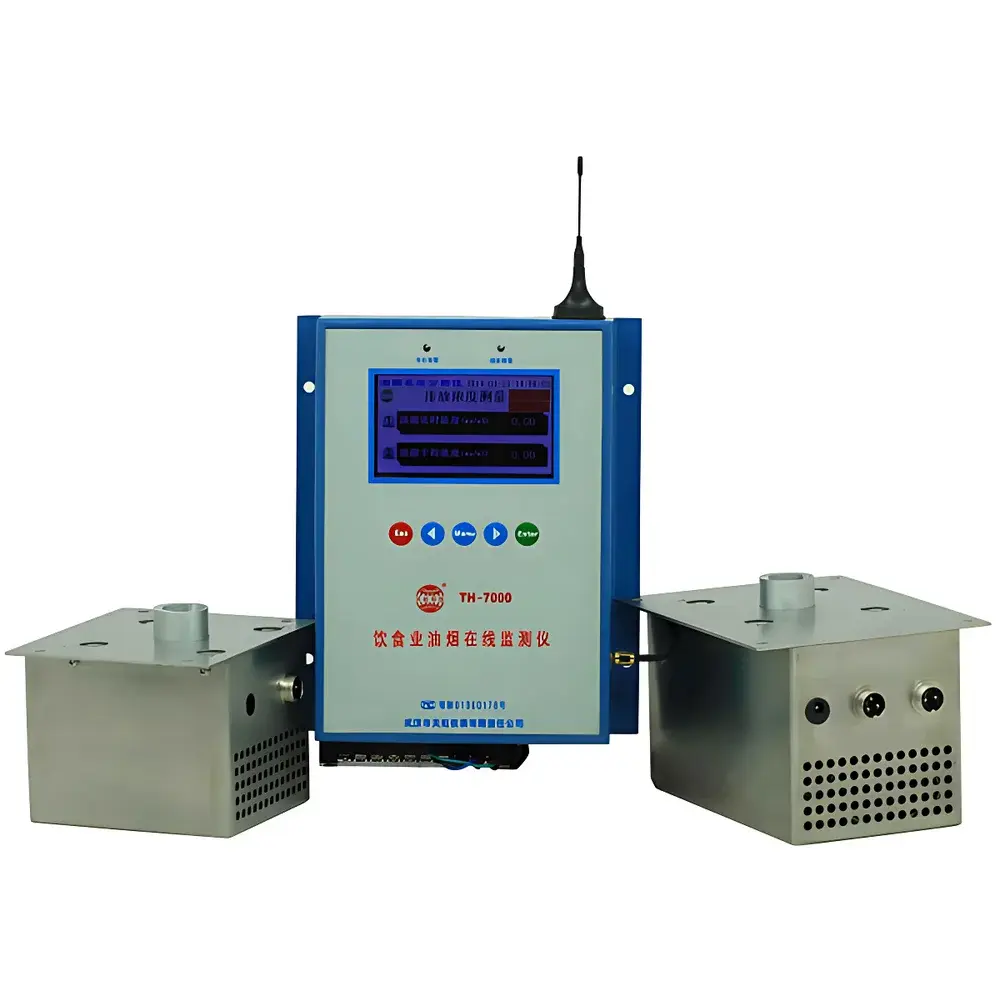
Tianhong TH-7000 Online Cooking Fume Monitoring System
| Brand | Tianhong |
|---|---|
| Origin | Hubei, China |
| Manufacturer Type | Authorized Distributor |
| Country of Origin | China |
| Model | TH-7000 |
| Pricing | Available Upon Request |
Overview
The Tianhong TH-7000 Online Cooking Fume Monitoring System is an industrial-grade, real-time emission monitoring instrument engineered for continuous measurement of cooking oil fume concentration in exhaust ducts of commercial food service establishments. It operates on the principle of full-flow optical scattering—where sampled flue gas passes directly through a calibrated optical path without dilution or filtration—enabling quantitative detection of particulate-phase油烟 (cooking oil aerosol) based on light extinction and Mie scattering characteristics. Designed in strict compliance with China’s GB 18483–2001 “Emission Standard for Cooking Fume from Catering Industry” and the China Environmental Protection Industry Association’s Technical Specification for Online Monitoring Systems for Cooking Fume Concentration (issued July 7, 2011), the TH-7000 serves as a regulatory-grade solution for environmental compliance verification, process optimization, and enforcement support in municipal air quality management programs.
Key Features
- Full-flow optical sensing architecture ensures representative sampling across varying duct velocities and particle size distributions (typically 0.1–10 µm aerodynamic diameter)
- Modular design with physically separated optical sensor unit and data processing/display unit—minimizing cross-contamination risk and facilitating maintenance in high-grease environments
- Dedicated lens protection system (e.g., purge air barrier and hydrophobic coating) maintains optical clarity and long-term signal stability under continuous exposure to condensable organics and soot
- On-site zero/span calibration capability supports traceable measurement integrity; automatic baseline drift compensation improves inter-day reproducibility
- Integrated flue gas parameter expansion interface enables concurrent acquisition of dynamic pressure, static pressure, and flue gas temperature (optional probes supported)
- GPRS-based wireless telemetry transmits time-stamped concentration values, operational status (e.g., hood fan ON/OFF, purifier bypass state), and alarm events to municipal environmental monitoring platforms
Sample Compatibility & Compliance
The TH-7000 is validated for use in stainless-steel or insulated rectangular/round exhaust ducts (diameter range: 200–1500 mm) typical of Chinese-style restaurant kitchens, fast-food chains, and central kitchen facilities. Its optical path geometry accommodates turbulent flow profiles and transient grease-laden plumes without requiring flow conditioning. The system meets mandatory requirements outlined in Q/WTH 30–2014 (Enterprise Standard of Wuhan Tianhong Environmental Technology Co., Ltd.) and aligns with technical validation criteria defined by the China Environmental Certification Center (CEC). While not certified to ISO/IEC 17025 for laboratory accreditation, its design principles reflect metrological rigor consistent with field-deployable ambient air monitoring systems referenced in EPA Method 202 and EN 15267-3 for automated measuring systems.
Software & Data Management
The embedded Linux-based firmware supports local data logging at user-configurable intervals (1–30 minute resolution), retaining up to 45,000 records (~90 days at 30-minute intervals). All stored entries include timestamp, measured fume concentration (mg/m³), reference oxygen-corrected emission rate (mg/m³ @ 10% O₂), flue gas parameters (if equipped), and system health flags. Data export is available via USB mass storage or secure FTP. Remote configuration and firmware updates are performed over GPRS using TLS-encrypted command channels. Audit trails record all calibration actions, parameter modifications, and alarm triggers—supporting basic GLP-aligned operational documentation for environmental inspectors.
Applications
- Real-time compliance monitoring for catering enterprises subject to local environmental supervision (e.g., Shanghai Municipal Ecological Environment Bureau’s “Blue Sky Defense Campaign”)
- Performance evaluation of electrostatic precipitators, UV photolysis units, and wet scrubbers installed downstream of kitchen hoods
- Baseline characterization and seasonal trend analysis for urban air quality modeling in mixed-use districts
- Pre-commissioning verification and routine QA/QC for third-party environmental service providers conducting facility audits
- Integration into building energy management systems (BEMS) to correlate fume load with ventilation fan speed and thermal load
FAQ
What is the measurement principle used by the TH-7000?
It employs full-flow optical scattering, where exhaust gas flows unaltered through a fixed optical path; concentration is derived from attenuation and angular scattering intensity of near-infrared light (typically 850 nm).
Does the system require periodic manual cleaning?
Yes—the optical sensor window requires scheduled inspection and gentle wiping every 3–6 months depending on grease loading; the purge air system reduces frequency but does not eliminate maintenance.
Can it operate in high-humidity or condensing duct environments?
It is rated for relative humidity ≤95% non-condensing; prolonged exposure to visible condensate may compromise lens integrity and is outside specified operating conditions.
Is the GPRS transmission compatible with international mobile networks?
The module is configured for China Mobile/China Unicom NB-IoT and 2G fallback; hardware-level adaptation would be required for LTE-M or CAT-1 deployment outside mainland China.
How is measurement traceability ensured?
Calibration uses NIST-traceable standard aerosols (e.g., dioctyl phthalate or polyalphaolefin) during factory verification; field zero checks are performed with clean air; span verification requires certified reference generators per Q/WTH 30–2014 Annex B.
Related Products







