
Tianhong TH-891 Portable Membrane-Based Gas Preconditioning System
| Brand | Tianhong |
|---|---|
| Origin | Hubei, China |
| Manufacturer Type | Authorized Distributor |
| Country of Origin | China |
| Model | TH-891 |
| Pricing | Available Upon Request |
Overview
The Tianhong TH-891 Portable Membrane-Based Gas Preconditioning System is an engineered solution for real-time, field-deployable sample gas conditioning in continuous emission monitoring (CEM) and portable flue gas analysis applications. Designed specifically for high-humidity, high-particulate, and chemically aggressive flue gas streams, the TH-891 employs a dual-stage Nafion™ membrane drying architecture combined with integrated particulate filtration and selective ammonia removal to deliver conditioned sample gas that meets the stringent requirements of optical-based SO₂ and NOₓ analyzers—particularly those operating under ultra-low emission (ULE) regulatory thresholds. Its core principle relies on selective water vapor permeation through sulfonated fluoropolymer membranes under controlled thermal and purge-gas conditions, enabling dehydration without chemical absorption or catalytic reaction that could alter target analyte concentrations. The system operates on the principle of differential partial pressure-driven diffusion across the Nafion membrane, preserving gaseous pollutants—including SO₂, NO, NO₂, CO, CO₂, and NH₃ (when not actively filtered)—with minimal loss or artifact formation.
Key Features
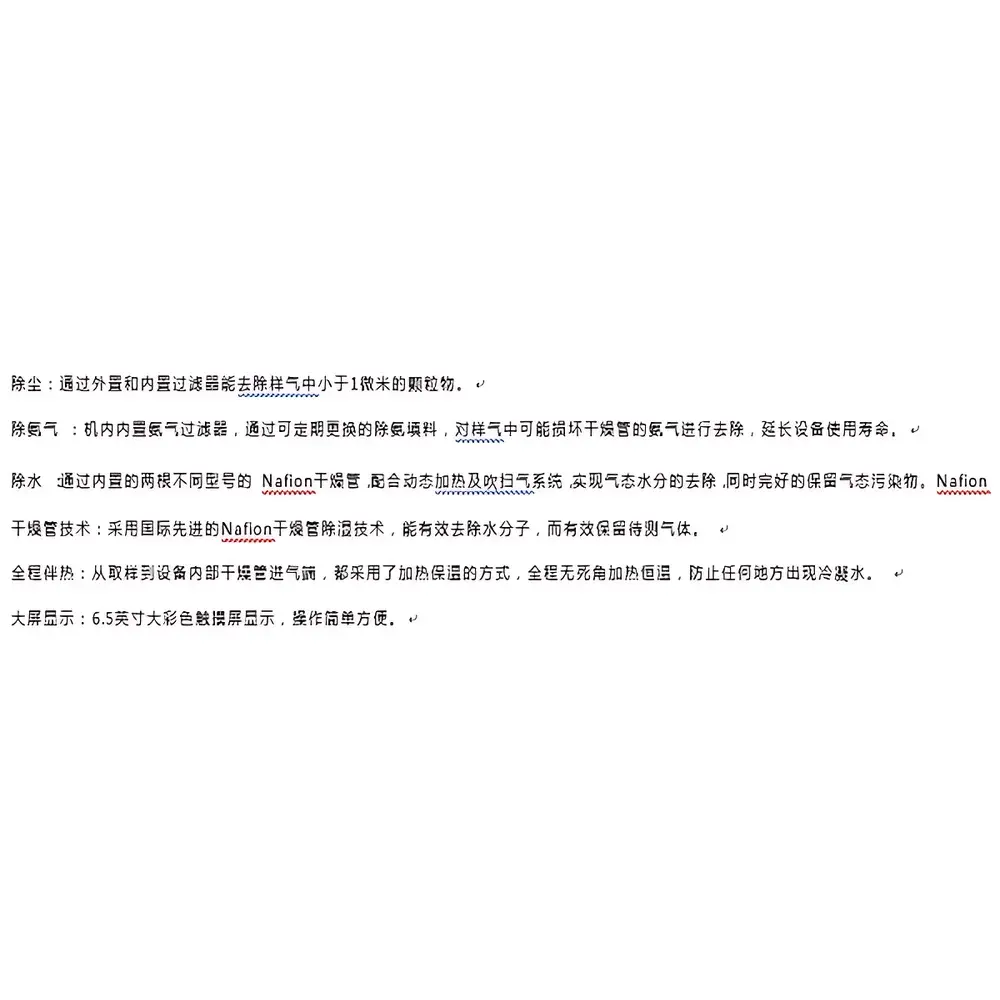
- Integrated Dual Nafion Drying Stages: Two thermally regulated Nafion™ membrane dryers—configured in series—enable progressive dew point reduction while maintaining >95% retention of target acidic and neutral gases under typical flue gas conditions (up to 15% vol. H₂O).
- Multi-Stage Particulate Filtration: Combines external sintered stainless-steel filter (10 µm nominal) and internal ceramic filter (<1 µm absolute), compliant with ISO 12103-1 A4 test dust specifications, to prevent membrane fouling and analyzer inlet clogging.
- Selective Ammonia Scrubbing: Removable cartridge containing acid-impregnated activated carbon selectively removes NH₃ prior to the first dryer stage, protecting Nafion integrity and extending service intervals—critical when operating downstream of SCR/SCR-SNCR systems.
- Full-Path Heated Sample Line Integration: Heated sampling probe interface (up to 180 °C), heated transfer line (120–160 °C), and heated dryer inlet ensure condensation-free transport from stack to preconditioner inlet—eliminating cold spots per EPA Method 320 and EN 15267-3 requirements.
- Intelligent Thermal Management: PID-controlled heating zones with independent temperature sensors and dynamic purge airflow (0.5–2.0 L/min, adjustable) optimize moisture removal efficiency while minimizing analyte adsorption or thermal decomposition.
- Human-Centric Interface: 6.5-inch capacitive color touchscreen with intuitive icon-driven navigation, real-time status indicators (temperature, flow, filter life), and on-device diagnostic logs supports rapid setup and field verification without external PCs.
Sample Compatibility & Compliance
The TH-891 is validated for use with flue gases from coal-fired power plants, sintering furnaces, coke ovens, waste incinerators, and catalytic cracking units. It accommodates inlet gas temperatures up to 180 °C, moisture content up to 25% v/v, and particulate loading ≤100 mg/m³ (dry basis). Performance aligns with draft technical specification HJ XXX-201X for optical SO₂/NOₓ analyzers, JJG 986-2002 verification protocol for flue gas analyzers, and enterprise standard Q/WTH 39-2017 (derived from GB/T 35213–2017 and EN 15267-3). All wetted materials—including Nafion tubing, PTFE seals, and 316L stainless-steel manifolds—meet USP Class VI and FDA 21 CFR 177.1550 compliance for inert gas contact. Design supports GLP/GMP traceability via timestamped calibration and maintenance records stored onboard.
Software & Data Management
The embedded firmware (v2.4+) supports USB-C data export (CSV/JSON), Bluetooth 5.0 configuration sync, and Modbus RTU output for integration into central CEMS SCADA systems. Onboard logging captures hourly averages of inlet/outlet dew point (calculated), flow rate, heater setpoints, and filter replacement timestamps—enabling full audit trails per ISO 17025 clause 7.7 and EPA 40 CFR Part 60 PS-17 QA/QC requirements. Firmware updates are performed via signed .bin files to ensure integrity; no cloud connectivity is implemented to maintain air-gapped operational security.
Applications
- Preconditioning for UV-DOAS, FTIR, and tunable diode laser (TDLAS) analyzers in ULE-compliant thermal power plants.
- Field validation and QA/QC support for certified reference methods (e.g., EPA Method 6C, EN 14791) during stack testing.
- Mobile monitoring of fugitive emissions in petrochemical and steelmaking facilities with variable flue gas composition.
- Calibration gas humidification control and zero-air generation in laboratory reference systems.
- Interfacing with portable Fourier-transform infrared (FTIR) spectrometers for multi-component speciation under ASTM D6348-18.
FAQ
What is the maximum allowable inlet moisture concentration for reliable operation?
The TH-891 maintains stable dew point suppression up to 25% v/v inlet water vapor at 180 °C inlet temperature, provided purge gas flow and heater setpoints are within specified ranges.
How often must the ammonia scrubber cartridge be replaced?
Under typical coal-fired flue gas conditions (NH₃ < 10 ppm), replacement is recommended every 300–500 hours of cumulative runtime; built-in usage counter triggers visual alert at 90% depletion.
Does the system meet EPA or EU regulatory requirements for certified CEMS use?
While the TH-891 itself is not a certified CEMS component, it is designed to satisfy the sample conditioning performance criteria referenced in EPA PS-17, EN 15267-3 Annex C, and HJ XXX-201X for use with certified analyzers.
Can the Nafion dryers be regenerated in the field?
No—Nafion membranes are non-regenerable consumables; each dryer module has a rated lifetime of ≥12 months under continuous operation at ≤120 °C and ≤10 ppm SO₂.
Is the touchscreen interface compatible with gloved operation in industrial environments?
Yes—the projected capacitive display supports operation with standard nitrile or leather work gloves and includes haptic feedback confirmation for critical actions.
Related Products







