
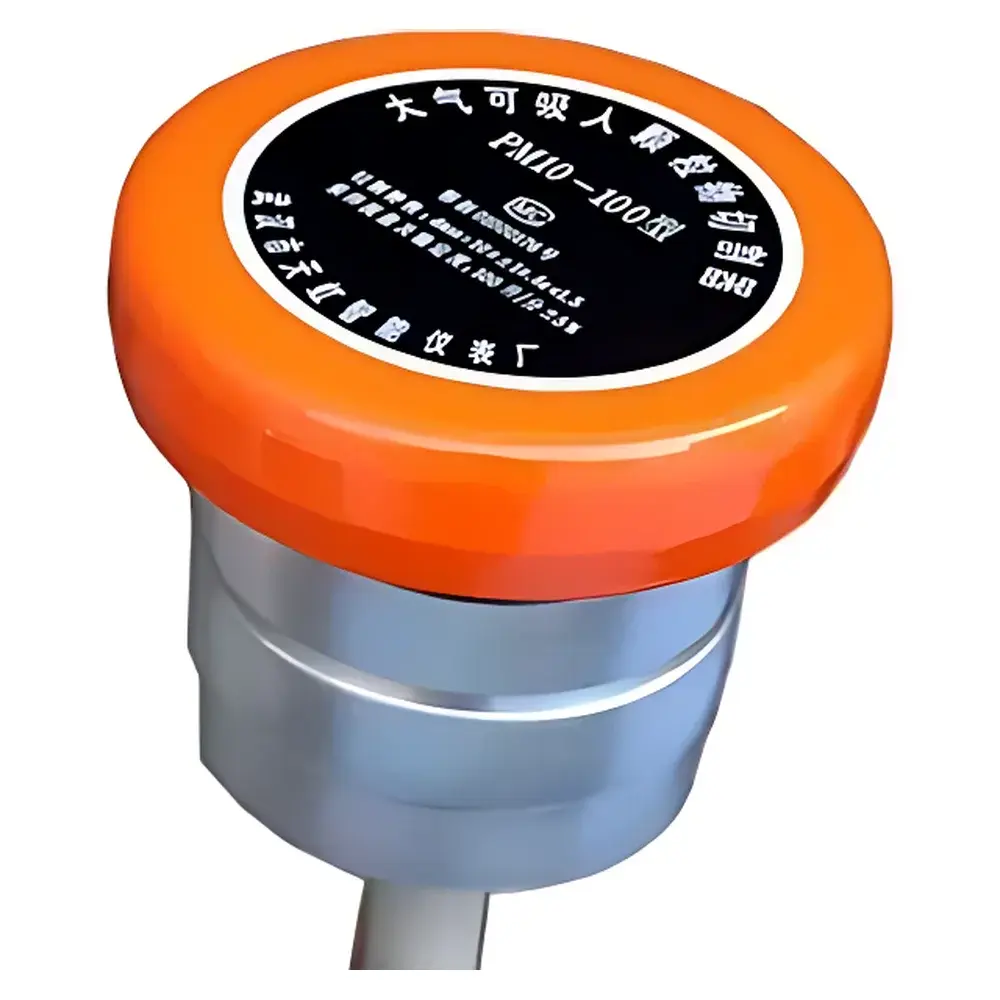
Tianhong PM10–100 Ambient Inhalable Particulate Matter Size-Selective Inlet (PM10 Cyclonic Separator)
| Brand | Tianhong |
|---|---|
| Origin | Hubei, China |
| Model | PM10–100 |
| Cut-Point Diameter (da50) | 10 ± 1 µm |
| Geometric Standard Deviation (δg) | ≤ 1.5 |
| Nominal Sampling Flow Rate | 100 L/min ± 5% |
| Flow Stability | ±3% |
| Effective Filter Membrane Area | Ø80 mm |
| Inlet Thread Specification | M18×2 |
| Compliance | GB 6921–1986 (Ambient Particulate Matter Sampling) |
Overview
The Tianhong PM10–100 Size-Selective Inlet is a precision-engineered cyclonic particle separator designed for ambient air monitoring applications requiring compliance with Chinese national standard GB 6921–1986. It functions as a physical inertial impactor that discriminates airborne particulate matter based on aerodynamic diameter, enabling selective collection of inhalable particles (PM10) while rejecting coarse particles larger than 10 µm. Its operational principle relies on controlled airflow dynamics within a calibrated cyclone geometry, where particles with aerodynamic diameters greater than the cut-point (da50 = 10 ± 1 µm) experience sufficient inertia to deviate from the main stream and impact onto internal surfaces, whereas particles below this threshold remain entrained in the flow and pass through to the downstream filter substrate. The device is not a standalone sampler but serves as a critical front-end component—integrated upstream of medium-flow rate sampling pumps—to ensure gravimetric or chemical analysis of the PM10 fraction meets regulatory method requirements.
Key Features
- Calibrated aerodynamic cut-point (da50) of 10 ± 1 µm with geometric standard deviation (δg) ≤ 1.5, validated per GB 6921–1986 using monodisperse ammonium fluorescein test aerosols (C20H15O5N)
- Optimized inlet velocity of 0.3 m/s and aspect ratio (b/a = 0.625) aligned with TSP sampling criteria in the same standard, permitting dual-mode operation (PM10 or TSP) via configuration change
- Stable flow performance at nominal 100 L/min (±5% specified, ±3% typical stability under calibrated pump conditions)
- Standardized Ø80 mm effective filtration area compatible with widely used quartz fiber, PTFE, or cellulose ester membrane filters
- Mechanically robust stainless steel or anodized aluminum construction (material unspecified in source; consistent with domestic environmental instrument practice)
- M18×2 threaded inlet interface for secure, leak-tight coupling to medium-flow sampling systems (e.g., 100 L/min diaphragm or rotary vane pumps)
Sample Compatibility & Compliance
The PM10–100 inlet is intended for use with certified medium-flow ambient air samplers operating within ±5% of 100 L/min. It supports both regulatory-grade PM10 mass concentration measurement (via gravimetric analysis per GB/T 15432–1995 or ISO 7708:1995) and total suspended particulates (TSP) assessment when reconfigured with a non-size-selective inlet cap. Performance validation was conducted by the Institute of Environmental Health and Engineering, Chinese Center for Disease Control and Prevention (formerly Chinese Academy of Preventive Medicine), confirming conformance with GB 6921–1986 efficiency curve specifications. While not explicitly certified to ISO 10993 or EPA Reference/Equivalent Methods, its design parameters align with internationally accepted cyclone separation theory (Hinds, 1999) and serve as a functional equivalent to U.S. EPA PM10 Federal Reference Method (FRM) inlets when deployed with traceable flow control and calibration.
Software & Data Management
As a passive mechanical inlet, the PM10–100 does not incorporate embedded electronics, firmware, or digital interfaces. All data acquisition, flow logging, temperature/pressure compensation, and audit trail generation are handled externally by the connected sampling system’s controller—typically a microprocessor-based medium-flow pump with integrated flow metering (e.g., thermal mass or critical orifice-based). For GLP/GMP-aligned deployments, users must implement external calibration records (e.g., primary calibrators traceable to NIM or NIST standards), documented field flow checks before/after sampling, and chain-of-custody protocols for filter handling. No software licensing, cloud connectivity, or FDA 21 CFR Part 11 compliance features are applicable.
Applications
- Ambient air quality monitoring networks (urban, rural, roadside, background stations) requiring PM10 mass concentration data for national reporting and WHO Air Quality Guideline comparisons
- Source apportionment studies where size-resolved particulate composition (e.g., crustal elements, sulfates, nitrates) is analyzed via ICP-MS or ion chromatography after filter extraction
- Workplace exposure assessment in industrial zones where inhalable dust fractions (e.g., coal, silica, metal fumes) must be quantified against occupational exposure limits (OELs)
- Method validation and inter-laboratory comparison exercises under CNAS (China National Accreditation Service) or ILAC-MRA frameworks
- Educational and research laboratories conducting aerosol physics experiments on particle deposition efficiency and cyclone separation modeling
FAQ
Is the PM10–100 inlet suitable for PM2.5 sampling?
No. It is engineered exclusively for PM10 size selection (da50 = 10 µm). PM2.5 sampling requires a distinct impactor stage with da50 ≈ 2.5 µm and tighter δg tolerance.
Does it require periodic recalibration?
Not as a stand-alone component. However, the entire sampling train—including flow rate verification using a primary standard (e.g., bubble meter or laminar flow element)—must be calibrated before each sampling campaign per GB/T 15432–1995.
Can it be used with high-volume samplers (e.g., 1.13 m³/min)?
No. Its design and flow rating (100 L/min) are incompatible with high-volume systems; attempting such integration will invalidate cut-point performance and violate GB 6921–1986 operational constraints.
What filter types are recommended?
Quartz fiber filters (for OC/EC analysis), PTFE membranes (for metal leaching studies), or glass fiber filters (for gravimetric mass determination), all with Ø80 mm diameter and appropriate blank levels for target analytes.
Is third-party certification available?
The unit was verified by the Institute of Environmental Health and Engineering, CCPHE, but no ISO/IEC 17025 test report or CE/UKCA marking is provided in original documentation. Users requiring formal accreditation must commission independent verification.







