
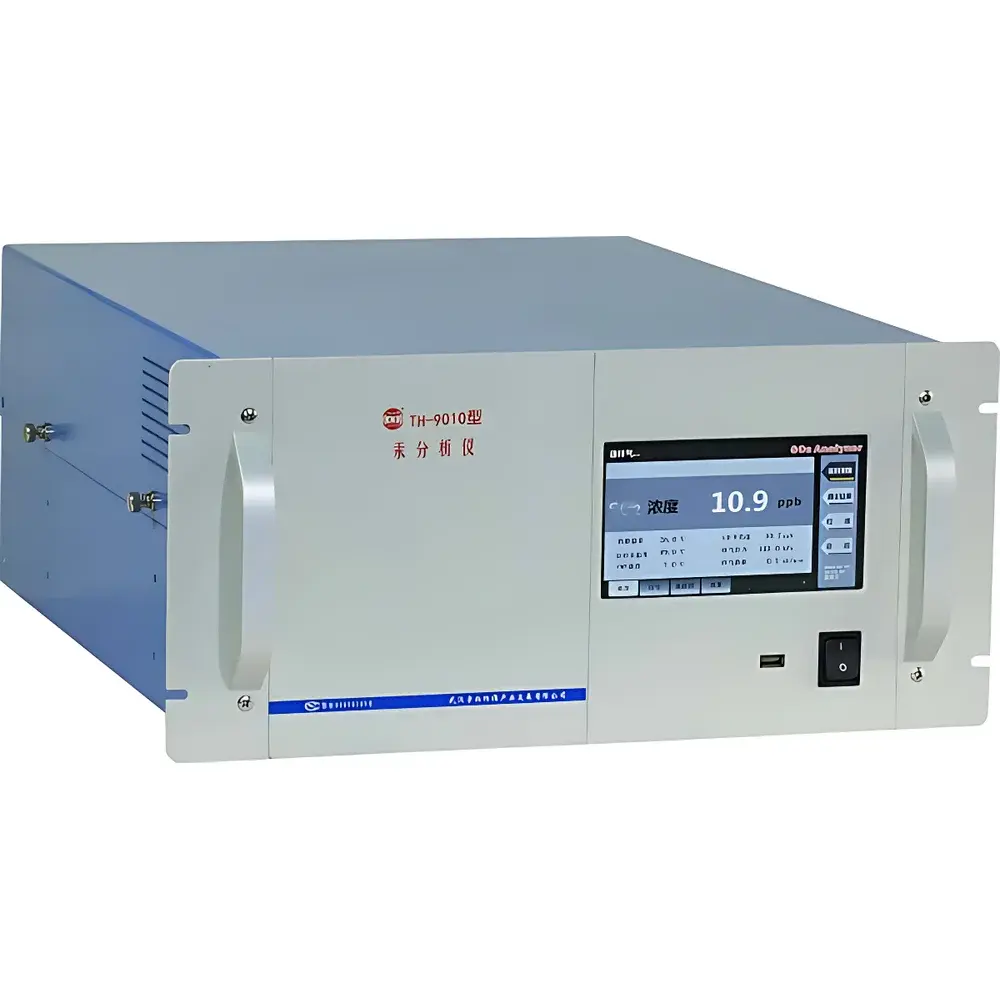
Tianhong TH-9010 Mercury Analyzer
| Brand | Tianhong |
|---|---|
| Origin | Hubei, China |
| Model | TH-9010 |
| Measurement Principle | Gold Amalgamation–Cold Vapor Atomic Fluorescence Spectrometry (CVAFS) |
| Measurement Range | 0.1–100 µg/m³ |
| Detection Limit | 0.05 µg/m³ |
| Filter Replacement Interval | 72 h |
| Operating Temperature | 0–40 °C |
| Operating Relative Humidity | 0–90 %RH |
| Atmospheric Pressure Range | 0–10 kPa |
| Compliance | HJ 542–2009 |
Overview
The Tianhong TH-9010 Mercury Analyzer is a continuous emission monitoring system (CEMS) engineered for real-time, in-situ quantification of gaseous elemental mercury (Hg⁰) in ambient air and flue gas streams. It operates on the well-established gold amalgamation–cold vapor atomic fluorescence spectrometry (CVAFS) principle—a reference-grade technique recognized for its exceptional selectivity, sensitivity, and stability in trace-level mercury analysis. Sample air is drawn through a heated sampling line into a gold-coated trap where Hg⁰ is selectively preconcentrated via amalgamation at room temperature. Following thermal desorption, the released mercury vapor is carried into a quartz reaction cell, irradiated by a low-pressure mercury lamp emitting at 253.7 nm, and the resulting atomic fluorescence is detected orthogonally by a high-gain photomultiplier tube (PMT). The linear relationship between fluorescence intensity and mercury concentration enables quantitative determination with high reproducibility and minimal interferences from other metal vapors or oxidized mercury species.
Key Features
- Gold amalgamation preconcentration module with automated thermal desorption—ensures sub-part-per-trillion (pg/m³) detection capability and eliminates memory effects.
- Optically isolated fluorescence detection cell with temperature-controlled quartz reaction chamber and anti-adsorption surface coating—maintains measurement integrity across variable humidity and particulate load conditions.
- Corrosion-resistant PTFE-solenoid valves and fluoropolymer-lined sample pathways—prevents mercury adsorption or catalytic loss during transport.
- Integrated 7-inch capacitive touchscreen interface with full Chinese-language menu navigation—supports intuitive configuration, diagnostics, and real-time trend visualization without external PC dependency.
- Auto-ranging optical gain control and dynamic baseline correction—enables seamless transition between low-background ambient monitoring (0.1–5 µg/m³) and high-concentration stack applications (up to 100 µg/m³).
- Dual communication architecture: RS-232/RS-485 serial protocols compliant with Modbus RTU, plus 4–20 mA analog output with galvanic isolation—facilitates direct integration into SCADA, DCS, or EPA-compliant data acquisition systems.
Sample Compatibility & Compliance
The TH-9010 is validated for continuous operation in both ambient atmospheric monitoring networks and fixed-source emission stacks per Chinese national standard HJ 542–2009 (“Determination of Mercury in Ambient Air—Thiol Cotton Enrichment–Cold Vapor Atomic Fluorescence Spectrophotometry”). Its design accommodates complex matrices including humidified flue gas (up to 90 %RH), low-pressure environments (down to 10 kPa absolute), and particulate-laden airstreams when paired with optional heated cyclone and Teflon membrane filtration. The instrument meets electromagnetic compatibility (EMC) requirements per GB/T 18268.1–2010 and environmental operating specifications aligned with IEC 60721-3-3 Class 3K3. While not certified to US EPA Method 29 or EN 13211, its CVAFS methodology is functionally equivalent to EPA-approved analyzers used in MATS compliance reporting when operated within defined calibration and QA/QC protocols.
Software & Data Management
Embedded firmware supports automated daily zero/span verification, multi-point calibration curve generation, and audit-trail logging of all critical events—including filter replacement alerts (triggered every 72 h), trap regeneration cycles, lamp intensity decay tracking, and temperature/humidity drift compensation parameters. Data export formats include CSV and XML, timestamped to UTC with millisecond resolution. All stored records retain immutable metadata (operator ID, calibration certificate reference, ambient pressure compensation factor), satisfying basic GLP documentation requirements. Remote firmware updates and diagnostic telemetry are accessible via secure HTTPS-enabled web interface—no proprietary software installation required.
Applications
- Continuous monitoring of elemental mercury emissions from coal-fired power plants, waste incinerators, and non-ferrous metal smelters.
- Urban and regional background air quality surveillance networks targeting long-range mercury transport and deposition modeling.
- Industrial hygiene assessments in chlor-alkali facilities, dental laboratories, and fluorescent lamp recycling operations.
- Research-grade field studies requiring high-temporal-resolution (1–5 min averaging) mercury speciation support when coupled with upstream Hg²⁺ reduction units.
- Regulatory compliance reporting under China’s “Emission Standard of Pollutants for Thermal Power Plants” (GB 13223–2011) and “Ambient Air Quality Standards” (GB 3095–2012).
FAQ
What mercury species does the TH-9010 measure?
It measures only elemental mercury (Hg⁰); oxidized mercury (Hg²⁺) and particulate-bound mercury (Hgp) require separate sampling and reduction pretreatment.
Is the analyzer suitable for unheated ambient air sampling?
Yes—the gold trap operates efficiently at ambient temperatures; however, heated sampling lines (≥120 °C) are recommended for stack applications to prevent condensation-induced losses.
How often must the gold trap be replaced?
Under typical ambient monitoring conditions, the trap lasts ≥12 months; in high-concentration industrial settings, replacement is guided by desorption efficiency validation (per HJ 542–2009 Annex C).
Does the instrument support remote calibration verification?
Yes—integrated permeation tube-based span gas generation allows automated daily or weekly span checks without manual cylinder intervention.
Can raw fluorescence intensity data be exported for third-party processing?
Yes—raw PMT voltage signals, lamp intensity references, and temperature-compensated detector gain values are accessible via Modbus register mapping.







