
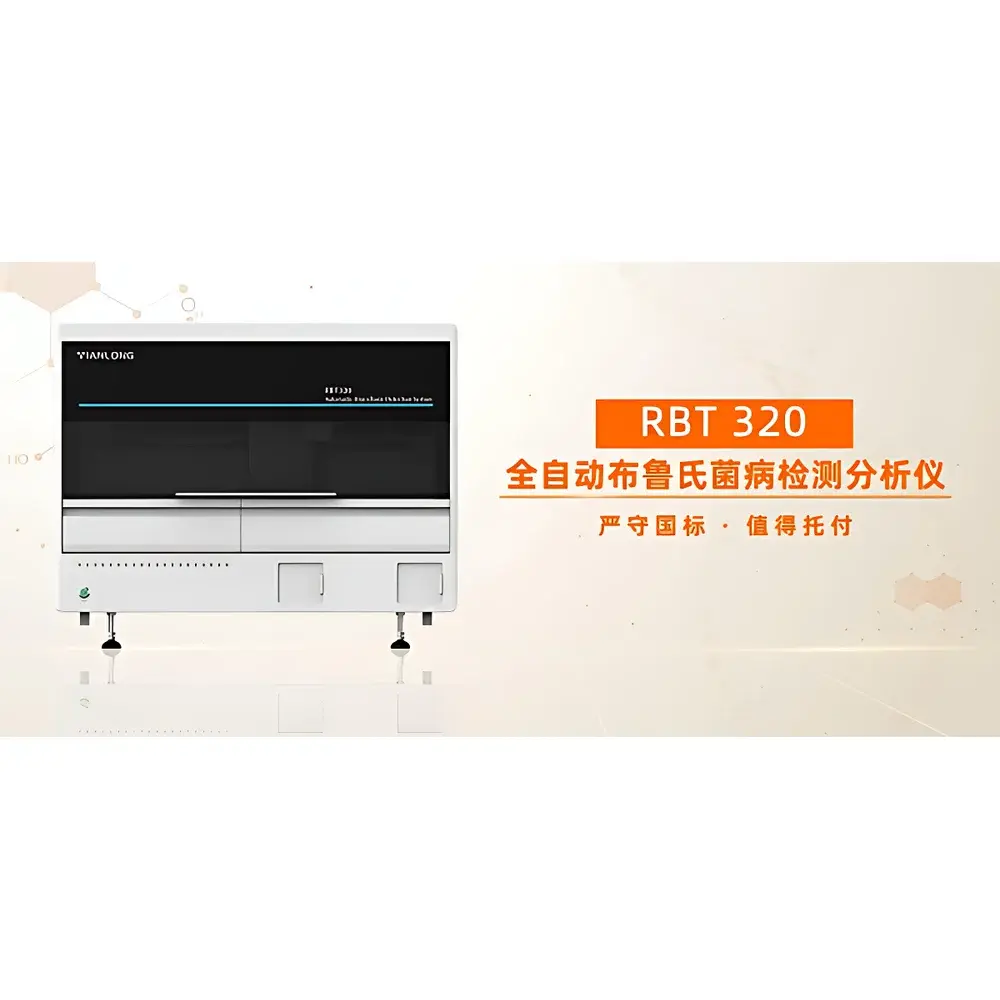
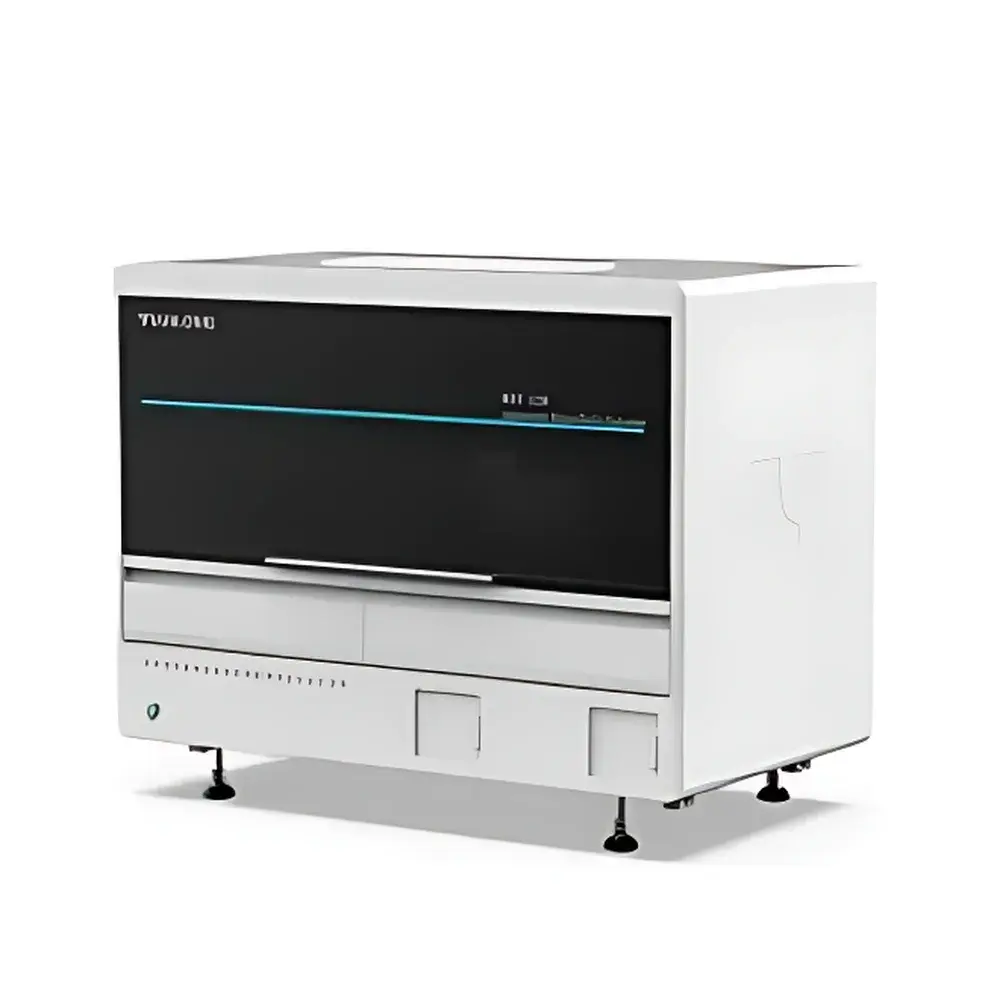
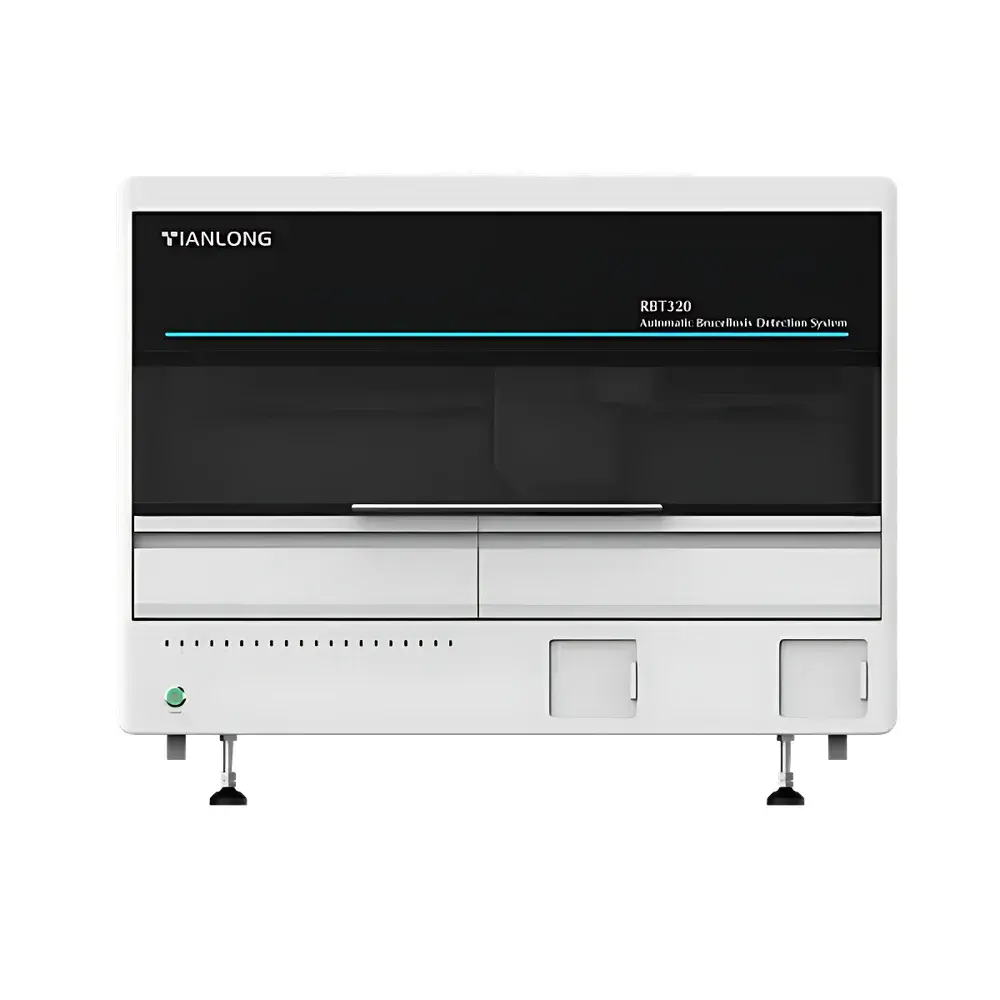
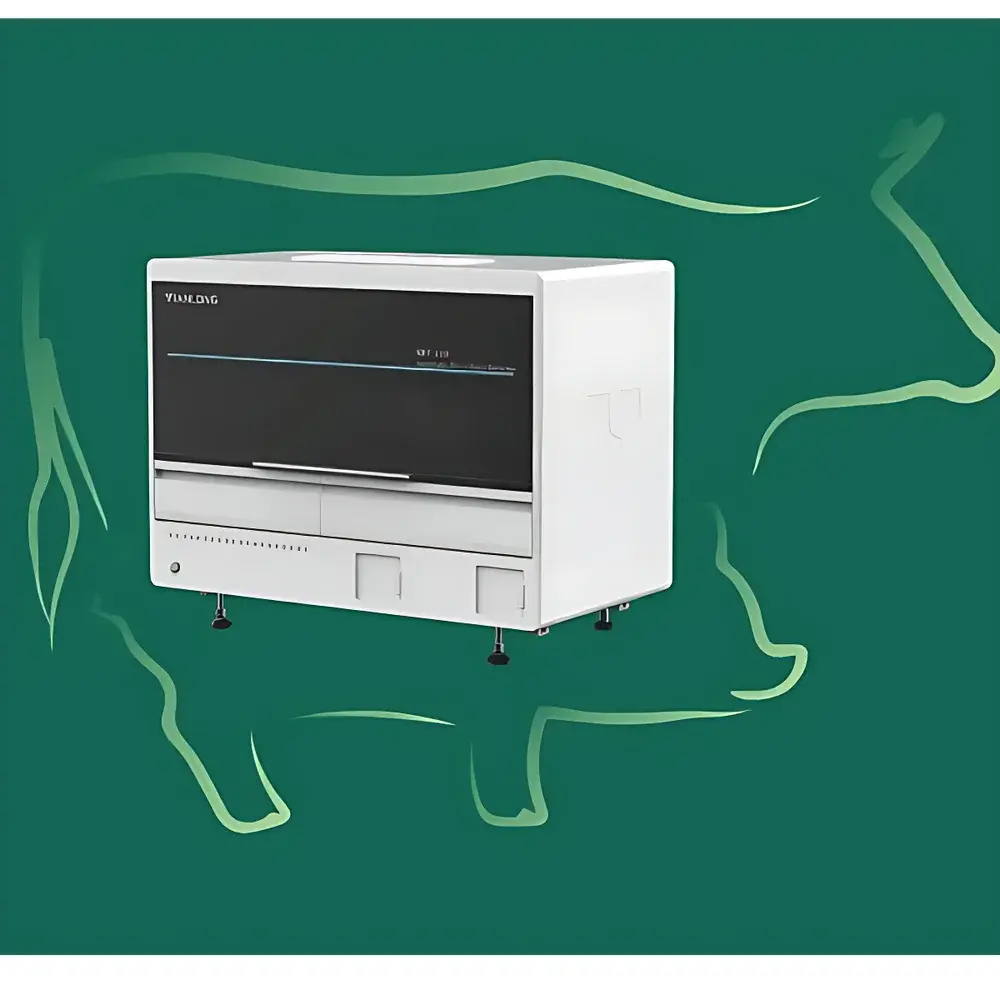
TIANLONG RBT320 Fully Automated Brucella Antibody Detection Analyzer
| Brand | TIANLONG |
|---|---|
| Origin | China |
| Manufacturer Type | Manufacturer |
| Model | RBT320 |
| Sample Type | Serum |
| Throughput | 320 tests/hour |
| Assay Method | Rose Bengal Plate Agglutination (RBPT) |
| Reaction Time | 4 min/test (24 tests in 4 min) |
| Sample Capacity | 320 samples per run |
| Temperature Control | 22 ± 4 °C (chamber), ±1.0 °C accuracy |
| Pipetting Range | 15–50 µL (Er ≤ 1.5%, CV ≤ 1.5%), >50 µL (Er ≤ 1.0%, CV ≤ 1.2%) |
| Compatible Consumables | 8-test PET reaction plates (20 mm well diameter), 200 µL universal tips |
| Dimensions | 1250 × 710 × 940 mm (L×W×H) |
| Power Supply | AC 220 V, 50 Hz |
| Operating Environment | 10–35 °C, RH ≤ 80% |
Overview
The TIANLONG RBT320 Fully Automated Brucella Antibody Detection Analyzer is a CE-marked, ISO 13485–compliant clinical laboratory instrument engineered for high-throughput serological screening of Brucella antibodies in serum samples. It implements the standardized Rose Bengal Plate Agglutination Test (RBPT) — a qualitative, rapid, and cost-effective immunoagglutination assay endorsed by the Chinese National Standard GB/T 18646–2018 “Diagnostic Techniques for Animal Brucellosis” and aligned with OIE (WOAH) guidelines. Unlike conventional manual RBPT, the RBT320 replaces subjective visual interpretation with algorithm-driven digital image analysis of agglutination patterns. The system integrates precise temperature-regulated reaction chambers, real-time consumables monitoring, and closed-loop process control to ensure reproducible, auditable, and GLP-aligned performance across veterinary diagnostic laboratories, national animal disease surveillance centers, and regional zoonosis reference labs.
Key Features
- Regulatory-Compliant Automation: Fully automates all critical RBPT steps — plate loading/unloading, reagent dispensing (Rose Bengal antigen), sample aspiration, vortex-assisted mixing, incubation at controlled 22 ± 4 °C, high-resolution imaging under standardized lighting, and AI-powered agglutination classification (positive/negative/indeterminate).
- Robust Environmental Control: Onboard thermal sensors continuously monitor chamber temperature with ±1.0 °C accuracy; automatic alarm triggers if deviation exceeds ±4 °C, halting assay execution to prevent false-negative or false-positive outcomes per GB/T 18646–2018 Clause 5.2.3.
- Intelligent Process Monitoring: Real-time tracking of sample rack presence, 8-test PET plate inventory, tip stock levels, reagent volume (via weight-based or optical sensing), and ambient/assay temperature — enabling predictive replenishment and seamless resumption after consumable top-up.
- Traceable Liquid Handling: Dual-mode liquid level detection (capacitive + pressure sensing) ensures reliable aspiration from diverse tube formats (vacutainers, 1.5/2.0 mL microcentrifuge tubes, cryovials); pipetting performance meets ISO 8655–6 specifications (accuracy Er ≤ 1.5% at 15–50 µL, CV ≤ 1.2% above 50 µL).
- Secure Data Architecture: Embedded Ethernet interface supports DICOM-compliant image archiving, audit-trail-enabled result storage (user ID, timestamp, instrument ID, calibration log), and export of structured CSV/Excel reports compliant with national veterinary data reporting frameworks.
Sample Compatibility & Compliance
The RBT320 accepts undiluted human or animal serum specimens collected in standard clinical tubes. Its open reagent architecture accommodates third-party Rose Bengal antigen preparations meeting GB/T 18646–2018 purity and titer requirements. All consumables — including proprietary 20 mm-diameter, 8-well PET reaction plates — conform to national geometric tolerances specified in Annex A of the standard. The analyzer’s operational validation protocol includes IQ/OQ documentation packages supporting FDA 21 CFR Part 11 readiness (electronic signatures, audit trails) and EU IVDR Class B conformity assessment pathways. Routine performance verification follows internal QC protocols aligned with ISO/IEC 17025 clause 7.7.
Software & Data Management
The embedded Windows-based control software provides bilingual (English/Chinese) GUI with role-based access control (administrator, technician, reviewer). Image acquisition uses monochrome CMOS sensors calibrated against NIST-traceable grayscale standards; agglutination scoring employs convolutional neural networks trained on >50,000 manually annotated RBPT images from endemic regions. Raw images, processed heatmaps, and binary decision logs are stored locally with SHA-256 hashing for integrity verification. Export modules generate PDF reports embedding QR-coded test IDs for integration with LIMS (e.g., LabVantage, STARLIMS) via HL7 v2.5 or RESTful API. Software updates are digitally signed and require dual-factor authentication.
Applications
- Large-scale surveillance of brucellosis in cattle, sheep, goats, and swine herds during pre-movement or slaughterhouse screening.
- Confirmatory testing in veterinary diagnostic reference laboratories performing differential diagnosis against other Gram-negative intracellular pathogens (e.g., Coxiella burnetii, Yersinia enterocolitica).
- Human public health investigations in occupational settings (veterinarians, abattoir workers, dairy farmers) where exposure risk necessitates rapid seroepidemiology.
- Quality assurance of Brucella vaccines by monitoring post-vaccination antibody kinetics in field trials.
- Supporting WHO/FAO One Health initiatives through interoperable data submission to national animal disease information systems (e.g., China’s Animal Disease Surveillance Platform).
FAQ
Does the RBT320 comply with international brucellosis diagnostic standards beyond GB/T 18646–2018?
Yes — its RBPT implementation satisfies OIE Terrestrial Manual Chapter 2.4.3 requirements for sensitivity/specificity thresholds and incorporates temperature controls mandated by EU Commission Regulation (EU) No 2020/2002 for official testing.
Can the system integrate with existing laboratory information management systems (LIMS)?
Yes — it supports HL7 v2.5 ADT/ORU messaging, ASTM E1384-compliant result export, and configurable REST API endpoints for bidirectional data exchange.
What maintenance is required to sustain regulatory compliance?
Daily cleaning of optical paths and fluidic manifolds; quarterly verification of pipette accuracy per ISO 8655–6; annual full IQ/OQ performed by TIANLONG-certified engineers with traceable calibration certificates.
Is the image recognition algorithm validated for cross-species serum matrices?
Yes — analytical validation included 1,240 blinded samples from bovine, ovine, caprine, porcine, and human sera; achieved ≥98.7% concordance with reference ELISA (kappa = 0.96, 95% CI: 0.94–0.98).
How does the system handle borderline agglutination patterns?
It flags indeterminate results (scored 1+ to 2+ intensity with heterogeneous particle distribution) for manual review; original images and pixel-level confidence maps are retained for adjudication.





