
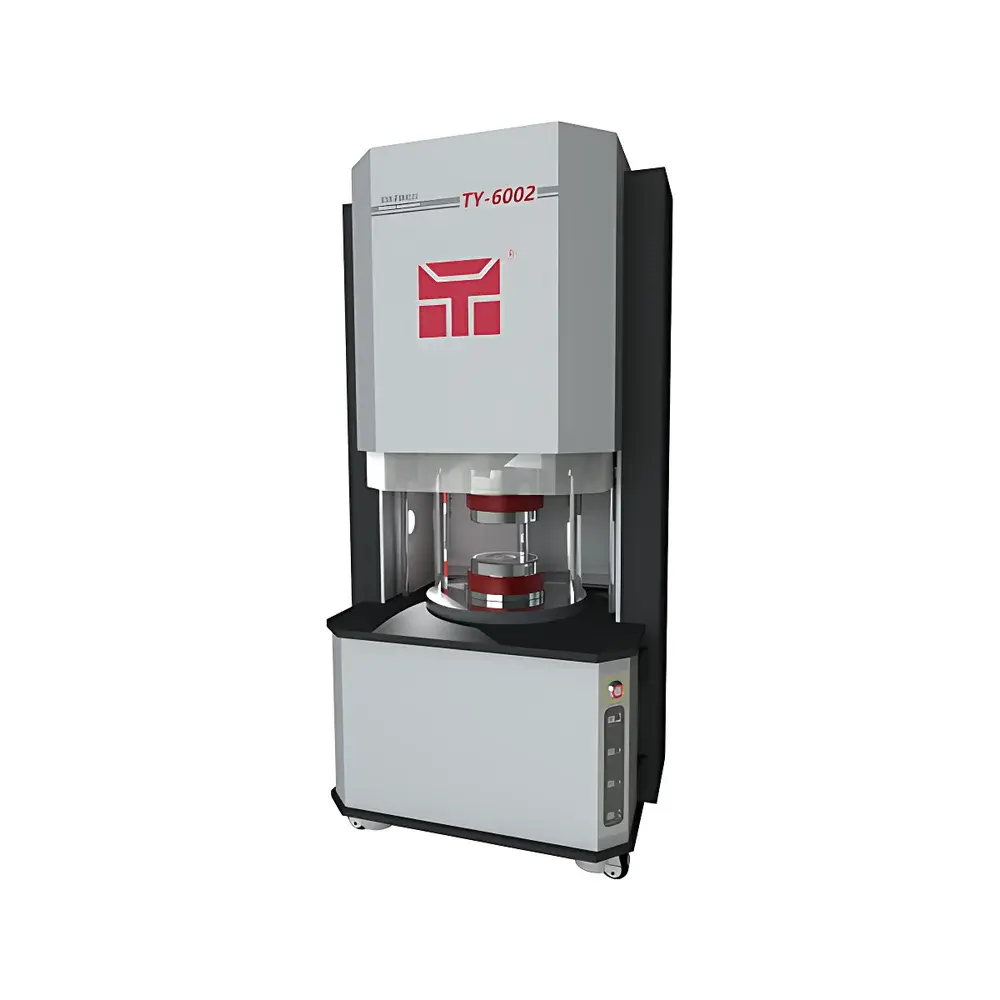
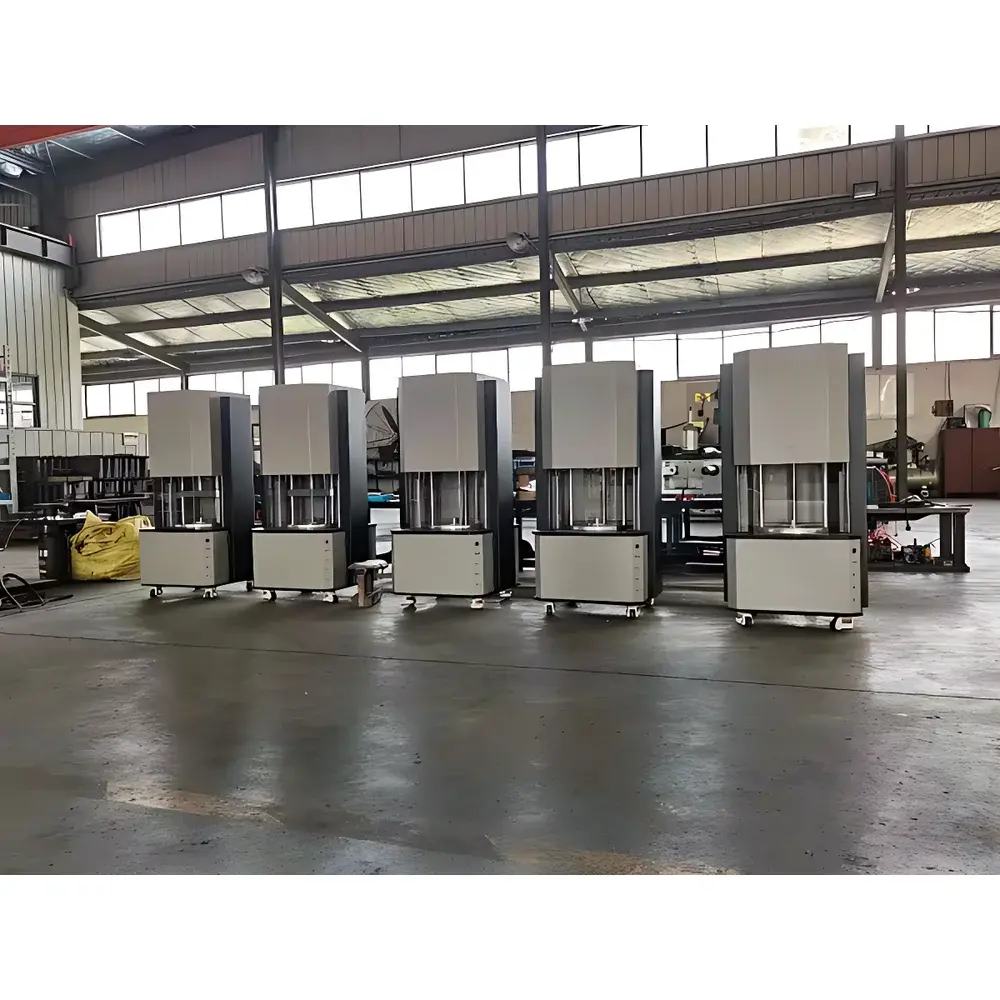
TianYuan TY-6002 Servo Motor Rotorless Vulcanizer
| Brand | TianYuan |
|---|---|
| Origin | Jiangsu, China |
| Manufacturer Type | Direct Manufacturer |
| Country of Origin | China |
| Model | TY-6002 |
| Torque Range | 0–20 N·m |
| Torque Resolution | 0.001 N·m |
| Temperature Range | RT–200 °C |
| Temperature Control Accuracy | ≤ ±0.3 °C |
| Temperature Resolution | 0.01 °C |
| Heating Rate | RT to 150 °C in <20 min |
| Oscillation Frequency | 1.7 Hz |
| Oscillation Amplitude | ±0.5° / ±1° (±3° optional) |
| Cavity Material | Cr6WV tool steel |
| Power Supply | AC 220 V ±10%, 50/60 Hz |
| Rated Power | 800 W |
| Dimensions (W×D×H) | 660 × 580 × 1300 mm |
| Weight | 260 kg |
| Ambient Operating Conditions | 0–35 °C, RH <80% |
| Compressed Air Requirement | 0.4 MPa |
| Data Interface | USB |
Overview
The TianYuan TY-6002 Servo Motor Rotorless Vulcanizer is a precision-engineered instrument designed for real-time monitoring of rubber compound vulcanization kinetics under controlled thermal and dynamic shear conditions. Based on the principle of oscillating disc rheometry (ODR), it applies a small-amplitude sinusoidal torsional strain to uncured rubber specimens confined within a sealed, temperature-regulated cavity. The resulting torque response—proportional to the material’s storage modulus (G′) and directly correlated with crosslink density—is continuously measured throughout the cure cycle. This enables quantitative determination of critical vulcanization parameters including scorch time (ts₁, ts₂), optimum cure time (t₉₀), minimum and maximum torque (ML, MH), rate of cure, and reversion behavior—essential for formulation development, quality control, and process validation in tire, automotive, and industrial rubber manufacturing.
Key Features
- High-resolution torque measurement system with 0.001 N·m resolution over a 0–20 N·m range, ensuring high reproducibility across low- and high-viscosity compounds.
- Integrated Panasonic servo motor drive with amplitude stabilization circuitry, delivering precise, drift-free oscillation at 1.7 Hz and selectable amplitudes (±0.5° or ±1° standard; ±3° available upon request).
- Intelligent multi-channel PID temperature control using high-stability Pt100 sensors and adaptive parameter tuning, achieving ≤ ±0.3 °C uniformity across the Cr6WV alloy cavity surface (RT–200 °C range).
- Automated safety architecture: 5-mm acrylic transparent shield synchronized with mold actuation, fail-safe power cutoff on interruption, and mandatory physical button activation for closing—compliant with ISO 13857 and IEC 61508 functional safety principles.
- LED illumination system activated automatically during mold opening, enhancing visual inspection of specimen integrity and cavity cleanliness without manual intervention.
- USB-based digital data acquisition interfaced with TY-CureMeter software, supporting real-time curve overlay, comparative analysis of historical batches, adjustable test duration (1–300 min), and automated report generation.
Sample Compatibility & Compliance
The TY-6002 accommodates standard ASTM D5289 and ISO 6502-compliant 40 mm diameter × 5 mm thick rubber discs. Its Cr6WV cavity offers exceptional wear resistance and thermal stability, minimizing surface degradation during repeated high-temperature testing of aggressive compounds (e.g., EPDM, NR, SBR, FKM). The instrument meets GB/T 16584 requirements for Chinese rubber industry certification and supports audit-ready data handling per GLP/GMP guidelines. All torque and temperature data are timestamped and stored with full metadata (operator ID, sample ID, test conditions), enabling traceability required for FDA 21 CFR Part 11–aligned environments when deployed with validated software configuration.
Software & Data Management
TY-CureMeter v3.x is a Windows-based application offering multilingual UI (English, Simplified/Traditional Chinese, Russian) and structured data management. It provides raw data export in CSV and XML formats, customizable report templates (PDF/Excel), and built-in statistical tools for Cp/Cpk analysis of cure parameter distributions across production lots. Audit trails log all user actions—including parameter edits, curve annotations, and result approvals—with immutable timestamps. Software calibration verification routines support periodic performance checks aligned with internal SOPs and external accreditation requirements (e.g., CNAS, A2LA).
Applications
- Rubber formulation optimization: Screening accelerator systems, sulfur donors, and curatives for cure rate balance and scorch safety.
- Batch-to-batch consistency verification in compound manufacturing and mixing operations.
- Process window definition for extrusion, calendering, and molding processes based on t₉₀ and reversion onset.
- Accelerated aging studies via elevated-temperature vulcanization profiling.
- Technical service support for OEM customers requiring standardized cure characterization per ISO 2231 or SAE J200 specifications.
FAQ
What standards does the TY-6002 comply with for international testing?
It conforms to ISO 6502, ASTM D5289, and GB/T 16584. Optional firmware and documentation packages support alignment with EN 16227 and JIS K 6300-1 upon request.
Can the instrument operate continuously across multiple shifts?
Yes—designed for industrial laboratory use, its robust thermal management, sealed cavity design, and 800 W power rating enable unattended operation for up to 12 hours with scheduled cooldown intervals.
Is remote monitoring or network integration supported?
Native USB-only connectivity is standard; Ethernet or RS-485 interfaces are available as factory-installed options for integration into LIMS or MES platforms.
How often does the torque sensor require recalibration?
Annual calibration is recommended; the system includes onboard zero-point verification and reference torque check routines accessible via maintenance mode.
Does the software support electronic signatures for regulated environments?
When deployed with validated installation and documented change control, TY-CureMeter supports role-based electronic signatures compliant with 21 CFR Part 11 Annex 11 requirements.






