
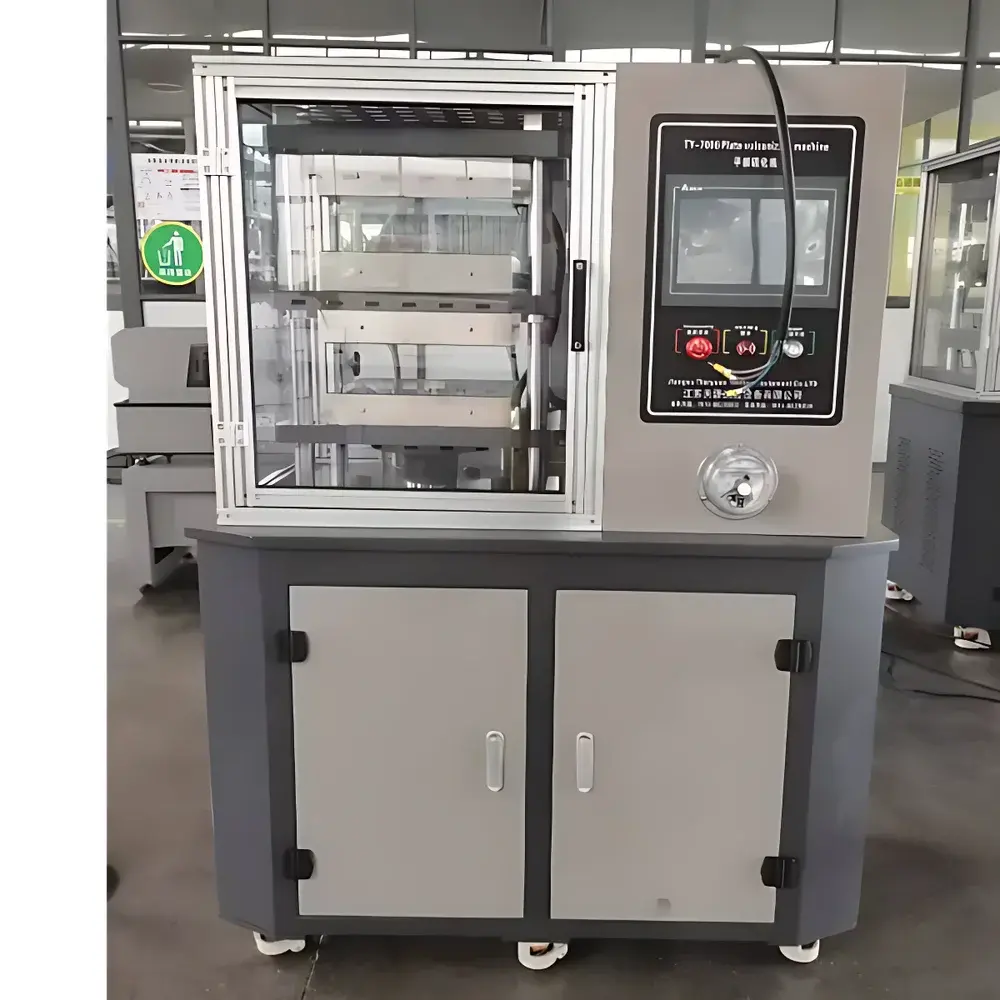
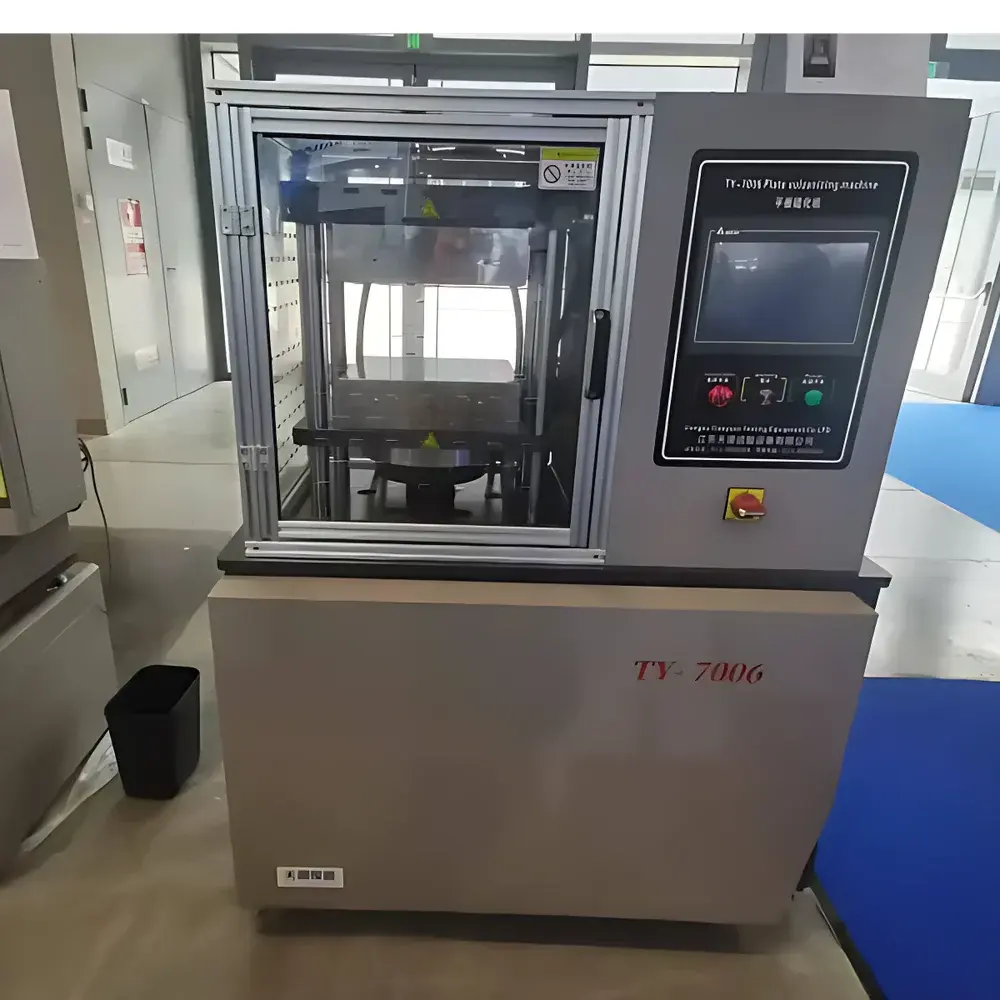
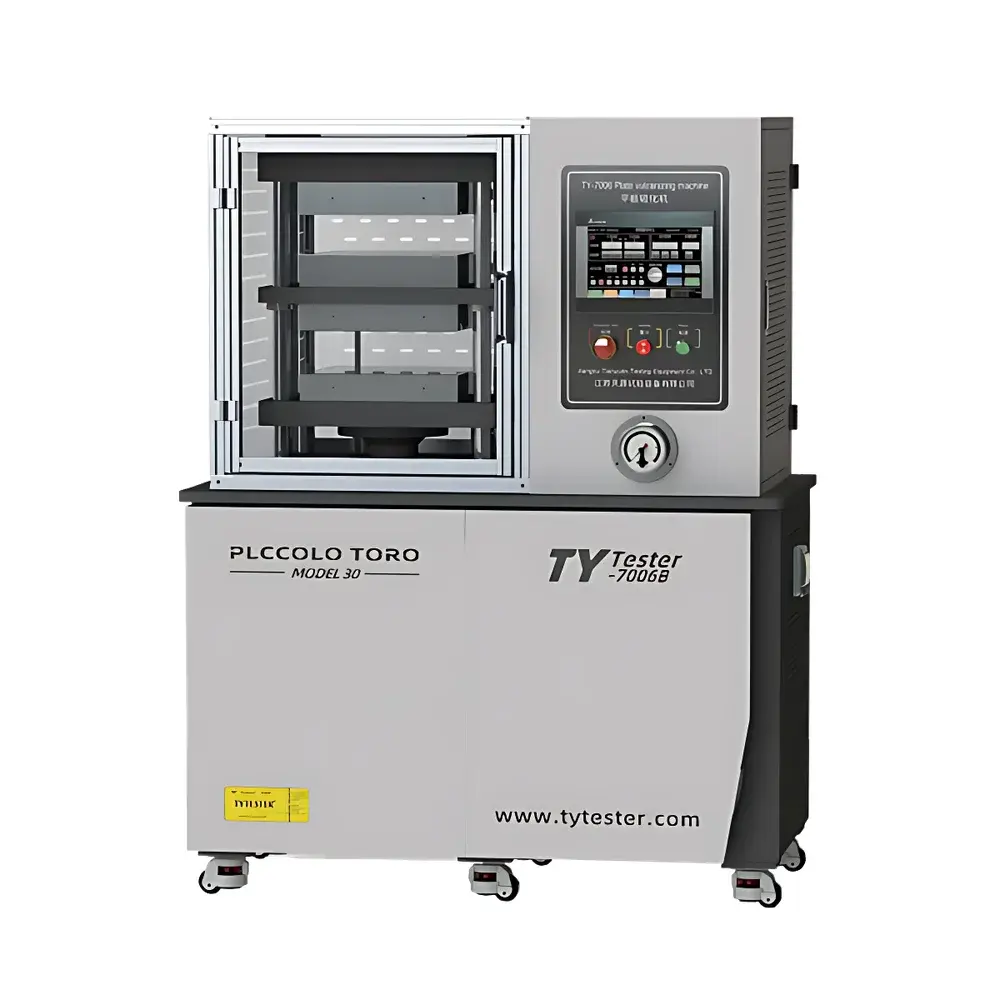
TianYuan TY-7006 20-Ton Automatic平板硫化机
| Key | Brand: TianYuan |
|---|---|
| Origin | Jiangsu, China |
| Manufacturer Type | Direct Manufacturer |
| Equipment Type | Automatic Hydraulic Hot Press |
| Capacity | 20 Ton (200 kN) |
| Temperature Range | Ambient to 300 °C |
| Temp. Accuracy | ±2 °C |
| Opening Distance | 140 mm (Upper Gap: 75 mm |
| Lower Gap | 65 mm) |
| Platen Size | 300 × 300 × 60 mm |
| Platen Material | Ductile Cast Iron (Precision Ground, Corrosion-Resistant) |
| Platen Configuration | Dual-Layer (Top Heated, Bottom Cooled) |
| Cooling Method | Tap Water Circulation (Dedicated Cooling Channel in Bottom Platen) |
| Exhaust Cycles | 0–10 Programmable |
| Hydraulic System | Proportional Flow Control Valve with Closed-Loop Feedback |
| Hydraulic Fluid | Mobil DTE 32 Anti-Freeze Hydraulic Oil (User-Supplied) |
| Safety Features | Interlocked Transparent Safety Guard Door (Instant Power Cut-off on Opening) |
| Dimensions (W×D×H) | 1180 × 585 × 1460 mm |
| Power Supply | AC 380 V ±10%, 18 A |
| Heating Power | 9 kW (Single-Layer Mode), 18 kW (Dual-Layer Mode) |
| Weight | Approx. 738 kg |
Overview
The TianYuan TY-7006 20-Ton Automatic Hydraulic Hot Press is a precision-engineered laboratory-scale vulcanizing press designed for standardized sample preparation in polymer R&D, quality control, and pre-production validation. Operating on the principle of controlled thermal compression—applying simultaneous, uniform pressure and programmable temperature across parallel platens—the system enables reproducible fabrication of cured elastomer sheets, thermoplastic pellets, composite laminates, and filled rubber compounds. Unlike manual or semi-automatic presses, the TY-7006 integrates a PLC-based control architecture with a full-color HMI touchscreen interface, enabling precise orchestration of multi-stage vulcanization cycles—including programmable exhaust intervals, ramp-and-soak temperature profiles, and real-time process monitoring. Its dual-layer platen configuration (heated top, water-cooled bottom) ensures rapid thermal stabilization and minimizes post-cycle thermal lag—critical for maintaining dimensional consistency and minimizing residual stress in test specimens per ASTM D3182 and ISO 2533.
Key Features
- PLC-controlled closed-loop hydraulic system with proportional flow valve for stable, ripple-free pressure delivery up to 200 kN (20 ton-force), with <±0.5% repeatability across repeated cycles.
- Dual-zone thermal management: Top platen heated via Y-connected three-phase resistive elements (eliminating phase imbalance); bottom platen actively cooled by continuous tap-water circulation through integrated channels.
- Precision-ground ductile cast iron platens (300 × 300 × 60 mm), surface-finished to Ra ≤ 0.8 µm, offering high thermal conductivity, low distortion under load, and long-term corrosion resistance.
- Linear voltage regulation module ensures monotonic, non-overshoot heating response—reducing thermal overshoot to <1.5 °C during ramp phases, improving process fidelity per ISO 6502.
- Interlocked transparent safety guard door with hardwired emergency stop circuitry—compliant with EN ISO 13857 and IEC 60204-1 for operator protection during loading/unloading.
- Programmable exhaust function (0–10 cycles) with adjustable dwell time and platen separation distance—essential for removing entrapped air and volatiles during elastomer compounding.
Sample Compatibility & Compliance
The TY-7006 accommodates standard mold geometries (e.g., ASTM D3182 rectangular molds, ISO 37 dumbbell blanks, and custom cavity inserts up to 280 × 280 mm footprint). It supports both uncured raw compounds (NR, SBR, EPDM, silicone) and thermoplastic feedstocks (PP, PE, PC) requiring hot-compression molding prior to tensile, hardness, or rheological testing. All operational parameters—including pressure setpoints, temperature ramps, hold durations, and exhaust logic—are fully traceable and auditable, supporting GLP-compliant documentation workflows. The system meets electromagnetic compatibility (EMC) requirements per EN 61326-1 and electrical safety standards per EN 61000-6-2/6-4. While not FDA-certified as standalone equipment, its construction materials (food-grade compliant hydraulic oil option available) and cleanable surfaces align with USP <661> and ISO 10993-1 prerequisites for material-contact validation studies.
Software & Data Management
The embedded HMI firmware stores up to 200 user-defined process recipes, each with timestamped execution logs (start/end time, actual vs. setpoint pressure/temperature curves, exhaust event markers). Data export is supported via USB 2.0 port in CSV format for integration into LIMS or statistical process control (SPC) platforms. Audit trail functionality records all parameter modifications, operator logins, and safety interlock triggers—enabling compliance with 21 CFR Part 11 requirements when paired with validated third-party data archiving software. No cloud connectivity or remote access capabilities are included, preserving network isolation for secure lab environments.
Applications
- Preparation of standardized test specimens for ASTM D412 (tensile properties), ASTM D573 (heat aging), and ISO 34-1 (tear strength).
- Quality assessment of compound homogeneity—detecting gel particles (“fish eyes”), carbon black dispersion, and foreign inclusions via optical or SEM analysis of compression-molded plaques.
- Rapid formulation screening: evaluating cure kinetics, scorch time, and crosslink density via post-press rheometry or DSC of molded samples.
- Color matching and pigment dispersion validation using spectrophotometric analysis of uniformly compressed color chips.
- Thermoplastic sheet consolidation for peel adhesion, impact, or flame-retardancy testing per UL 94 or ISO 5660-1.
FAQ
What is the maximum recommended operating temperature for continuous use?
The system is rated for sustained operation up to 250 °C; 300 °C is permissible for short-duration (<15 min) validation runs only.
Can the cooling water circuit be connected to a recirculating chiller instead of tap water?
Yes—provided inlet pressure remains between 0.2–0.6 MPa and flow rate exceeds 3 L/min. Chiller integration requires optional flow sensor and temperature feedback loop (available as field upgrade).
Is calibration documentation provided with shipment?
A factory-issued calibration certificate (traceable to NIM China) covering platen temperature uniformity (±2 °C across 300 mm zone) and load cell linearity (±0.3% FS) is included.
Does the system support external trigger inputs for synchronized data acquisition?
Yes—dry-contact TTL-compatible start/stop signals and analog 4–20 mA outputs for real-time pressure and temperature are accessible via terminal block on rear panel.
What maintenance intervals are recommended for hydraulic oil replacement?
Mobil DTE 32 oil must be replaced every 2,000 operating hours or biannually—whichever occurs first—along with inspection of filter elements and seal integrity.



